AI agent development companies are easy to find and hard to tell apart. Most describe the same capabilities, so the most useful filter for a CTO or CIO is where the agents will run. If your data, identity and governance already sit in Microsoft Azure, you need a partner that builds on Microsoft Foundry and the surrounding Azure security and identity services, not one that treats Azure as one option among many.
The stakes are real. Gartner predicts that over 40% of agentic AI projects will be canceled by the end of 2027, citing escalating costs, unclear business value or inadequate risk controls. A vendor shortlist cannot remove those risks, but it can keep you from starting with a partner that has no Azure track record.
This guide profiles ten AI agent development companies that hold a Microsoft Solutions Partner designation for Azure, with services, credentials and Clutch review figures. The companies are not ranked. CIGen publishes this guide and is one of the ten; its entry follows the same template and sources as the others.
Key takeaways for choosing AI agent development companies on Azure
Four findings from the research shape how to use the profiles that follow.
- Scale and price vary widely. Among the companies with comparable Clutch data, listed hourly bands run from $25–$49 to $150–$199 and minimum project sizes from $10,000+ to $100,000+, so the size of the vendor should match the size of the project.
- Review evidence is uneven. Clutch review counts range from none to just under a hundred, and several of the largest firms show three or fewer reviews, so reference calls matter more than ratings.
- A Microsoft Solutions Partner designation is not proof of agent delivery. It confirms an Azure track record. Agent experience has to be checked through named cases and the vendor's approach to Microsoft Foundry components.
The comparison table puts the main figures side by side before the individual profiles.
For those not quite sure how to embark on AI adoption journey, AI agent consulting services might be the way to go.
How we selected these AI agent development companies
This list is an editorial selection, not a ranking. Each company had to meet five criteria, checked against public sources.
- Microsoft Solutions Partner. The company holds an Azure Solutions Partner designation, confirmed in the Microsoft partner directory.
- A published AI service. The company lists generative AI, agentic AI or AI platform work among its services on its own site or Microsoft Marketplace listing.
- Verifiable company data. Services, industries and credentials can be traced to the company’s website or the Microsoft partner directory.
- Independent review evidence. A Clutch profile or similar review listings exist, and we record its rating, review count, rate band and minimum project size, noting where evidence is thin or missing.
- A spread of sizes and delivery models. The list covers global integrators, Azure specialists and independent delivery partners, so readers with different budgets can find a fit.
Where a figure is company-reported rather than independently verified, the profile says so, and the sources line under each profile shows where we checked. The profiles follow.
Top 10 AI agent development companies specializing in Azure
Each profile follows one template: a best-for line, a summary table and three short paragraphs. Companies are grouped by type, with global integrators first, then Azure and Microsoft specialists, then European delivery partners.
CIGen
CIGen is an Azure-focused software, AI and data development company working across manufacturing, logistics, fintech, marketing technology. It reports 40+ completed projects and a 92% customer satisfaction rate, and holds a 4.8 rating from 8 reviews on its Clutch profile.
The company concentrates on Microsoft Azure: cloud-native development, application modernization, migration, DevOps, and AI agent development on Microsoft Foundry. It builds complex data platforms with Microsoft Fabric, Azure Synapse Analytics and Azure Databricks, and a verified 5.0 Clutch review from a client's Lleader of Software Engineering describes a data consolidation platform that CIGen's QA, engineering, product management, design and data science specialists are helping to build. The reviewer says data ingestion moved from a manual three-month process to an automated service. For AI agent projects, CIGen returns an estimate within two business days.
The team has earned 2 Microsoft Solutions Partner designations: Data and AI (Azure) pathway as well as the Digital and App Innovation (Azure) pathway designation.
Companies choose CIGen when they want an Azure-focused team with ISO 27001-certified delivery and AI agent development alongside cloud-native and modernization work.
EPAM
EPAM is a global software engineering and AI transformation company that works mainly with large enterprises. Its Clutch profile shows a 5.0 rating, but from a single review.
The company covers software and platform engineering, consulting, design and AI, and names AI offerings such as AI/RUN, DIAL and Agentic QA. It serves financial services, healthcare and life sciences, manufacturing and retail clients. On Azure, EPAM won the 2025 Microsoft Partner of the Year award for Innovate with Azure AI Platform.
Companies choose EPAM when an Azure AI agent program needs a very large, multi-country engineering organization and an enterprise-level budget.
SoftServe
SoftServe is a global engineering company with AI, cloud and data practices, and reports 20K+ customer projects. Its Clutch profile shows 4.8 from 3 reviews.
Its services span AI, cloud and DevOps, and data and analytics. For AI agents, SoftServe lists an Azure Marketplace offer called Agentic Catalyst that delivers three agents in 30 days.
Companies choose SoftServe when they want a large engineering partner with a documented security posture, including ISO 27001 and SOC 2 Type 2, and a short route into agent development.
Xebia
Xebia is a technology consultancy for AI, cloud and data modernization, with its own training arm. Its Clutch profile shows 4.7 from 7 reviews.
Its services cover applied and generative AI, intelligent automation, cloud and data modernization, and digital products, including agentic AI services. Xebia Academy provides training, and Microsoft lists Xebia as a Training Service Provider.
Companies choose Xebia when they want delivery and capability building in one engagement, so their own engineers learn the Azure stack alongside the build.
Simform
Simform is a digital engineering company with an agentic AI practice. It has the largest review base in this guide on Clutch: 89 reviews at 4.8.
The company covers product engineering, data and analytics, cloud and platform engineering and managed services. Its Azure Marketplace listing includes an Agentic AI Strategy and Roadmap Workshop built on Microsoft Foundry, and Microsoft gives it the Azure Expert MSP badge. It serves high-tech, fintech, healthcare, logistics and retail clients.
Companies choose Simform when they want a mid-sized partner with deep Azure and data credentials and a defined entry point into agentic AI.
Southworks
SOUTHWORKS is an AI and cloud engineering company that builds on Microsoft Azure. Its Clutch profile lists no reviews yet.
It builds AI copilots and intelligent agents, cloud migration and modernization projects, and cloud security for telecom, media and gaming, health and life sciences, manufacturing and retail clients. Microsoft named it 2025 Partner of the Year for Gaming and a finalist for Innovate with Azure AI Platform.
Companies choose SOUTHWORKS when they want a Microsoft-focused engineering team that has shipped Azure AI work for sports and media brands.
N-iX
N-iX is a software engineering company with large cloud, data and AI practices. It holds a 4.8 rating from 35 reviews on Clutch.
Its services cover software engineering, AI consulting and implementation, cloud migration and managed services, data platform engineering, application modernization and cybersecurity, for finance, retail, healthcare, manufacturing, telecom, energy and logistics clients. N-iX holds ISO 27001:2022 and SOC 2 Type 2 certifications.
Companies choose N-iX when they need to scale a dedicated engineering team and want Eastern European delivery with documented compliance.
Itransition
Itransition is a software engineering company with Azure, data and Microsoft business application practices. It reports 1,530+ projects and holds a 4.9 rating from 42 reviews on Clutch.
Its services include AI and automation, with agentic process automation and Copilot Studio agents, data engineering on Microsoft Fabric, Synapse and Databricks, Dynamics 365 and Power Platform, and Azure engineering. It serves healthcare, finance, manufacturing, retail, insurance and professional services clients, and lists ISO 27001 and ISO 9001 certifications.
Companies choose Itransition when they want a single vendor to cover Azure AI, data engineering and Microsoft business applications in one engagement.
DataArt
DataArt is a software engineering company with data, AI and cloud practices. It holds a 4.9 rating from 26 reviews on Clutch.
It serves finance, healthcare and life sciences, travel and hospitality, media and entertainment, and retail and distribution clients, and its services include data and analytics, AI, cloud and DevOps, software engineering and cybersecurity. DataArt reports a 95% client return rate.
Companies choose DataArt when they want a large engineering partner with sector knowledge in finance, healthcare and travel and the capacity to staff long programs.
Leobit
Leobit is a software development company that focuses on .NET and Microsoft Azure product engineering. It holds a 5.0 rating from 63 reviews on its Clutch profile.
The company covers custom software, cloud and SaaS development, dedicated teams and build-operate-transfer engagements, with depth in PropTech, healthcare, fintech, logistics and legal tech. On the AI side it offers agentic AI development, works with Microsoft Foundry, OpenAI and Anthropic models, and says it runs more than 20 AI agents internally. Its portfolio includes a commercial real estate platform that, according to Leobit, facilitated over $1.4 billion in purchases.
Companies choose Leobit when they want a mid-sized nearshore team with a Microsoft-stack background, ISO 27001-certified delivery and AI agent capability alongside core product engineering.
How to choose an AI agent development company for Azure
Start with the type of vendor that fits your scale, then test each shortlisted company on evidence rather than on positioning.
- Match the vendor to the size of the project. Among the global integrators with comparable Clutch data, listed hourly bands run from $50–$99 (Xebia) to $150–$199 (EPAM), and minimum project sizes reach $100,000+. The Eastern European delivery partners sit between $25–$49 (Itransition, Leobit) and $50–$99 (N-iX, DataArt, CIGen), and the Azure specialists vary. These are listed bands, not quotes, but they show which vendors expect which budgets.
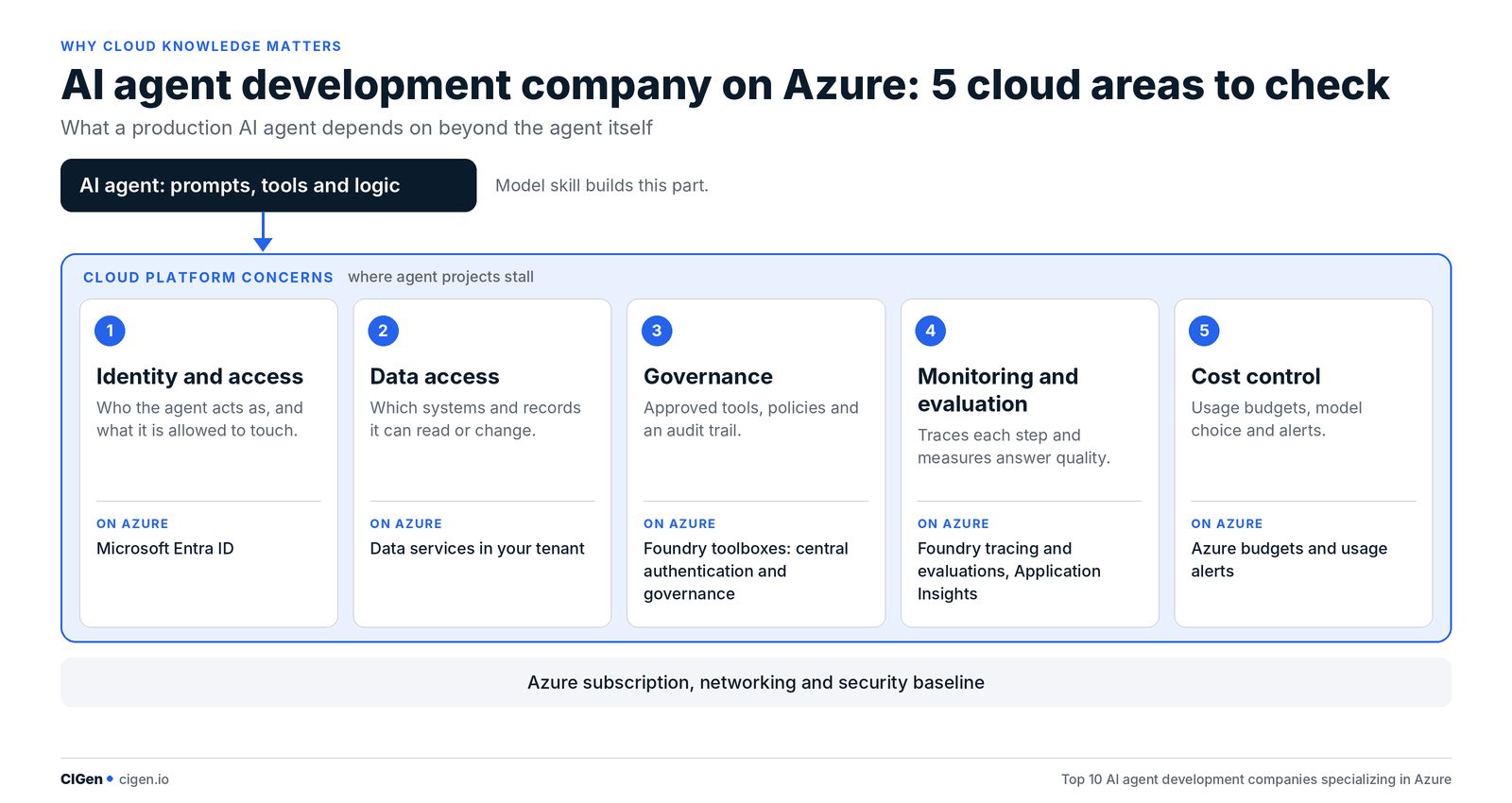
- Ask which Microsoft Foundry components the vendor builds on. Foundry Agent Service is Microsoft's managed platform for building, deploying and scaling AI agents, and it supports prompt agents, hosted agents, shared tools and end-to-end tracing and evaluation. A credible vendor can say which of these it uses, how it traces agent decisions, and how it evaluates quality before release.
- Ask for a named production case, not a demo. Compare every claim with public evidence: client names on the vendor's site, Marketplace offers, Microsoft recognition and review profiles. Treat thin review counts as a prompt for reference calls with clients who run the agents in production.
- Agree access requirements before kickoff. A realistic engagement needs an Azure subscription and resource group in your tenant, role-based access for the vendor's engineers through Microsoft Entra ID, read access to the systems the agent will call, and a decision on where test and evaluation data live. Building in a vendor-owned tenant adds a migration step later.
- Define deliverables in the contract. Specify source code and infrastructure as code in your repository, an evaluation set with pass thresholds, architecture and security documentation, an operations runbook and a handover session with your team.
With vendor type, platform approach, evidence, access and deliverables settled, timing is the next question.
How long does Azure AI agent development take?
Timelines depend on data readiness, integrations and security review more than on the agent itself, and we found no primary-source benchmark for typical durations. Two published vendor figures give reference points, and the five stages below show where the time goes.
- Scoping and estimate. Requirements, data sources and success metrics are defined. CIGen promise if to return an estimate for AI agent projects within two business days.
- Proof of concept. One workflow runs on real data against an agreed metric. SoftServe lists an Azure Marketplace offer, Agentic Catalyst, that delivers three agents in 30 days. This is a vendor claim for a defined package.
- Pilot. A limited group of users runs the agent with human oversight, evaluation results and a governance review.
- Production hardening. Identity, monitoring, cost controls and rollout plans are put in place before the agent handles live traffic.
- Operation. Quality is re-evaluated as models, data and prompts change, and the vendor or your team owns support.
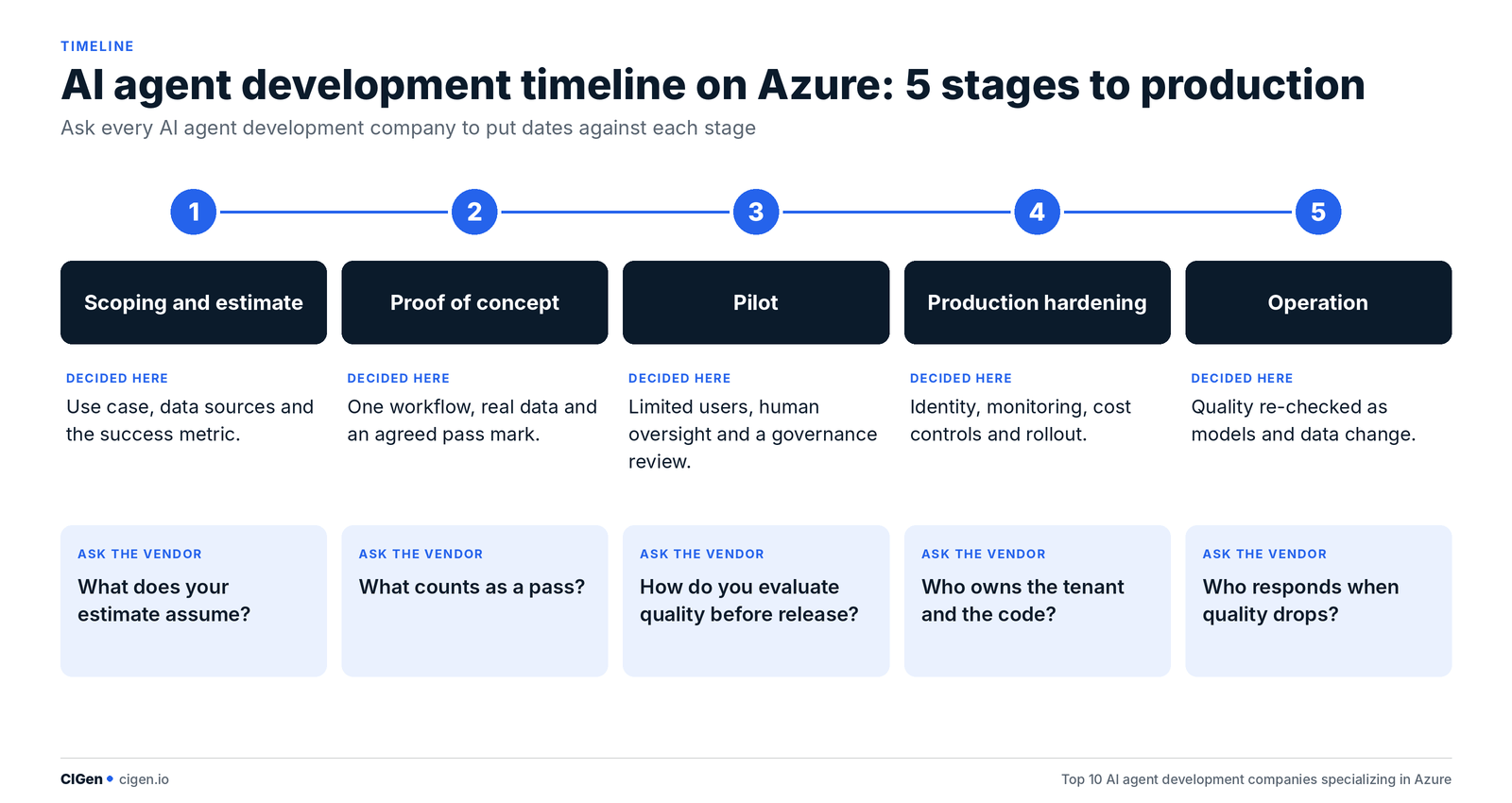
Ask each shortlisted vendor to put dates against these five stages and to state which of them its estimate covers, because a quote that stops at proof of concept covers only part of the cost.
Red flags when evaluating AI agent development companies
Gartner's three reasons for cancellation, escalating costs, unclear business value and inadequate risk controls, map onto the warning signs below.
- No named production case. Without a client that runs the agent in production, the value claim is untested.
- "Agent" means a chatbot. Ask what actions the agent takes, with which permissions, and how errors are caught and reversed.
- No evaluation or tracing plan. If the vendor cannot show how agent quality is measured before and after release, risk controls are missing.
- Security claims without scope. An ISO 27001 or SOC 2 mention should name the entity, the offices and the scope it covers.
- Estimates without assumptions. A fixed number with no stated data, integration or security assumptions is where costs escalate later.
- A review profile carries the whole case. One to three reviews, however strong, are a starting point for reference calls, not evidence.
- Unclear ownership. Code, infrastructure as code and the Azure tenant should belong to you from day one.
A vendor that answers these points directly is ready for a paid discovery step, and one that cannot is easier to rule out now than after a pilot.
Summary: shortlisting AI agent development companies on Azure
Choosing among AI agent development companies on Azure comes down to fit and evidence. Match the vendor type to your scale, check agent work through named cases, and settle access, deliverables and timing before kickoff.
If you are scoping an Azure AI agent project, CIGen's AI agent development services page describes how it scopes and delivers one, with an estimate returned within two days.