
AI agent project ideas to inspire SMB owners to finally start building
Gartner forecasts that spending on AI agent software will reach $206.5 billion in 2026, up from $86.4 billion in 2025. That is a 139% jump in a single year. If you are searching for AI agent project ideas for your own business, you are not early to this trend. You are catching it at the exact moment it turns mainstream.
Most guides on this topic are written for two audiences: solo developers building weekend projects, or enterprise buyers with dedicated IT budgets and governance teams. Neither quite fits a small or mid-sized business owner who wants to know what an AI agent actually does, what it costs, and which department should get one first.
This guide fills that gap. We will define what an AI agent is, walk through three ways to build one depending on your technical comfort, break down realistic pricing, and then hand you 30+ AI agent project ideas for small business, organized by department so you can find the one that matches your most painful workflow today.
What is an AI agent? [And why it's not a chatbot]
An AI agent is an autonomous software system that uses artificial intelligence to perceive its environment, make decisions, and take independent actions to achieve specific goals.
A chatbot answers one question and stops. An AI agent works differently: it takes a goal, breaks it into steps, uses tools such as your email, calendar, or CRM to complete those steps, checks its own work, and keeps going until the task is done.
Task-specific agents can operate and perform complex, end-to-end tasks rather than simply responding to prompts. Gartner predicts that 40% of enterprise applications will include task-specific AI agents by the end of 2026, up from less than 5% in early 2025.
That distinction matters for SMB owners specifically because it changes what you are shopping for. A chatbot upgrade improves your website. An agent removes a chunk of recurring work from someone's plate.
The 2026 landscape: SMBs are catching up fast
Small business adoption of AI agents looked experimental as recently as 2024. That has changed. SMB Group found that 42% of SMBs with 50 to 499 employees now use AI in at least one business process, up from 23% in 2024. The Upwork Research Institute's Q1 2026 survey of SMB leaders found that 41% are running active pilots to test AI agents for decision-making tasks, with only 3% saying they are not considering agents at all.
A few patterns show up across nearly every recent survey:
- Adoption is accelerating faster among growing businesses than declining ones, suggesting agents are becoming a competitive differentiator, not just a cost play
- Data analytics, content generation, and inventory management are the first functions moving from pilot to full-scale use among SMBs
- Cost and lack of in-house expertise remain the top two barriers, not lack of interest
The practical takeaway: waiting is no longer the safe option. The businesses moving first on AI agent project ideas are building an operating advantage while competitors are still in the research phase.
How to build an AI agent: Three paths by technical acumen
You do not need a developer on staff to launch your first agent. You do need to pick the build path that matches your team's actual skills, not the one that sounds most impressive.
No-code. Platforms like Zapier, Make, and n8n let you assemble an agent from prebuilt blocks: trigger, action, condition, done. No programming required. This path suits a business owner or office manager comfortable with spreadsheets and basic software settings.
Low-code / API-assembled. Tools like Voiceflow, Dify, or Microsoft Copilot Studio sit between no-code and custom development. You configure logic visually but connect to specific APIs, add custom prompts, and sometimes write short scripts. This path suits a marketing ops person, a technical office manager, or a part-time contractor.
Custom-coded. Frameworks like LangChain and CrewAI give a developer full control over logic, memory, and integrations. This path suits an in-house developer, a freelance engineer, or a consulting partner, and it is the right choice once your agent needs to touch multiple systems or handle edge cases a no-code tool cannot express.
What does an AI agent cost? Ballpark pricing by build path
Cost is the single biggest question SMB owners ask before committing to an AI agent project idea, and it is also the hardest to pin down without a specific workflow in mind. That said, three cost drivers show up in nearly every project: the number of systems the agent connects to, the volume of data it processes, and whether it needs compliance or audit controls.
A useful reference point: the average SMB using AI tools already spends around $18,000 a year on AI-related software and subscriptions. Treat your first agent project as a slice of that budget, not a brand-new line item, and set a hard usage cap on any API-metered service before you turn a workflow loose in production.
30+ AI agent project ideas [by department]
This is the core of the guide: AI agent project ideas grouped by department, so you can start with the team that has the most repetitive, rules-based work. Each section below lists project ideas with a one-line description of what the agent actually does.
Customer service & support
Support teams handle high ticket volume and predictable questions, which makes this department the most common starting point for a first AI agent project.
- Tier-1 support triage agent: reads incoming tickets, answers common questions from your help docs, and escalates only what a human needs to see
- Order status and shipping tracker agent: checks order systems and answers "where is my order" questions automatically
- Appointment scheduling agent: books, reschedules, and confirms appointments across your calendar without back-and-forth emails
- After-hours chatbot with human handoff: answers simple questions overnight and routes anything urgent to an on-call number
- Customer feedback summarizer: reads reviews and support transcripts weekly and produces a short themes report
- Warranty and return request processor: checks eligibility against your policy and either approves or flags the request for review
Getting this department right usually buys you back the most hours per dollar spent, since ticket volume tends to be the most repetitive workload in a small business.
Sales & Marketing
Sales and marketing teams juggle lead follow-up, content production, and competitive awareness, three tasks that agents handle well because they are time-sensitive and format-driven.
- Lead qualification agent: scores inbound leads against your criteria and routes hot leads straight to a rep
- Meeting scheduler and follow-up agent: sends meeting confirmations, reminders, and a follow-up email after every sales call
- Content repurposing agent: turns a blog post into social captions, an email snippet, and a short summary automatically
- Competitor price and offer monitor: checks competitor pages on a schedule and flags meaningful changes
- Email nurture sequence agent: personalizes drip emails based on what a lead clicked or downloaded
- Review response agent: drafts responses to new Google or industry reviews for a human to approve and post
Speed matters more than polish for most of these projects. A lead follow-up agent that responds in minutes rather than hours has a measurable effect on close rates. This insight provides a deeper dive into the AI applications in marketing.
Finance & back office
Finance workflows are rules-heavy and repetitive, which makes this department one of the safer places to hand real responsibility to an agent, provided a human still signs off on anything involving money leaving the business.
- Invoice processing and AP agent: reads incoming invoices, matches them to purchase orders, and queues them for approval
- Expense report reviewer: checks receipts against policy limits and flags anything unusual before reimbursement
- Cash flow forecasting agent: pulls recent transactions and projects the next 30 to 90 days of cash position
- Collections and receivables reminder agent: sends graduated payment reminders and tracks who has and has not responded
- Monthly close reporting assistant: compiles the numbers finance needs into a first-draft summary each month
- Budget variance analyzer: compares actual spend against budget by category and explains the gaps in plain language
Keep a human approving any payment or refund an agent recommends. The value here is in removing the manual pulling and formatting of numbers, not in giving software unsupervised access to your bank account.
AI agent project ideas for Human resources and recruitment
HR tasks like screening, onboarding, and policy questions follow clear rules most of the time, which is exactly the pattern that suits an agent well.
- Resume screening agent: scores applicants against a rubric you define and ranks them for a first read
- Onboarding checklist agent: tracks every task, document, and system access a new hire needs and nudges the right person when something is missing
- Policy and benefits Q&A agent: answers common questions about leave, benefits, and payroll using your own documents
- Training and upskilling tracker: reminds employees about required training and flags who is falling behind
Start with resume screening or onboarding if HR is your first stop. Both have a clear, measurable "before and after" that makes the project easy to justify. Also, you might want to check out our extended insights on AI in HR for advancing into action.
IT & Admin
Small businesses rarely have a dedicated IT department, which means routine tickets and admin tasks often land on whoever is available. An agent can absorb a good share of that load.
- Password reset and access request agent: handles routine account requests without waiting on a human
- Document filing and retrieval agent: files incoming documents into the right folder and answers "where is that file" questions
- Meeting notes and action item agent: joins a call, summarizes it, and emails out the action items afterward
- Software subscription auditor: checks which tools are actually being used and flags subscriptions worth canceling
This department is a good testing ground precisely because the stakes are low. A misfiled document is easy to fix; a missed payment is not.
Legal AI agent project ideas
Legal work at a small business is usually reactive: contracts to review, compliance deadlines to track. An agent here should support a human reviewer, not replace one.
- Contract clause review agent: flags non-standard clauses in incoming contracts against your usual terms
- Compliance monitoring agent: tracks regulatory deadlines relevant to your industry and reminds you before they hit
- NDA and vendor agreement intake agent: pre-screens routine agreements and routes anything unusual for legal review
Treat every output here as a first draft for a human, never a final answer. Legal risk is the one place where "close enough" is not good enough.
R&D
Product and R&D teams at small businesses often skip structured research because nobody has time for it. An agent can make that research a standing habit instead of an occasional scramble.
- Competitive teardown agent: checks competitor product pages and release notes on a schedule and summarizes what changed
- Customer feedback clustering agent: groups feature requests and complaints by theme so patterns are visible, not buried
- Literature and patent summarizer: reads new research or patent filings in your field and produces a plain-language digest
Even a lightweight version of this, running weekly, gives a small product team visibility they would otherwise only get by hiring a research analyst.
Operations
Operations covers the physical and process side of a business, whether that means a hotel front desk, a manufacturing floor, or a services company juggling vendors. The tasks below apply across most of those settings.
- Inventory reorder alert agent: watches stock levels and drafts a reorder before you run out
- Vendor and logistics tracking agent: checks delivery status across multiple vendors and flags delays before they become a problem
- Quality control checklist agent: walks through a standard checklist against photos or sensor data and flags exceptions
- Demand forecasting agent: looks at historical patterns and seasonality to suggest staffing or stock levels for the week ahead
- Equipment maintenance scheduler: tracks maintenance intervals across equipment and schedules service before something breaks
Operations tends to produce the clearest ROI story of any department, since delays, stockouts, and equipment failures usually have a dollar figure already attached to them.
Where to find more AI agent project ideas: Open-source repositories
If the ideas above spark a direction but you want to see a working example before committing, a handful of open-source repositories catalog hundreds of real AI agent builds.
The most useful one for SMB owners is ashishpatel26/500-AI-Agents-Projects, a GitHub repository documenting 500+ agent examples. It is organized two ways that matter for a non-developer:
- By industry: healthcare, finance, retail, legal, manufacturing, and more, each with a short description and a link to working code
- By framework: CrewAI, AutoGen, Agno, and LangGraph, useful if you already know which framework your developer or agency prefers
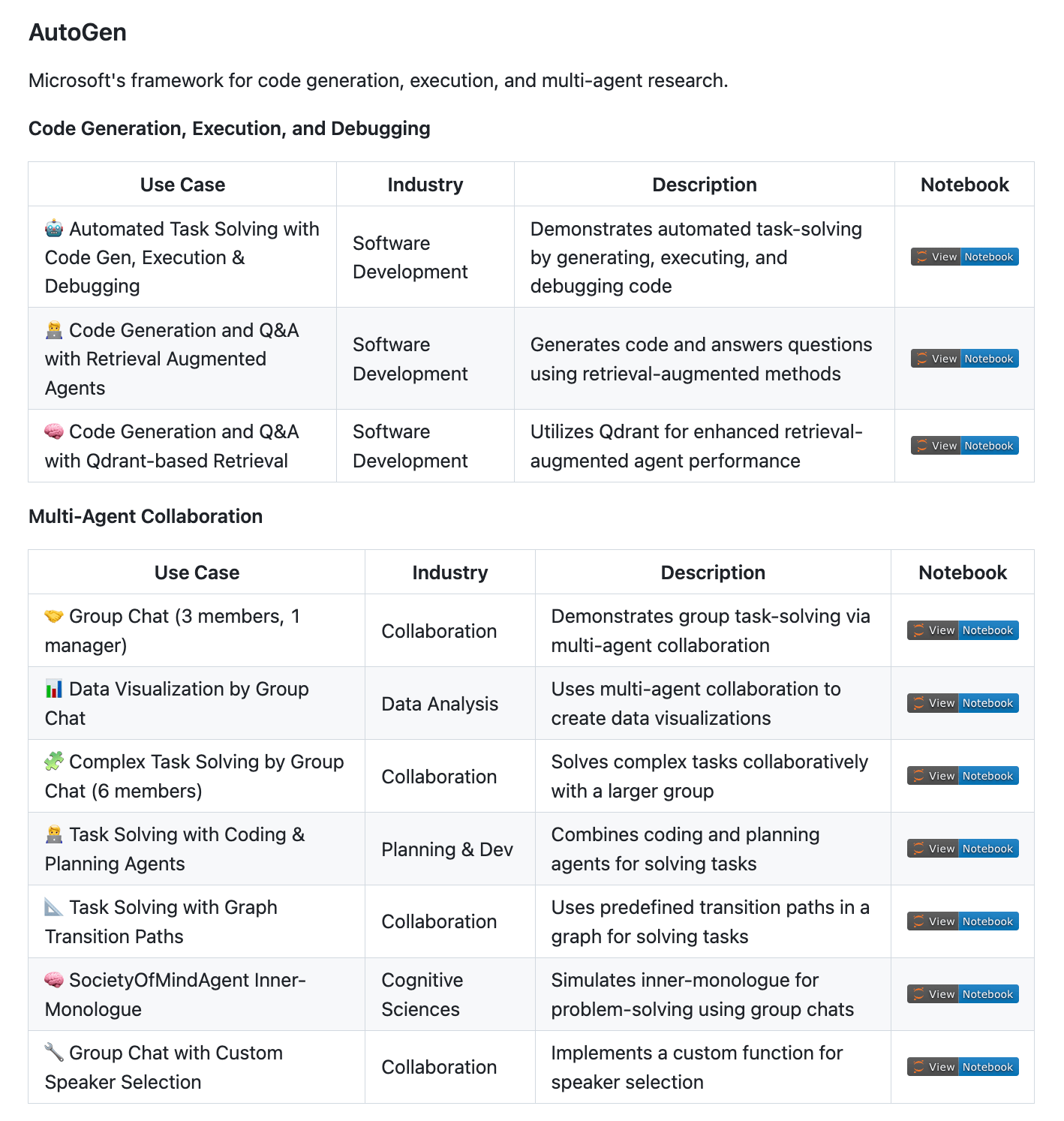
You do not need to write code to get value from a repository like this. Browse the industry table for something close to your own business, read the description, and use it as a brief when you talk to a developer or agency: "build me something like this, but for my invoicing process" is a perfectly good starting point for a scoping conversation.
For a more structured, beginner-friendly starting point, Microsoft's ai-agents-for-beginners curriculum offers 12 sequential lessons with runnable code, useful if someone on your team wants to learn the underlying skills rather than commission a build.
How to choose your first AI agent project
With 30-plus ideas on the table, the harder question is which one to build first. Three checks help narrow it down:
- Do you already have the data the agent needs? A project using data you already collect (invoices, tickets, calendar entries) is faster and cheaper than one requiring a new system first.
- Can you describe "done" in one sentence? "The agent reads overdue invoices and drafts reminder emails" is buildable. "The agent manages our finances" is not.
- Is the outcome measurable? Pick a project tied to a number you already track: hours saved, tickets closed, days-sales-outstanding, response time. If you cannot measure it, you cannot tell whether it worked.
Projects in Customer Service, Finance, and Operations tend to score well on all three checks for most small businesses, which is why they show up first in nearly every AI agent project ideas list, including this one.
Frequently Asked Questions
Conclusion
The best AI agent project idea for your business is not the most impressive one on this list. It is the smallest one that fixes a workflow you already feel the pain of every week. Pick a department, pick one project, define what "done" looks like in a sentence, and measure the result before you scale to a second one.
If you want a structured way to prioritize these ideas against your own data readiness, technical capacity, and budget, CIGen's AI Adoption Strategy workshop on the Microsoft Azure Marketplace walks your team through exactly that process, from use case prioritization to vendor selection, so your first AI agent project starts on solid ground instead of a guess.