
Should you build that AI agent? Get a real answer in just a few minutes
Get an instant feasibility score, a ballpark cost and timeline range, and 3 tailored AI agent ideas in under 2 minutes.
This interactive assessment turns "should we build an AI agent?" into a data-grounded answer, before you commit budget or engineering time.
Start your free assessment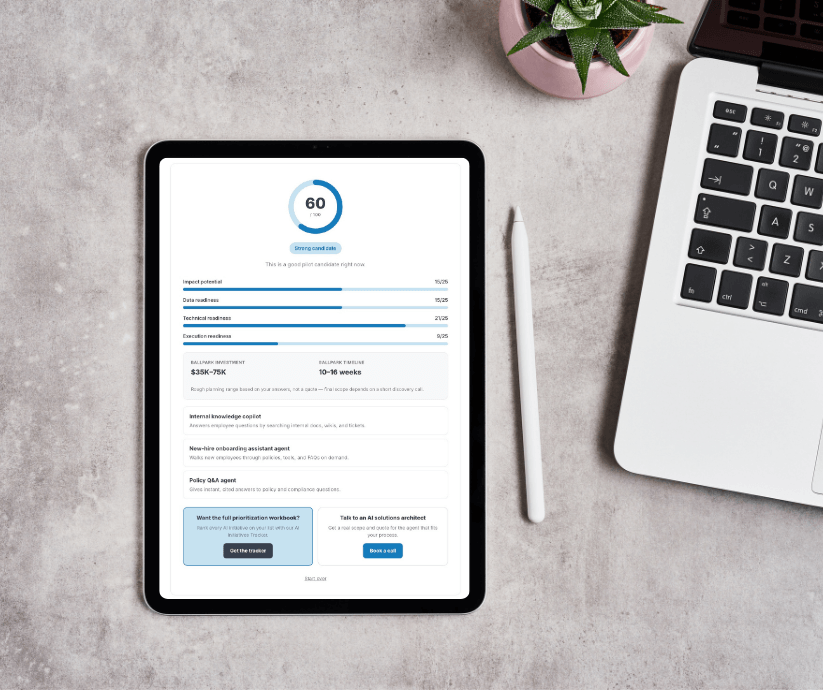
How this AI agent cost estimator supports confident
AI agent development decisions
See in minutes whether a process is a strong candidate for an AI agent, based on volume, data, and technical readiness.
Get ballpark investment and delivery ranges for your specific process, before committing budget or engineering time.
Consistent scoring criteria replace guesswork with a repeatable, comparable result you can defend to stakeholders.
Receive 2–3 AI agent concepts matched to the process you described: not generic, one-size-fits-all examples.
Understand exactly which dimension (data, integration, or AI maturity) is holding a use case back.
Use your result to decide whether to pilot now, close a readiness gap first, or bring in a scoping conversation.
Key features of the AI agent feasibility & cost estimator
This interactive tool helps you evaluate whether a specific process is ready for AI agent automation. It combines a short structured questionnaire, automated scoring across four readiness dimensions, and a tailored cost, timeline, and use case breakdown,- all in one guided experience.
Not sure if an AI agent is worth building yet?
Use a structured feasibility assessment to get a real answer in minutes before committing budget or engineering time. Based on your process, your data, and your team's readiness.
Key dimensions this estimator evaluates
The estimator scores every response across four readiness dimensions. Each one helps determine whether a process is ready for an AI agent now, needs groundwork first, or isn't the right first candidate.
Weekly hours currently spent on the process, across the whole team.
A higher current time cost means a bigger addressable return once the process is automated.
A process consuming 80+ hours/week of manual effort scores far higher than one consuming under 10.
How structured the underlying data is — databases and forms versus free text, PDFs, or calls.
Structured data is faster and cheaper to build against; unstructured data adds discovery and engineering work.
A claims process backed by structured records scores higher than one built on scanned, handwritten forms.
Your current AI maturity, and how many systems the agent would need to connect to.
Organizations further along in AI adoption, with fewer integration points, move from pilot to production faster.
A standalone process at an AI-mature organization scores higher than a multi-system integration at an early-stage one.
API availability across the systems involved, and the sensitivity of the data (public, internal, or regulated).
Modern APIs shorten build time; regulated data adds governance and compliance work that extends timelines.
A process using modern APIs and internal-only data scores higher than one requiring legacy integration with regulated data.
Tool limitations: When expert AI agent scoping is required
This estimator gives a fast, directional read on feasibility, cost, and timeline for a single AI agent idea. It helps you decide whether a process is worth pursuing further, it isn't a substitute for technical discovery or delivery planning.
Turning a strong result into a working AI agent typically requires deeper validation of your data, your systems, and your organization's specific constraints. This tool tells you where to look first. A scoping conversation tells you exactly how to build it.
Why it matters: Two agents in the same tier can still differ significantly in real cost depending on details a questionnaire can't capture.
Where experts help: A short scoping call narrows the range to a real quote based on your actual systems and data.
Why it matters: API availability and data quality often look different once you dig into a specific vendor or legacy system.
Where experts help: Architects validate integration assumptions before you commit engineering time.
Why it matters: GDPR, HIPAA, or PCI-relevant data changes what's required before an agent can go to production.
Where experts help: Specialists design the compliance and access-control layer around the agent from day one.
Why it matters: Portfolio-level trade-offs need more context than a single assessment can capture.
Where experts help: Use the AI Initiatives Tracker or a prioritization workshop to sequence multiple candidates.
Signals that indicate a strong AI agent candidate
Strong candidates typically share a set of characteristics worth checking before you run the full assessment.
High manual volume
Processes consuming significant weekly staff hours offer the clearest return once automated. Recurring, repeatable tasks are easier to justify and scope than one-off efforts. Examples include ticket triage, document review, or recurring reporting.
Structured or semi-structured data
AI agents perform most reliably against consistent, well-defined data. Processes built on databases, forms, or structured logs give an agent a stronger foundation than free text or handwritten input. Examples include CRM records, transactional data, or structured intake forms.
Clear, measurable outcomes
A strong candidate is tied to outcomes you can measure before and after: time saved, errors reduced, or faster response times. Without a defined metric, it's hard to know whether the agent delivered value. Track indicators like resolution time, hours saved, or error rate.
Next steps: turning your result into action
This AI agent feasibility estimator helps you make an early, well-grounded call on a single AI agent idea. Once you have your result, here's how to move forward.
Answer the 9 questions with your best current estimate for the process you're evaluating. It takes about 2 minutes.
Look at your overall result and the four dimension scores to see which readiness gaps, if any, stand out.
Get your ballpark cost/timeline range and 2–3 tailored AI agent use case ideas for your process.
If you have more than one candidate process, run the assessment again or use the AI Initiatives Tracker to rank them side by side.
For a real scope and quote, or to validate a strong result before committing budget, book a short call.
CIGen's AI adoption toolkit
The AI Agent Feasibility & Cost Estimator is one part of CIGen's broader AI adoption toolkit.
It helps you decide whether a specific process is ready for an AI agent, before you invest time in a full use case comparison or implementation roadmap. Each resource in the toolkit addresses a different decision point in the AI adoption journey.
Compare and rank multiple AI initiatives side by side once you've validated a few with this AI agent feasibility & cost estimator.
Track AI agents portfolio over time: status (PoC, pilot, and production), estimated vs. actual ROI, and risk/compliance visibility across your whole portfolio. Ongoing governance, not a one-time ranking.
Understand where your organization stands overall before evaluating individual use cases.
Turn a validated, high-scoring use case into a phased delivery plan.


