
Frontend modernization strategy decision matrix for legacy applications
Determine whether your application frontend modernization effort should focus on refactoring, replatforming, or full architectural redesign.
This downloadable decision matrix template evaluates scalability constraints, ROI, technical scope, and strategic goals to guide modernization planning. The result is a structured recommendation that reduces risk before major engineering investment.
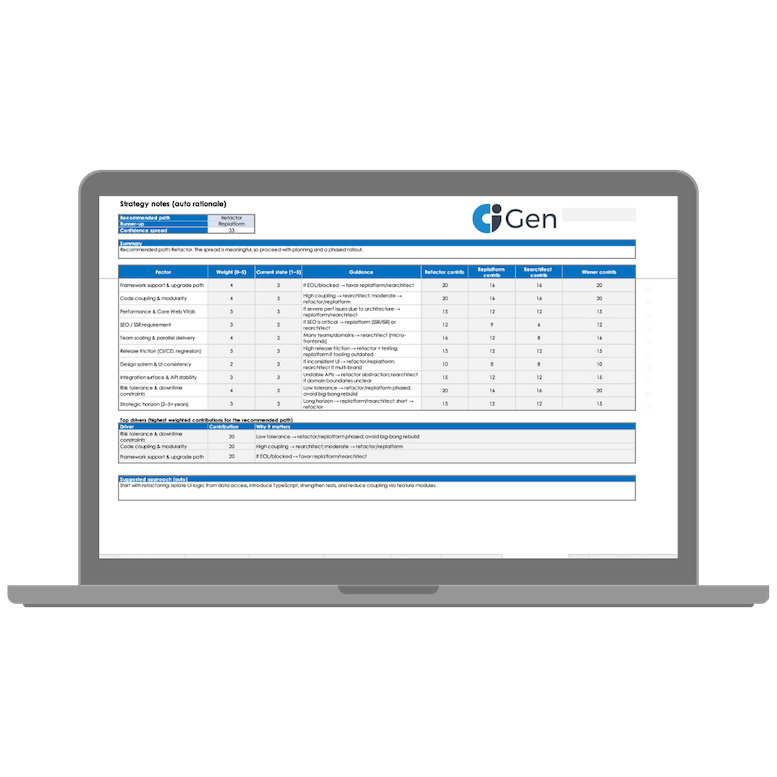
How modernization matrix for app frontends helps businesses make informed architecture decisions
Evaluate whether your frontend should be refactored, replatformed, or rearchitected using a structured scoring model that weighs technical debt, architectural constraints, and business priorities.
The matrix converts factors such as framework support, performance limitations, and team scalability into weighted scores, helping teams compare modernization strategies objectively.
Assess how factors like release friction, SEO requirements, integration stability, and strategic horizon influence the most suitable modernization path.
Use the built-in effort estimator to approximate engineering workload and modernization timelines, helping teams align architectural changes with delivery capacity.
The ROI model helps estimate cost, return on investment, and payback period, supporting budget planning and internal approval for frontend modernization initiatives.
The automated recommendation and strategy notes sheet summarize the results, highlight the top decision drivers, and suggest the most appropriate modernization approach.
Key factors when assessing legacy frontend modernization strategies
Choosing whether to refactor, replatform, or rearchitect a legacy frontend requires evaluating several technical and operational signals. The decision matrix included in this tool weighs these factors to help teams determine the most appropriate modernization strategy for their application frontend architecture.
Review whether the current framework version is still actively maintained, supported by the vendor, and compatible with modern tooling and browser standards.
- End-of-life framework versions (e.g., AngularJS, legacy jQuery-heavy applications)
- Limited compatibility with modern build tools and package managers
- Dependency chains tied to outdated libraries
Unsupported frameworks increase security exposure, upgrade complexity, and long-term maintenance cost, often making replatforming the safer modernization path.
If the frontend relies on deprecated framework versions that cannot upgrade incrementally, migrating to React, Angular, or Vue ecosystems may be required.
Assess how UI components, business logic, and data access layers are organized within the application.
- Large monolithic component structures
- Shared global state with limited isolation
- Tight coupling between UI components and backend APIs
Poor modularity increases regression risk and slows development cycles. In severe cases, teams may need to introduce domain-driven architecture or micro-frontend patterns.
A monolithic SPA with tightly coupled modules may benefit from progressive modularization or domain-based decomposition before further modernization.
Analyze real user performance metrics and rendering behavior across devices and networks.
- Large JavaScript bundles
- Long hydration times in SPA architectures
- High Largest Contentful Paint (LCP) and Time to Interactive (TTI)L tools.
Modern frameworks and rendering strategies such as SSR (Server-Side Rendering) or ISR (Incremental Static Regeneration) can significantly improve performance and SEO visibility.
Migrating from a purely client-rendered SPA to a Next.js or Nuxt architecture may improve both performance and search discoverability.
Review how efficiently teams can develop, test, and deploy frontend changes.
- Slow build pipelines
- High regression risk during releases
- Limited automated testing coverage
Frontend modernization can introduce better CI/CD pipelines, improved testing practices, and more modular development workflows, reducing delivery risk.
Teams struggling with release cycles may benefit from component isolation, improved testing frameworks, and modern build tooling.
Assess whether multiple teams can safely work on different frontend domains without creating integration conflicts.
- Frequent merge conflicts across modules
- Shared deployment pipelines for unrelated features
- Lack of domain ownership within the UI architecture
Modern architectures such as micro-frontends or domain-driven frontend modules allow teams to work independently while maintaining a shared design system.
Organizations supporting multiple product domains may benefit from federated frontend architectures using module federation or similar techniques.
Legacy frontend becoming harder to maintain and scale?
Use this frontend modernization decision matrix to determine whether refactoring, framework migration, or architectural redesign is the most appropriate route forward.
Tool limitations: When expert modernization consulting may be required
While the decision matrix provides a structured way to evaluate frontend modernization options, some modernization initiatives require deeper architectural expertise.
Complex frontend ecosystems, legacy dependencies, and large-scale application environments often benefit from guidance from experienced software architects and engineering teams.
Modernizing such systems may require domain-driven frontend architecture, modular decomposition, or micro-frontend strategies, which typically benefit from experienced architectural guidance.
Designing scalable solutions such as micro-frontends, module federation architectures, or domain-based UI ownership often requires architectural planning and governance frameworks.
Migrating from client-side rendering to SSR or hybrid rendering models, implementing edge rendering, or optimizing build pipelines may require deeper frontend engineering expertise.
Addressing these constraints may require coordinated modernization of API layers, authentication mechanisms, and backend contracts, which typically benefits from cross-stack architectural expertise.
Inside the frontend modernization decision matrix: evaluate strategies and plan modernization
The downloadable decision matrix includes several structured worksheets that help teams evaluate frontend modernization options and estimate implementation effort, risk, and business impact. Each tab focuses on a specific aspect of modernization planning.
Weighted scoring model
Purpose:
Evaluate modernization strategies based on technical and business signals.
Key data:
Framework support, code modularity, performance metrics, SEO requirements, team scalability, and delivery friction.
What it's for:
Calculates weighted scores to compare refactor, replatform, and rearchitect strategies.
Strategy recommendation
Purpose:
Convert scoring results into a clear modernization direction.
Key data:
Total weighted scores, ranking of strategies, and confidence spread.
What it's for:
Automatically identifies the most suitable modernization approach based on the evaluated factors.
Strategy notes and decision drivers
Purpose:
Explain why a specific modernization path was recommended.
Key data:
Top contributing factors, weighted drivers, and summary insights.
What it's for:
Helps teams communicate modernization decisions to technical leadership and stakeholders.
Engineering effort estimator
Purpose:
Estimate engineering workload required for frontend modernization.
Key data:
Application size, component complexity, number of teams, and integration surface.
What it's for:
Provides a rough estimate of effort, duration, and engineering capacity requirements.
ROI and modernization cost model
Purpose:
Estimate the financial impact of frontend modernization initiatives.
Key data:
Engineering cost, infrastructure changes, productivity improvements, and expected ROI.
What it's for:
Supports budgeting discussions and investment justification for modernization projects.
Risk and modernization constraints
Purpose:
Identify operational and delivery risks associated with modernization.
Key data:
Downtime tolerance, integration dependencies, architectural constraints, and release risk.
What it's for:
Helps teams plan phased rollouts and risk mitigation strategies before modernization begins.
Next steps: Turning your frontend modernization assessment into action
This decision matrix helps engineering teams evaluate legacy frontend systems and identify whether refactoring, replatforming, or rearchitecting is the most appropriate modernization strategy. By reviewing the scoring results and decision drivers, teams can align technical priorities with business goals and plan modernization initiatives more confidently.
Populate the scoring model with information about your frontend architecture, including framework support, code modularity, performance metrics, delivery friction, and strategic horizon. This creates a structured profile of your frontend system and highlights the factors influencing modernization decisions.
Analyze the weighted scoring results to see which strategy - refactor, replatform, or rearchitect - best fits your current architecture and long-term goals.The recommendation sheet also highlights the key drivers behind the suggested approach.
Use the decision matrix outputs to facilitate discussions between engineering leaders, architects, and product teams. The results can help prioritize modernization initiatives and align stakeholders around a clear architectural direction.
If the analysis reveals complex architectural constraints, legacy dependencies, or large-scale modernization requirements, expert guidance may help refine the strategy. Experienced architects can assist with frontend architecture audits, modernization roadmaps, and implementation planning for complex systems.

Download the application frontend modernization matrix
Use the decision matrix outputs to facilitate discussions between engineering leaders, architects, and product teams.
The results can help prioritize modernization initiatives and align stakeholders around a clear architectural direction.


