
AI use case prioritization template for risk-averse adoption
Identify, compare, and sequence AI initiatives based on business value, feasibility, and risk.
This practical use case assessment framework for seamless AI adoption helps teams move from ideas to a prioritized shortlist of use cases grounded in data readiness, delivery effort, and expected impact. It is designed to support structured decision-making before committing resources to implementation.
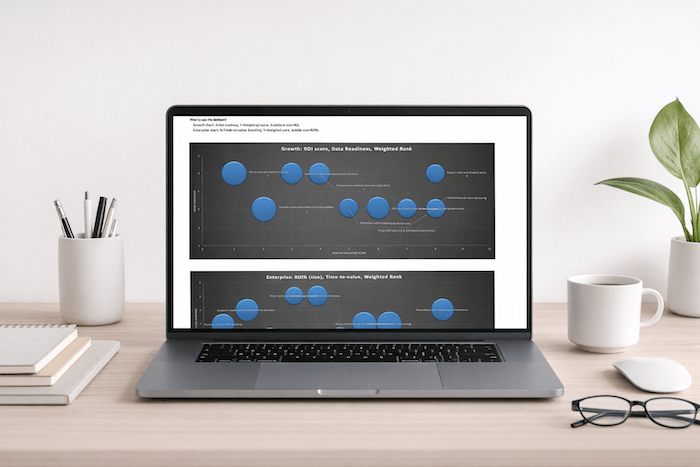
How this framework supports practical AI adoption
Quickly surface AI initiatives that are grounded in real business needs rather than abstract experimentation or vendor-driven ideas.
Evaluate expected value across efficiency, cost reduction, revenue potential, or risk mitigation to focus on outcomes that matter.
Review data availability, technical complexity, and delivery effort to understand whether a use case is realistic in the near term.
Expose requirements around data quality, integrations, infrastructure, and skills that may affect delivery timelines.
Apply consistent scoring criteria to compare use cases side by side and avoid prioritization based on intuition alone.
Translate prioritization results into a logical order for pilots and implementation phases, reducing early-stage delivery risk.
Key features of the AI use case prioritization template
This Excel-based framework helps organizations evaluate, compare, and sequence AI initiatives across different maturity levels. It supports consistent decision-making by combining structured inputs, automated scoring, visual summaries, and practical guidance in a single, adaptable template.
Fearing wasted resources on the wrong AI use cases?
Use a structured use cases prioritization framework to evaluate AI initiatives based on business value, feasibility, and delivery risk before committing resources.
Key dimensions when assessing AI use cases for prioritization
When evaluating potential AI initiatives, it is critical to review them across multiple dimensions. Each dimension helps determine whether a use case is worth pursuing now, later, or not at all, balancing value, feasibility, and risk to support informed decision-making.
Expected efficiency gains, cost reduction, revenue impact, risk mitigation, or customer experience improvement.
AI initiatives without a clear business outcome often fail to justify investment or lose stakeholder support.
An AI demand forecasting model that improves inventory accuracy by a measurable margin may have higher priority than an experimental personalization feature.
Data availability, quality, consistency, historical depth, labeling status, and update frequency.
Even high-value use cases can stall if underlying data is incomplete, fragmented, or unreliable.
A predictive maintenance use case may be deprioritized if sensor data is sparse or inconsistently collected across assets.
Model complexity, integration with existing systems, infrastructure readiness, and deployment constraints.
Highly complex solutions increase delivery time, cost, and operational risk, especially in early adoption stages.
A rules-based automation may be prioritized over a custom deep learning model if it delivers sufficient value with lower effort.
Development effort, required skills, tooling, infrastructure costs, and ongoing maintenance.
Limited budgets and teams require focusing on initiatives with a reasonable effort-to-value ratio.
Two use cases with similar impact may be ranked differently if one requires significantly less engineering effort.
Change management, user adoption, compliance implications, explainability requirements, and dependency on external teams.
Unaddressed risks can delay deployment or prevent solutions from being adopted in practice.
An AI decision-support tool may rank higher than a fully autonomous system if governance and accountability are not yet defined.
Tool limitations: When expert AI consulting is required
The AI use case prioritization framework provides a structured way to compare initiatives based on value, feasibility, and risk. It helps teams create clarity at the decision stage, but it remains a planning and alignment tool.
While it highlights which use cases appear promising and which may be premature, it does not replace deeper discovery, architectural design, or delivery planning. Turning prioritization outcomes into production-ready AI solutions often requires domain expertise, technical validation, and hands-on execution. This tool helps you understand what to focus on first. Expert consulting helps define how to execute effectively.
Why it matters
Scoring alone cannot resolve strategic trade-offs between initiatives with different time horizons, risk profiles, or organizational impact.
Where experts help
Consultants support portfolio-level decision-making, balancing short-term wins with long-term capability building.
Why it matters
Early assumptions about feasibility may underestimate integration effort, data gaps, or change management challenges.
Where experts help
Specialists validate assumptions through technical discovery and risk analysis before significant investment is made.
Why it matters
Even well-prioritized use cases can stall without clear ownership, operating models, or adoption readiness.
Where experts help
Consultants help design roles, workflows, and governance structures that enable AI initiatives to move forward.
Why it matters
Overlapping dependencies can create bottlenecks or duplication if not managed holistically.
Where experts help
Experts identify common foundations and design shared enablers to reduce long-term cost and delivery friction.
Why it matters
Prioritization clarifies what to pursue, but not how to implement safely and efficiently.
Where experts help
Consultants translate prioritized use cases into phased roadmaps, pilots, and production-ready delivery plans.
Signals that indicate a strong AI use case candidate
Strong candidates typically share a set of characteristics that make them suitable for prioritization and delivery.
Reviewing potential initiatives against these signals helps filter ideas before deeper evaluation.
Data intensity
AI performs best when trained on large volumes of relevant, repeatable data generated through normal business operations. Processes that consistently produce structured, semi-structured, or unstructured data provide a stronger foundation for model development and validation.
Examples include transactional records, logs, customer interactions, sensor data, or historical process outcomes collected over time.
Decision frequency
Use cases that involve frequent decisions or recurring judgments are often better suited for AI support. High decision volume increases the potential return by reducing manual effort, improving consistency, or accelerating response times.
Typical signals include operational decisions made daily or in real time, especially where humans rely on patterns, thresholds, or historical comparisons.
Measurable outcomes
A strong AI use case is tied to outcomes that can be clearly defined and measured. Without objective success metrics, it becomes difficult to assess whether an AI initiative delivers meaningful value.
Relevant indicators include cost reduction, efficiency gains, error reduction, risk mitigation, revenue impact, or service quality improvements that can be tracked before and after implementation.
Next steps: Turning AI use case prioritization into action
This framework helps structure early AI decision-making by comparing initiatives across value, feasibility, and risk. Once the template is completed, the next step is to use the results to align stakeholders, focus resources, and plan realistic execution paths. Where additional validation or expertise is needed, prioritization outcomes can be extended into deeper discovery and delivery planning.
Document candidate AI use cases using consistent criteria such as business impact, data readiness, delivery effort, and risk. Ensure assumptions are explicit and inputs reflect current organizational realities.
Analyze the automated scores to identify high-priority use cases, borderline candidates, and initiatives that may be premature. Look for patterns across value versus feasibility rather than focusing on rankings alone.
Use the results to facilitate discussions across business, product, and technical teams. Confirm which use cases align with strategic objectives, available capacity, and near-term constraints.
For top-ranked use cases, define next actions such as data validation, technical discovery, or proof-of-concept activities to reduce uncertainty before full-scale delivery.
When prioritization highlights complex dependencies, elevated risk, or unclear feasibility, external expertise can help translate priorities into actionable roadmaps and implementation plans.
CIGen's AI adoption toolkit
This AI use case prioritization template is a core component of CIGen’s broader AI adoption toolkit.
It helps organizations move from scattered AI ideas to a clear, defensible shortlist of initiatives grounded in business value, feasibility, and delivery risk.
The toolkit is designed to support early and parallel stages of AI adoption, from deciding what to build first, to planning how to implement it responsibly and effectively. Each resource addresses a specific decision point in the AI journey, helping teams reduce uncertainty before committing significant time and budget.
Understand where your organization stands before you start building.
This interactive assessment helps teams evaluate their current AI maturity across strategy, data, technology, and governance dimensions. It highlights strengths, uncovers capability gaps, and recommends focus areas for scalable AI adoption.
Evaluate the quality, structure, and accessibility of your data.
Use this template to identify which datasets are AI-ready, where improvements are needed, and how to close gaps in collection, cleaning, and integration. It’s an essential resource for ensuring reliable model training and analytics outcomes.
Turn prioritized AI use cases into an actionable delivery plan.
This template helps structure the path from validation to implementation. It supports phased planning across discovery, data preparation, PoC, and production rollout, ensuring that prioritized use cases translate into realistic execution steps.
Ensure your AI initiative is compliant and secure from day one.
A checklist designed for AI projects, helping teams address data privacy, model transparency, auditability, bias mitigation and regulatory alignment.
Get AI use cases prioritization template
Download our free AI use cases prioritization framework, taking the first step toward building a solid foundation for a seamless risk-averse AI adoption.


