
SaaS vendor management tracker for CIOs and IT leaders
Track vendors, monitor license utilization trends, identify consolidation opportunities, and stay ahead of contract renewals with a practical SaaS management tracker designed for IT leadership teams.
Built for growing organizations that need clearer oversight of software costs, governance, and operational efficiency.
How the SaaS management tracker helps businesses improve software governance and vendor oversight
Track monthly SaaS usage trends, annual software spend, budget variance, and vendor performance across departments and business units.
Consolidate software subscription costs, vendor ownership, and renewal timelines into a centralized operational tracking model for improved financial oversight.
Monitor license utilization rates and adoption trends over time to better align software investments with actual business usage.
Track underutilized licenses, overlapping platforms, and low-adoption tools to support vendor consolidation and cost optimization initiatives.
Monitor contract renewal cycles, data processing agreement status, security review completion, and ownership accountability across vendors.
Prioritize upcoming renewals, identify negotiation opportunities, and evaluate platform rationalization initiatives using centralized reporting and tracking.
SaaS vendor management tracker:
key tracking dimensions
A structured SaaS vednor management tracker helps organizations improve visibility into software spending, reduce fragmented vendor oversight practices, and create a more consistent approach to SaaS governance. Instead of relying on scattered invoices, procurement records, or isolated admin portals, teams gain an operational framework for tracking renewals, software utilization, vendor ownership, compliance status, and optimization opportunities across departments.
This CIO template is designed to support operational software governance, vendor management processes, and long-term SaaS cost optimization initiatives in growing organizations.These tracking dimensions reflect the core operational areas that should be monitored to improve software governance consistency, reduce SaaS sprawl, and support more informed technology investment decisions.
Track software subscription costs across business units, teams, and operational functions to identify budget concentration and overlapping vendor usage.
Break down annual software costs by platform, category, and business use case to support renewal planning and optimization prioritization.
Assign business and technical ownership to software vendors and subscriptions to improve governance consistency and operational accountability.
Track renewal dates, notice periods, and auto-renewal risks to improve negotiation preparation and reduce unmanaged renewals.
Maintain visibility into DPA completion status and vendor compliance documentation across SaaS providers handling organizational data.
Track MFA support, SSO enablement, and security review completion status across critical software platforms.
Measure active usage against purchased licenses to identify underutilized subscriptions and improve license allocation efficiency.
Track Jan–Dec usage dynamics to identify adoption changes, platform redundancy, and declining software engagement over time.
Centralize operational KPIs such as annual SaaS spend, utilization rates, consolidation opportunities, and upcoming renewals into a structured reporting model.
Monitor duplicate functionality across collaboration, CRM, analytics, project management, and productivity tools to support consolidation initiatives.
Identify vendors with consistently low adoption rates, excess licensing, or declining usage trends prior to renewal periods.
Prioritize negotiation, downsizing, or replacement opportunities based on utilization trends, contract timing, and operational value.
Create a centralized vendor management tracker to improve reporting consistency across procurement, IT, security, and finance stakeholders.
Track software spend against planned budgets to improve forecasting accuracy and support operational financial planning.
Support more mature SaaS management processes through centralized operational tracking, ownership accountability, and utilization visibility.
Losing visibility into SaaS spend, renewals, and underutilized software subscriptions?
As SaaS environments grow, organizations often struggle with fragmented vendor ownership, duplicated tools, unmanaged renewals, and limited visibility into actual software utilization. This SaaS management tracker helps IT leaders centralize vendor oversight, monitor usage trends, identify consolidation opportunities, and improve operational governance across the software portfolio.
Bottom-line-friendly SaaS subscriptions management practices
As SaaS environments expand across departments and business functions, software spending often becomes fragmented across vendors, overlapping platforms, and disconnected procurement decisions.
Without a structured SaaS management process, organizations frequently struggle with low license utilization, duplicated tooling, inconsistent ownership, and unnecessary subscription growth. These practices help establish a more sustainable foundation for SaaS governance, vendor oversight, operational reporting, and long-term software cost optimization.
Centralize vendor inventory
Maintain a unified software inventory to improve visibility into subscriptions, vendors, departments, and renewal obligations.
Standardize ownership tracking
Assign business and technical ownership to SaaS platforms to improve accountability and governance consistency.
Monitor spend across departments
Track software costs by business unit, function, or environment to identify fragmented purchasing and overlapping spend.
Track utilization trends continuously
Monitor monthly SaaS usage rates to identify declining adoption patterns and underutilized platforms.
Review inactive or excess licensing
Compare purchased licenses against active users to identify overspending and optimization opportunities.
Identify low-adoption vendors early
Use operational reporting to surface platforms with persistently low engagement before renewal cycles begin.
Identify overlapping platforms
Track duplicate functionality across vendors to support consolidation and software rationalization initiatives.
Evaluate consolidation opportunities
Review overlapping tools based on utilization, business criticality, and operational value.
Simplify vendor ecosystems
Reducing unnecessary platforms can improve governance consistency, reporting clarity, onboarding, and security oversight.
Monitor upcoming renewals proactively
Track contract dates, notice periods, and auto-renewal clauses to improve negotiation preparation.
Standardize compliance oversight
Maintain visibility into DPA status, security reviews, MFA support, and SSO enablement across SaaS vendors.
Improve procurement coordination
Centralized renewal tracking helps IT, procurement, finance, and security stakeholders coordinate software decisions more effectively.
Track budget variance and spend growth
Monitor annual software costs against planned budgets to improve forecasting and financial oversight.
Prioritize optimization initiatives
Focus on vendors with low utilization, high spend, or overlapping functionality to improve optimization ROI.
Build operational SaaS governance maturity
Consistent vendor tracking and utilization reporting help organizations establish more scalable software governance processes over time.
Inside the SaaS lisence management tracker:
monitor software spend, vendor governance, and SaaS utilization
The SaaS subscriptions management tracker helps IT and operations teams organize software vendor reporting, monitor subscription utilization, improve renewal visibility, and reduce fragmented SaaS oversight.
Each tab is designed to support a specific aspect of SaaS governance and can be used independently or together as part of a broader software management workflow.
SaaS vendor inventory & ownership registry
Purpose:
Central working sheet for tracking SaaS vendors, subscription ownership, annual spend, renewal dates, and operational accountability.
Key data:
Vendor name, software category, business owner, technical owner, annual cost, contract renewal date, DPA status, security review completion.
What it’s for:
Provides a centralized SaaS inventory that improves vendor visibility, operational governance, and renewal coordination across teams.
SaaS usage & license utilization tracking
Purpose:
Tracks monthly software adoption trends and license utilization across SaaS platforms.
Key data:
Purchased licenses, active users, monthly usage %, average utilization, lowest/highest adoption months, usage trend analysis.
What it’s for:
Helps organizations identify underutilized software, excess licensing, and declining adoption before renewal periods.
SaaS spend & budget reporting
Purpose:
Monitors annual software costs, departmental spend allocation, and budget variance across SaaS environments.
Key data:
Annual spend, monthly spend trends, planned budget, budget variance, software category spend analysis.
What it’s for:
Supports operational reporting, SaaS cost visibility, and software budgeting decisions across business units.
Vendor renewal & contract management
Purpose:
Tracks upcoming renewals, notice periods, and contract-related governance activities.
Key data:
Renewal dates, auto-renewal status, contract owner, notice period, negotiation status, renewal priority flags.
What it’s for:
Improves renewal preparedness, reduces unmanaged renewals, and supports vendor negotiation planning.
SaaS optimization & consolidation tracking
Purpose:
Identifies overlapping tools, low-adoption platforms, and software rationalization opportunities.
Key data:
Consolidation flags, overlapping categories, utilization trends, optimization candidates, estimated wasted spend.
What it’s for:
Supports SaaS cost optimization initiatives and helps organizations reduce duplicated tooling across departments.
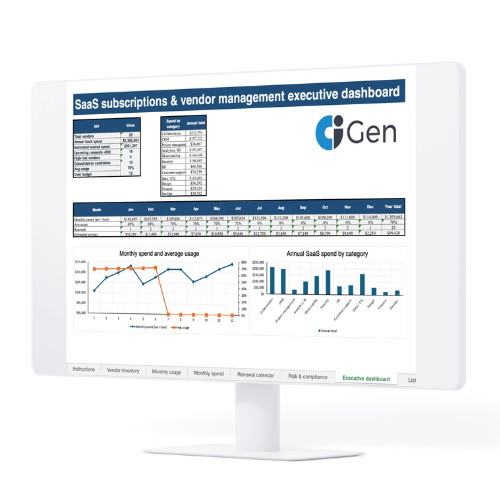
Dashboard & executive SaaS reporting
Purpose:
Provides centralized executive visibility into SaaS governance, utilization, renewals, and optimization KPIs.
Key data:
Total SaaS spend, utilization averages, upcoming renewals, consolidation opportunities, high-risk vendors, budget variance.
What it’s for:
Supports CIO reporting, operational governance oversight, and more informed software investment decisions.
Using the SaaS subscriptions management
tracker as a team
This tracker works best when used collaboratively across IT, procurement, finance, security, and operations teams. The goal is to maintain a shared operational view of SaaS spending, vendor ownership, software utilization, renewal risks, and optimization opportunities across the organization.
Define business and technical ownership for software vendors, subscriptions, and renewal processes to improve accountability and governance consistency.
Centralize software inventories, renewal timelines, utilization reporting, compliance tracking, and vendor costs into a shared operational reporting model.
Track software adoption changes, inactive licensing, usage decline, and overlapping platforms to improve SaaS visibility and optimization planning.
Capture underutilized subscriptions, duplicate tools, consolidation candidates, and renewal risks in a centralized optimization backlog.
Prioritize vendor optimization efforts based on annual spend, utilization rates, contract timing, operational importance, and estimated savings potential.
Conduct recurring reviews of vendor ownership, renewal schedules, software utilization, DPA status, and budget variance to improve long-term SaaS governance maturity.
CIGen's CTO/CIO toolkit
This subscription management template is part of a broader toolkit designed to help technology leaders improve operational visibility, support modernization initiatives, and bring more structure to complex engineering and infrastructure decisions.
These practical templates and frameworks are created to support common operational challenges across cloud governance, application modernization, AI adoption, reporting, and technology strategy.
Plan frontend modernization initiatives with greater technical and operational clarity.
This framework helps engineering teams evaluate whether a frontend application is better suited for refactoring, replatforming, or full architectural redesign based on technical debt, business impact, scalability, maintainability, and modernization risk.
Useful for:
- Legacy frontend modernization planning
- Technical debt assessment
- Framework migration discussions
- Modernization ROI evaluation
- Architecture decision support
Explore the tool:
Frontend modernization decision matrix
Improve visibility into cloud spending, monitor optimization opportunities, and support more structured cloud cost governance across Azure environments.
The tracker helps engineering, finance, and operations teams centralize cloud cost reporting, track workload-level spending trends, monitor tagging compliance, and identify infrastructure optimization opportunities through a structured operational reporting model.
Useful for:
- Cloud cost visibility
- Budget variance tracking
- Tagging governance monitoring
- Optimization backlog management
- Workload-level reporting
- Executive cloud cost reporting
Explore the tool:
Cloud cost governance tracker

Download the SaaS vendor management tracker
Are software subscriptions becoming harder to track across departments, vendors, and business units? Without structured SaaS management and vendor oversight, organizations often struggle with fragmented renewals, underutilized licenses, duplicated tools, and limited visibility into actual software adoption and spend.
Download the SaaS vendor management template to organize subscription inventories, monitor license utilization, track contract renewals, identify consolidation opportunities, and improve long-term SaaS governance visibility and operational reporting.


