
AI initiatives tracker for structured AI use case development & ROI visibility
Track and manage AI initiatives from idea to production with a practical structure for evaluation and execution.
This AI use case tracker helps maintain visibility across initiatives, align efforts with business value, and support consistent decision-making as projects scale.
How AI initiatives tracker supports
AI use case development and governance
Maintain a structured overview of all initiatives in one place, helping teams avoid duplication and keep visibility across the full AI use case portfolio.
Compare estimated and actual outcomes to assess business impact and support data-driven decisions on scaling or stopping initiatives.
Track initiatives through defined stages from idea to production, ensuring consistent execution and reducing the risk of stalled projects.
Evaluate initiatives based on value, effort, and risk to focus resources on use cases with the strongest business potential.
Capture data sensitivity and regulatory considerations early, helping teams manage risk and align AI initiatives with internal policies.
Provide a shared view for technical and business stakeholders, improving coordination and ensuring initiatives remain aligned with strategic goals.
AI initiatives tracker:
key tracking dimensions
A structured AI use case tracker helps reduce fragmented experimentation and brings consistency to how initiatives are evaluated, tracked, and scaled. Instead of managing AI efforts in isolation, it provides a unified view across the entire AI use case portfolio.
These dimensions reflect the core parameters that should be monitored to support effective AI use case development and governance.
Define the problem, expected outcome, and business context for each initiative.
Assign ownership to ensure initiatives are backed by relevant stakeholders.
Identify responsible teams or individuals managing execution.
Capture expected benefits such as cost reduction, revenue growth, or efficiency gains.
Monitor investment required across different stages of development.
Compare projected outcomes with actual results to validate business impact.
Monitor movement from idea to PoC, pilot, and production.
Track start dates and expected delivery milestones.
Ensure initiatives follow a defined AI use case framework.
Assess the type and criticality of data used in each initiative.
Connect the AI output to user interfaces, dashboards, internal systems, or customer-facing applications.
Provide a structured way to evaluate and compare initiative risk levels.
Balance expected impact against required resources.
Rank initiatives based on standardized criteria.
Track whether initiatives are active, on hold, scaled, or discontinued.
Struggling to keep track of your AI initiatives and their impact?
Download the AI initiatives tracker to organize use cases, monitor progress, and evaluate ROI.
Managing your AI use case portfolio:
key practices for early-stage adoption
Early AI adoption often involves multiple parallel initiatives with varying levels of maturity and impact. Without a structured approach, organizations risk fragmented experimentation, unclear ownership, and limited business outcomes.
These practices help establish a sustainable foundation for managing your AI use case portfolio during the first stages of adoption.
Centralize all initiatives
Maintain a single AI use case inventory to track ideas, experiments, and active projects.
Standardize use case definition
Ensure each initiative includes a clear problem statement, expected outcome, and ownership.
Limit parallel experimentation
Focus on a manageable number of initiatives to avoid resource dilution.
Evaluate business value early
Prioritize AI use cases with measurable outcomes such as efficiency gains or revenue impact.
Assess data and technical readiness
Avoid initiatives that depend on unavailable or low-quality data.
Balance ambition with feasibility
Select use cases that can realistically progress within existing capabilities.
Define clear stages (Idea → PoC → Pilot → Production)
Ensure all initiatives follow a consistent AI use case framework.
Set expectations for each stage
Define what success looks like before moving forward.
Monitor progression across the portfolio
Identify bottlenecks and stalled initiatives early.
Track estimated vs actual ROI
Validate whether initiatives deliver expected value.
Introduce basic risk and compliance checks
Assess data sensitivity and regulatory implications from the start.
Enable portfolio-level decisions
Use consistent metrics to decide what to scale, pause, or stop.
Inside the AI initiatives tracker:
plan and track your AI use case portfolio
The AI initiatives tracker helps teams organize their AI use case inventory, monitor progress, and evaluate outcomes across the entire portfolio. Each tab is designed to support a specific aspect of AI use case development and can be used independently or together.
Initiatives tracker
Purpose:
Central working sheet to track all AI initiatives from idea to production.
Key data:
Use case name, business sponsor, AI type, estimated value, costs, stage, status, ROI, risk level.
What it’s for:
Provides a structured AI use case inventory, helping teams maintain visibility across initiatives and manage execution consistently.
ROI & performance tracking
Purpose:
Tracks expected versus actual outcomes to validate business impact.
Key data:
Estimated ROI, actual ROI, cost vs benefit, KPI baseline and current values.
What it’s for:
Helps assess whether AI initiatives deliver measurable value and supports decisions on scaling, adjusting, or stopping projects.
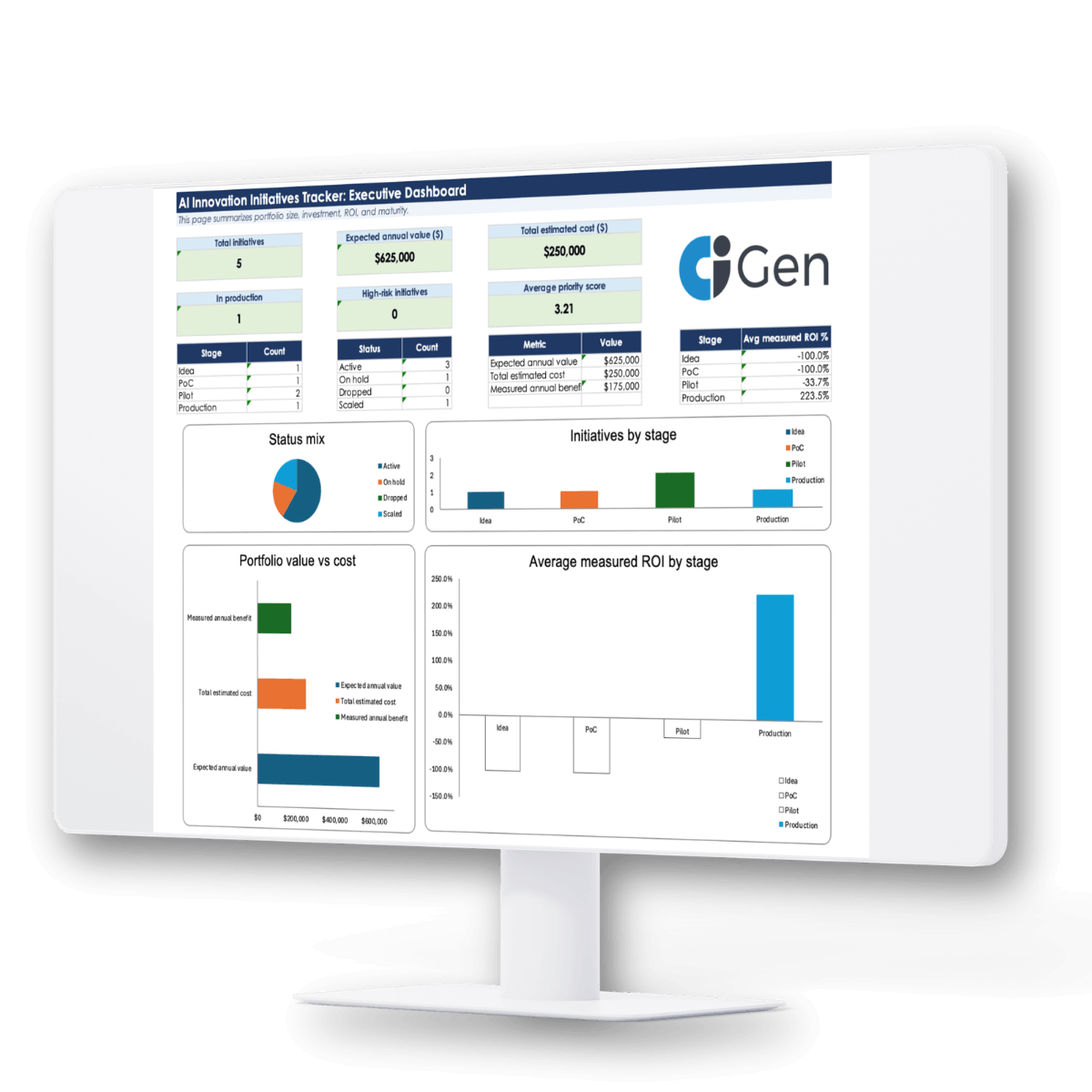
Dashboard & portfolio overview
Purpose:
Offers a consolidated view of the AI use case portfolio for quick decision-making.
Key data:
Number of initiatives by stage, total investment vs expected value, high-risk initiatives, top-performing use cases.
What it’s for:
Enables leadership to monitor portfolio health, identify bottlenecks, and prioritize initiatives without reviewing individual entries.
Using the AI initiatives tracker as a team
This tracker works best when used collaboratively across technical, business, and data teams. The goal is to maintain a shared view of AI initiatives, ensuring alignment on value, progress, and decision-making.
Define why each AI initiative matters, expected outcomes, and how success will be measured.
Add initiatives to the tracker with clear ownership, value estimates, and scope.
Update stages, costs, and outcomes to maintain visibility across the AI use case portfolio.
Evaluate initiatives based on ROI, effort, and risk to decide what to scale, adjust, or stop.
CIGen's AI adoption toolkit
The AI roadmap template is just one part of a broader toolkit designed to help organizations adopt AI responsibly, efficiently, and with measurable results.
These complementary tools guide teams through earlier and parallel stages of AI readiness: from evaluating organizational maturity to preparing data for model development.
Understand where your organization stands before you start building.
This interactive assessment helps teams evaluate their current AI maturity across strategy, data, technology, and governance dimensions. It highlights strengths, uncovers capability gaps, and recommends focus areas for scalable AI adoption.
Evaluate the quality, structure, and accessibility of your data.
Use this template to identify which datasets are AI-ready, where improvements are needed, and how to close gaps in collection, cleaning, and integration. It’s an essential resource for ensuring reliable model training and analytics outcomes.
Pick the right AI projects with maximum impact.
An insight article detailing how to systematically evaluate and prioritize AI use cases by business value, data availability, technical complexity and risk.
Ensure your AI initiative is compliant and secure from day one.
A checklist designed for AI projects, helping teams address data privacy, model transparency, auditability, bias mitigation and regulatory alignment.

Download this AI use case tracker for 100% observability
Do your AI initiatives move beyond PoC, or get stuck without clear direction? Without structured tracking, it becomes difficult to evaluate value, manage risk, and decide what to scale.
Download the AI use case tracker to bring visibility, control, and governance to your AI initiatives.


