
Gartner projects that over 40% of agentic AI projects will be cancelled by 2027, largely because of unclear ROI and weak risk controls. IBM's 2025 CEO study found that only 25% of AI initiatives delivered the ROI leadership expected. And in PwC's 2026 CEO Survey of more than 4,400 executives, just 12% reported hitting both a revenue gain and a cost reduction from AI.
At the same time, the businesses that get it right are seeing genuine returns: a median payback period of roughly 5.1 months on agent deployments, according to BCG and Forrester's 2026 research. The gap between those two outcomes rarely comes down to the underlying model or the engineering talent. It comes down to what happened (or didn't happen) before a single line of code was written.
That's the role of AI agent consulting: a short, structured phase in the AI agent development process where an outside specialist helps you figure out which problems are worth automating, whether your data and systems can actually support it, and who is best placed to build it. It typically costs a small fraction of a full implementation and takes days or weeks rather than months. Skip it, and you're statistically much more likely to end up funding one of those cancelled projects.
This guide covers why that step matters, what it actually involves, what it costs, and how to find a provider - including free, no-obligation workshops available through marketplaces like Microsoft Azure Marketplace that let you get expert input before you sign anything.
Why AI agent consulting is a strategic, money-saving step
Every AI agent project eventually asks the same four questions. Answering them with an experienced third party, before budget is committed, is what separates a project that pays back in months from one that gets quietly shelved a year later.
1. Use case prioritization - critical step of the AI agent development consultation
Most organizations don't have a shortage of ideas for where an AI agent could help; they have too many, with no reliable way to rank them. An aAI agent consulting service typically scores candidate use cases against factors like:
- Volume and repeatability of the task
- Clarity of the decision logic involved
- Financial or operational impact if automated
- Regulatory compliance and/or reputational risk if the agent gets it wrong
- Data availability and quality for that specific workflow
This matters because the highest-visibility idea in the room is often not the highest-ROI one. Consultants who work across many clients bring pattern recognition; they've usually already seen which categories of use case (customer service deflection, internal ops copiloting, structured document processing) tend to pay back fastest, and which ones stall in production regardless of company.
Not ready for a fully-fledged consultation yet? gauge your
2. Understanding your data sources
An agent is only as good as what it can see. Before any development work starts, a consulting engagement maps:
- Where the relevant data actually lives (CRM, ERP, ticketing systems, spreadsheets, shared drives)
- Whether it's structured, semi-structured, or locked in documents and PDFs
- Data quality, freshness, and ownership
- Integration and API access constraints
- Compliance and data residency requirements
This audit alone frequently changes the scope of a project, sometimes shrinking it to something achievable in weeks, sometimes revealing that a data cleanup project needs to happen first.
3. Current state of technical maturity
Two companies can want the same agent and need completely different roadmaps to get there, depending on their starting point. A maturity assessment looks at existing infrastructure, cloud environment, API coverage, internal AI/ML skills, and governance processes (who approves what the agent is allowed to do autonomously). This is the step that determines whether you need a lightweight pilot or a longer platform-build phase first; it's also where the case for bringing in an AI ML consultancy rather than a generalist vendor becomes clear, since maturity assessments benefit from people who've built and shipped ML systems, not just prompted a model.
4. Testing before you commit to a fully-fledged AI agent development contract
Good AI consulting engagements end with a scoped proof of concept or pilot design, not just a slide deck. That means defining success metrics up front, agreeing on a small, representative test population, and setting a go/no-go bar before wider investment happens. This is the single biggest lever against the "40% of projects cancelled" statistic; most of those cancellations trace back to a project that scaled straight past this step.
5. Finding the right AI consulting company
Perhaps the most underrated output of a consulting phase: it de-risks vendor selection. An independent consultant can help you write a scope of work that's specific enough to get comparable quotes, evaluate whether a prospective AI agent company actually has relevant delivery experience versus a generic AI practice, and flag where a vendor's proposal is over-scoped (or under-scoped) relative to your actual maturity and use case.
Put together, these five steps are why an Artificial Inteligence agent consulting phase, often just 1 to 4 weeks, routinely saves multiples of its own cost in avoided rework, avoided wrong-vendor selection, and avoided cancelled projects.
What AI agent consulting actually looks like: a practical guide
Where to find AI agent services company
Providers generally fall into a few categories, and the right one depends on your scale and starting point:
- Global system integrators and Big 4 firms: strong for large, multi-year, compliance-heavy transformations; typically the highest cost and longest lead times.
- Specialized AI/ML consultancies: an AI consultancy focused specifically on applied AI and agents, usually mid-sized teams with hands-on delivery experience across multiple industries. Often the best fit for mid-market and growth-stage companies that want senior expertise without enterprise-consulting overhead.
- Boutique AI agent development consulting firms: smaller, deeply technical teams that combine strategy with hands-on build capability, useful when you want the same team to advise and then implement.
- Cloud marketplace listings: Microsoft Azure Marketplace, AWS Marketplace, and Google Cloud Marketplace all list vetted AI agent services providers, often with published rate cards, customer reviews, and, notably, free discovery workshops (more on this below).
- Freelance and fractional consultants: useful for narrow, well-defined questions, less suited to full readiness assessments.
What's іncluded: Typical AI agent services in a consulting engagement
A well-scoped consulting engagement usually includes:
- Discovery workshops with stakeholders across business and IT
- Use case identification and prioritization matrix
- Data and systems audit
- Technical and organizational maturity assessment
- Risk, compliance, and governance review
- A scoped pilot or proof-of-concept plan with defined success metrics
- Vendor/build-vs-buy recommendation
- A roadmap document with phased investment stages
Not every engagement includes every item; narrower workshops focus on one or two of these, while a full readiness assessment covers all of them.
How much does AI agent consulting cost? Understanding AI consulting rates
AI consulting rates vary significantly by provider type and region, but as a general guide:
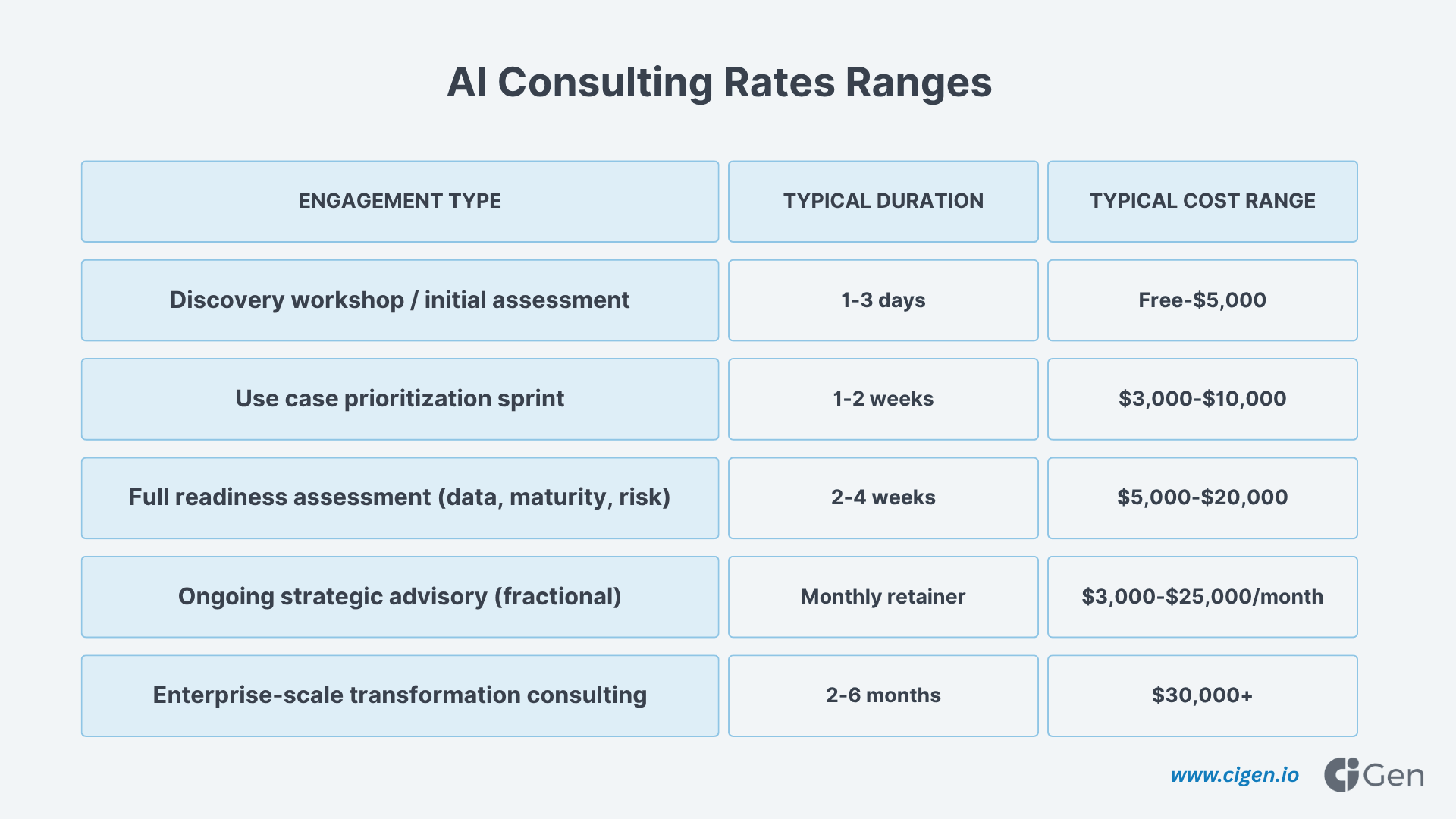
Rates depend heavily on consultant seniority, region, and whether the engagement is bundled with implementation. Boutique and specialized firms often price per-engagement rather than by hourly rate, since a scoped deliverable is easier to evaluate against ROI than an hours estimate. When comparing quotes, ask providers to break out what's included per the deliverables list above: a $5,000 "assessment" and a $40,000 "assessment" should not be covering the same scope.
What deliverables should you expect?
At minimum, a legitimate AI agent consulting engagement should hand you tangible artifacts, not just a conversation:
- A written use case prioritization matrix, ranked and scored
- A data readiness report identifying gaps
- A technical maturity scorecard
- A pilot design document with defined KPIs and a go/no-go threshold
- A vendor or build recommendation with rationale
- A phased roadmap with rough cost bands for each stage
If a proposal doesn't name concrete deliverables, that's a signal to ask more questions before signing.
AI agent business impact: What good looks like
When this process is done properly, the business impact shows up in two places: fewer abandoned projects, and faster payback on the ones that proceed. Organizations that pair a proper consulting phase with disciplined pilot testing are the ones most likely to land inside that roughly 5-month median payback window rather than becoming one of the cancelled-project statistics. For any AI agent business case going to a budget committee, having this documentation in hand, rather than a vendor's optimistic projections alone, makes the internal approval conversation considerably easier.
Start with a conversation, not a contract
Before committing budget to a build, it's worth taking advantage of the free, no-obligation consulting workshops available through cloud marketplaces like Microsoft Azure Marketplace and comparable platforms. These sessions are designed to give you real insight into your use cases and data readiness, and let you get a feel for a potential supplier's expertise, without any commitment on your side.
CIGen offers exactly this through its AI Adoption Strategy workshop, listed on Azure Marketplace:
Book the free AI Adoption Strategy consulting workshop →
It's a no-obligation way to prioritize your use cases, understand your data readiness, and find out whether CIGen is the right long-term partner for your AI agent journey, before you spend a dollar on development.