
Cloud cost optimization tracker that helps keep costs under control
Gain structured visibility into cloud spending, optimization opportunities, and governance gaps across Azure environments with a practical cloud cost optimization template built for engineering and operations teams.
Track cloud cost savings initiatives, monitor workload-level spend, improve cloud cost reporting, and organize optimization backlogs without relying solely on native billing dashboards.
How cloud cost governance tracker
helps businesses improve cloud spending oversight
Consolidate cloud services cost data across environments, workloads, and subscriptions into a structured operational reporting model.
Log rightsizing opportunities, idle resources, retention issues, and optimization initiatives in a centralized backlog.
Track resource tagging compliance, identify ownership gaps, and improve cloud cost governance across engineering teams.
Monitor workload-level spend trends, budget variance, and operational cost anomalies across production and non-production environments.
Track unit economics such as cost per transaction, deployment, API request, or active user to support engineering and financial decisions.
Prioritize cloud cost reduction initiatives using ROI calculations, implementation effort estimates, and optimization status tracking.
Cloud cost optimization tracker:
key tracking dimensions
A structured cloud cost optimization tracker helps organizations improve visibility into infrastructure spending, reduce fragmented reporting practices, and create a more consistent approach to cloud cost governance. Instead of relying only on native billing dashboards, teams gain an operational framework for tracking optimization initiatives, ownership, budgeting, and efficiency metrics across environments and workloads.
These dimensions reflect the core areas that should be monitored to support sustainable cloud cost optimization management and long-term operational efficiency.
Track production, staging, development, and sandbox spending separately to identify disproportionate growth patterns and budgeting issues.
Break down infrastructure costs by application, platform, service, or business capability to support more accurate cloud cost analysis and prioritization.
Assign technical and business ownership to workloads, subscriptions, and optimization initiatives to improve governance consistency.
Identify resources missing required metadata such as environment, owner, application, or cost center tags.
Improve consistency across engineering teams by defining mandatory tagging structures and operational reporting requirements.
Support more accurate cloud cost reporting and simplify internal reviews, budgeting discussions, and optimization assessments.
Compare planned budgets against actual cloud services cost trends to identify overspending risks earlier.
Monitor unexpected spikes related to storage growth, compute scaling, excessive logging, or underutilized resources.
Create centralized reporting views that provide leadership and engineering teams with actionable visibility into cloud cost efficiency and spending behavior.
Log oversized virtual machines, underutilized databases, excessive storage allocations, or inefficient scaling configurations.
Organize cloud cost reduction initiatives into a prioritized backlog with estimated savings, implementation effort, and ownership assignment.
Evaluate optimization candidates based on expected savings, implementation complexity, operational risk, and business impact.
Measure infrastructure efficiency against platform activity and workload utilization.
Track how infrastructure spending evolves relative to platform growth and customer adoption.
Monitor long-term relationships between cloud spending, workload growth, operational performance, and business expansion to support more sustainable cloud cost optimization decisions.
Struggling to keep cloud spending under control?
Download the cloud cost control tracker template to monitor infrastructure costs, improve governance, organize optimization initiatives, and identify cloud cost savings opportunities across workloads and environments.
Managing Azure cloud spending:
key practices for sustainable cost optimization
As Azure environments grow, cloud spending often becomes fragmented across subscriptions, workloads, teams, and environments. Without a structured approach to cloud cost monitoring and governance, organizations frequently struggle with limited visibility, inconsistent ownership, and delayed optimization decisions.
These practices help establish a more sustainable foundation for Azure cloud cost optimization, operational reporting, and long-term infrastructure efficiency.
Consolidate cloud cost reporting
Maintain a unified reporting structure for subscriptions, environments, and workloads instead of relying solely on isolated Azure billing views.
Standardize workload ownership
Assign technical and business owners to workloads, resource groups, and optimization initiatives to improve accountability and governance consistency.
Organize cloud cost data operationally
Use structured tracking models to separate infrastructure costs by application, platform, department, or business capability.
Define mandatory tagging standards
Establish consistent tags for environment, application, owner, cost center, and workload criticality across all Azure resources.
Monitor tagging compliance regularly
Track missing or inconsistent tags through recurring governance reviews to improve reporting accuracy and allocation visibility.
Align governance with operational reporting
Ensure tagging structures directly support budgeting, optimization tracking, and executive reporting requirements.
Maintain an optimization backlog
Track rightsizing opportunities, idle resources, storage retention issues, and underutilized infrastructure in a centralized optimization log.
Prioritize initiatives by business impact
Evaluate optimization candidates based on estimated savings, implementation effort, operational risk, and expected ROI.
Review optimization progress regularly
Establish recurring monthly or quarterly reviews to monitor implementation progress and validate realized cloud cost savings.
Measure unit economics
Track metrics such as cost per transaction, cost per active user, cost per deployment, or cost per API request to evaluate workload efficiency.
Monitor environment-level spending trends
Compare production and non-production growth patterns to identify unexpected increases or inefficient resource usage.
Detect operational anomalies earlier
Review spending spikes related to scaling behavior, excessive logging, unmanaged storage growth, or persistent idle infrastructure.
Use Azure-native optimization recommendations
Leverage Azure Advisor and Azure Cost Management to identify savings opportunities and monitor spending trends.
Support reporting with structured governance tracking
Use operational governance trackers to organize optimization initiatives, ownership, backlog prioritization, and implementation status outside native dashboards.
Establish recurring governance reviews
Create a repeatable process for reviewing budgets, optimization progress, tagging compliance, and workload-level cloud cost efficiency across engineering teams.
Inside the cloud cost optimization template:
monitor, govern, and optimize cloud infrastructure spending
The cloud cost governance tracker helps engineering and operations teams organize cloud cost reporting, monitor optimization opportunities, and improve visibility across workloads, environments, and subscriptions. Each tab is designed to support a specific aspect of cloud cost optimization management and can be used independently or together as part of a broader governance workflow.
Cloud inventory & workload registry
Purpose:
Central working sheet for tracking workloads, environments, subscriptions, ownership, and monthly cloud services cost.
Key data:
Environment, workload name, business owner, hosting model, monthly spend, budget allocation, optimization status, trend analysis.
What it’s for:
Provides a structured operational inventory that improves cloud cost visibility and supports more accurate reporting and governance.
Resource tagging compliance tracker
Purpose:
Monitors tagging completeness and governance consistency across Azure resources and workloads.
Key data:
Environment tags, application tags, owner assignments, cost centers, compliance percentage, remediation status.
What it’s for:
Helps organizations improve cloud cost governance, allocation accuracy, and operational reporting readiness.
Cost by environment & workload reporting
Purpose:
Tracks cloud cost distribution across production, staging, development, and individual workloads.
Key data:
Monthly spend by environment, workload-level cost analysis, budget variance, trend monitoring, infrastructure growth patterns.
What it’s for:
Supports cloud cost monitoring and helps teams identify areas with disproportionate spending growth or inefficient resource usage.
Unit economics & cloud cost efficiency tracking
Purpose:
Connects infrastructure spending with operational and business activity through measurable efficiency metrics.
Key data:
Cost per transaction, cost per active user, cost per API request, workload efficiency indicators, platform utilization trends.
What it’s for:
Helps engineering and leadership teams evaluate cloud native cost optimization efforts using operational KPIs instead of raw spending alone.
Rightsizing & optimization backlog
Purpose:
Centralizes cloud cost reduction initiatives and optimization opportunities into a structured operational backlog.
Key data:
Oversized resources, estimated savings, implementation effort, ROI calculations, optimization priority, ownership tracking.
What it’s for:
Supports continuous cloud cost optimization by helping teams organize and prioritize savings initiatives more consistently.
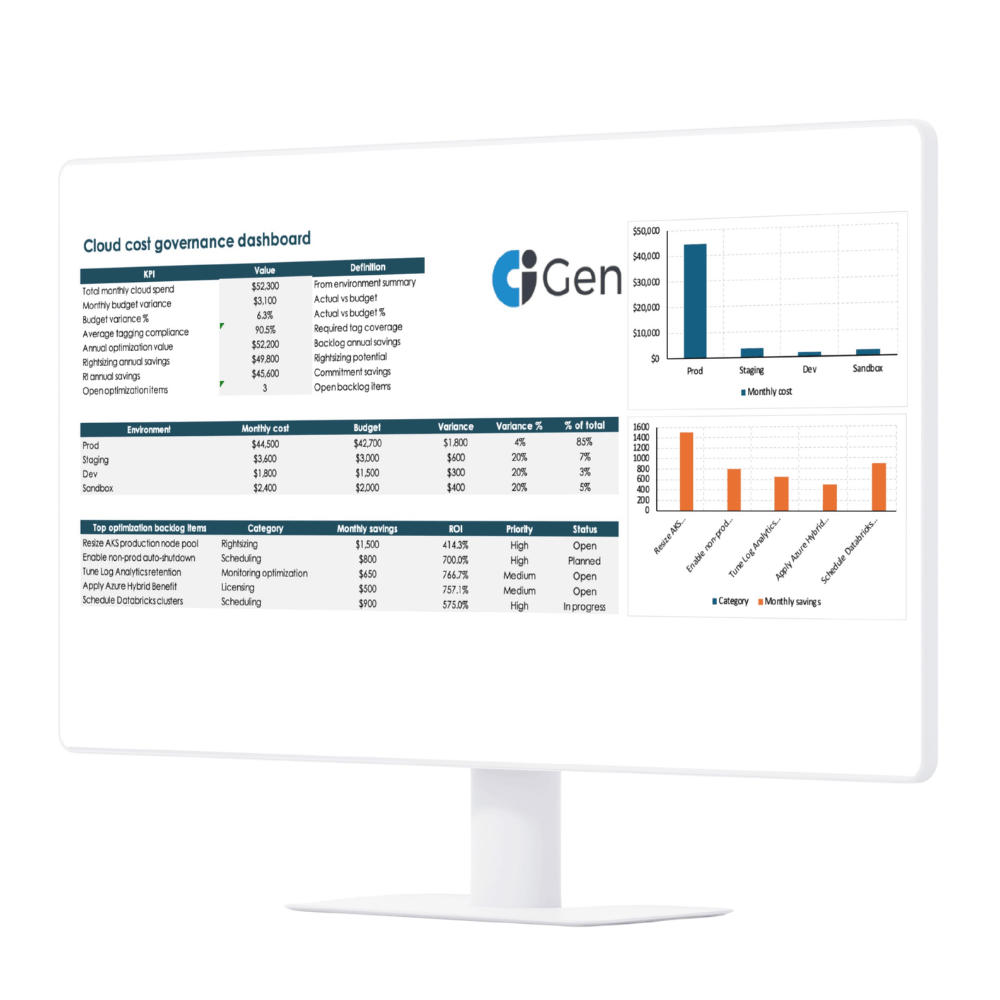
Dashboard & executive reporting overview
Purpose:
Provides a consolidated operational and financial view of cloud infrastructure spending and optimization progress.
Key data:
Total monthly spend, tagging compliance rate, optimization pipeline value, environment-level costs, realized cloud cost savings.
What it’s for:
Enables leadership teams to monitor cloud cost efficiency, governance maturity, and optimization progress through centralized reporting dashboards.
Using the Cloud Cost Optimization tracker as a team
This tracker works best when used collaboratively across engineering, operations, finance, and platform teams. The goal is to maintain a shared operational view of cloud spending, optimization priorities, governance gaps, and infrastructure efficiency across Azure environments.
Define technical and business ownership for subscriptions, workloads, and environments to improve accountability for cloud cost control and optimization decisions.
Centralize workload inventories, environment-level spending, tagging compliance, and budget tracking into a shared operational reporting model.
Track spending changes, budget variance, cloud storage cost growth, and workload-level anomalies to improve cloud cost monitoring and visibility.
Capture rightsizing candidates, idle resources, retention issues, and inefficient infrastructure configurations within a structured optimization backlog.
Prioritize optimization efforts based on estimated savings, implementation effort, operational risk, and expected ROI to support more effective cloud cost optimization management.
Conduct recurring reviews of tagging compliance, cloud cost reporting accuracy, optimization progress, and workload efficiency across engineering teams and environments.
Track unit economics such as cost per active user, cost per transaction, or workload utilization to better understand long-term cloud cost efficiency as infrastructure scales.
Check out more templates from our CTO/CIO toolkit
The cloud cost optimization tracker is part of a broader toolkit designed to help technology leaders improve operational visibility, support modernization initiatives, and bring more structure to complex engineering and infrastructure decisions.
These practical templates and frameworks are created to support common operational challenges across cloud governance, application modernization, AI adoption, reporting, and technology strategy.
Plan frontend modernization initiatives with greater technical and operational clarity.
This framework helps engineering teams evaluate whether a frontend application is better suited for refactoring, replatforming, or full architectural redesign based on technical debt, business impact, scalability, maintainability, and modernization risk.
Useful for:
- Legacy frontend modernization planning
- Technical debt assessment
- Framework migration discussions
-Modernization ROI evaluation
- Architecture decision support
Explore the tool:
Frontend modernization decision matrix
Organize, monitor, and prioritize AI initiatives across the organization.
The tracker helps teams maintain visibility across AI use cases, monitor implementation stages, evaluate expected versus actual outcomes, and improve governance around AI adoption initiatives.
Useful for:
- AI portfolio visibility
- ROI and value tracking
- AI governance workflows
- Initiative prioritization
- Executive reporting
Explore the tool:
AI initiatives tracker

Download cloud cost control tracker for better governance
Are cloud infrastructure costs becoming harder to track across environments, workloads, and teams?
Without structured cloud cost monitoring and governance, organizations often struggle to identify optimization opportunities, maintain reporting consistency, and improve long-term cloud cost efficiency.
Download the cloud cost optimization tracker to organize workload-level spending, monitor cloud cost savings initiatives, improve cloud cost reporting, and bring more operational visibility to Azure infrastructure management.


