You described what you wanted, an AI tool built it, and now it works. The screens look finished, the sign-up flow runs, and the friends who tested it liked what they saw. Tools like Lovable, Bolt, Replit and Cursor have made that moment possible for people who have never written a line of code, and that is a genuine shift in who gets to build software.
The harder question comes next: is the app ready for paying customers, their personal data, and the people who will try to break it? A vibe-coded app can pass every test you know how to run and still fail on its first day with real users, because the problems that matter most in production are the ones you can't see on the screen. This article explains why "working" and "production-ready" are different things, what tends to go wrong when vibe-coded apps go live, and the seven gaps founders most often miss before launch.
Why a working vibe-coded app isn't automatically production-ready
When an AI tool builds your app, it solves the problem you described: make this screen, save this form, show this list. It is very good at that. What it isn't doing, unless you know exactly what to ask for, is planning for everything that happens once strangers arrive. In a demo, every user is you or someone you trust, the data is fake, and nothing is at stake if a page breaks. In production, users make mistakes, a few act maliciously, real names and payment details sit in your database, and every outage costs trust you may not get back.

That gap shows up clearly in the research on AI-generated code. Veracode has tracked more than 100 large language models on security-sensitive coding tasks, and its 2026 GenAI Code Security Report found that AI-generated code passes syntax checks almost every time, yet only 56% of samples are secure. Without security-specific guidance, models introduce a known flaw nearly 44% of the time. That rate has barely moved in a year, and Veracode found that model size has no impact on security performance. In plain terms, AI-generated code almost always runs, but only about half the time is it safe.
Professional developers have reached a similar conclusion from the inside. In Stack Overflow's 2026 Developer Survey, which drew more than 30,000 responses, nearly half of developers said they trust AI when they can verify its work, and just 6.6% said they would trust it for important decisions. The people who use these tools every day treat their output as something to check, not something to ship.
None of this means vibe coding is a mistake. It means a working app is a strong first draft, and the distance between a draft and a product is mostly invisible from the outside. If you want a closer look at where AI coding assistants genuinely help and where they fall short, our analysis of AI-assisted coding in practice covers the engineering trade-offs in more depth.
Vibe coding security risks: what goes wrong when real users arrive
The clearest evidence of the gap comes from what researchers and founders have found once apps were live. These aren't hypothetical scenarios. They involve real applications built on popular platforms, many of them by founders who believed they were ready to launch.
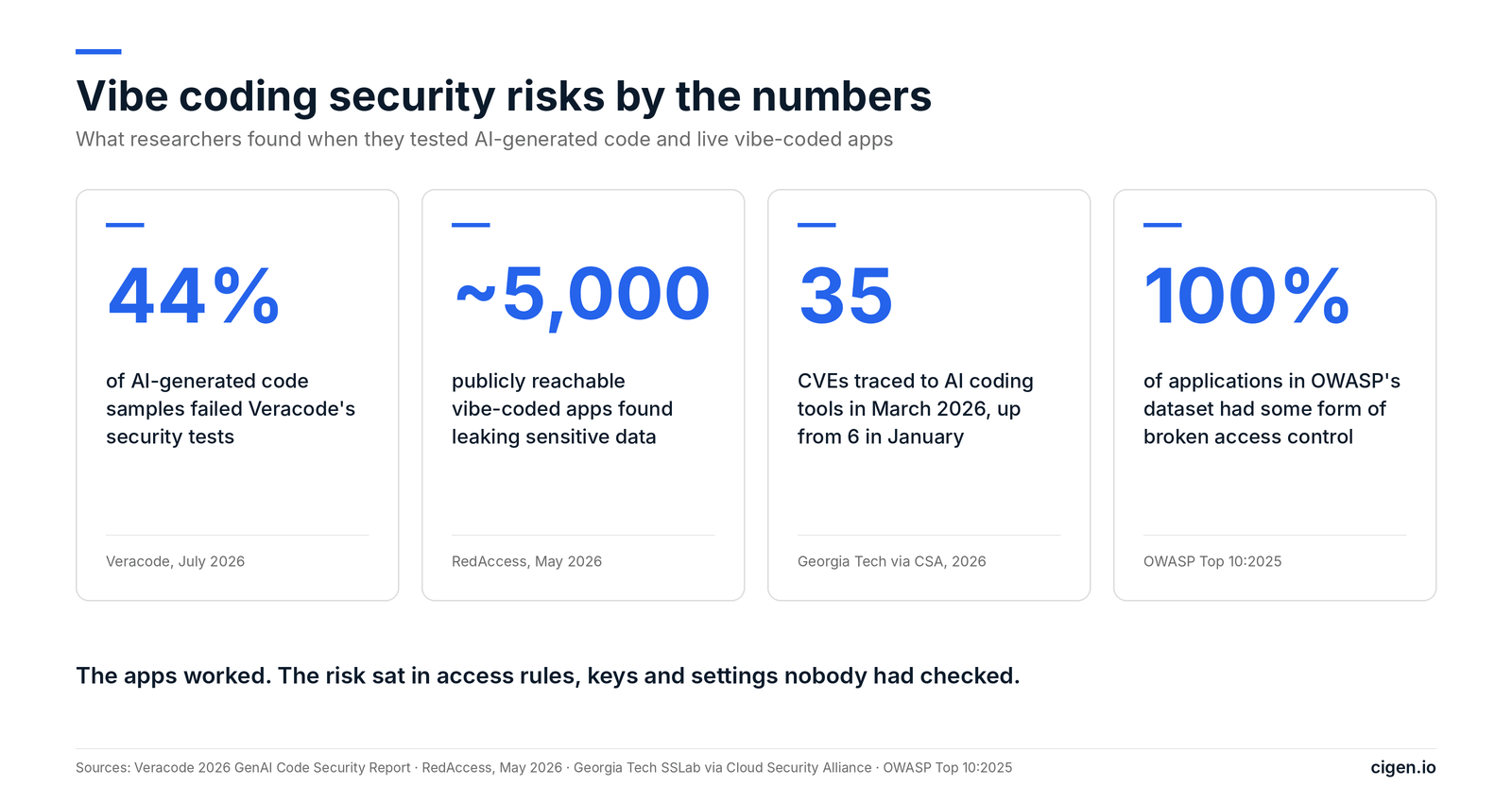
In May 2026, the Israeli security startup RedAccess reported that of roughly 380,000 publicly accessible apps and assets built with vibe coding tools, about 5,000 were leaking sensitive corporate or personal data. The exposed material included a hospital app holding summaries of doctor-patient conversations and internal financial information from a bank. Replit's CEO responded that it is expected for public apps to be reachable on the internet. That is technically true, and it is exactly the problem: an app that is public by default is only as private as the rules someone remembered to set.
Sometimes the weak point is the platform itself. In April 2026, a security researcher disclosed that a flaw in Lovable's API let anyone with a free account pull other users' source code and database credentials from projects created before November 2025. The issue had been reported through Lovable's bug bounty programme 48 days earlier. Lovable's first public response was that it had not suffered a data breach and that the exposure was intended behaviour for public projects; later that day it issued a partial apology. Whatever you make of that position, it tells you where the accountability lands: you need to know what your platform treats as public, because if customer data leaks, the consequences are yours.
The trend is moving in the wrong direction. Georgia Tech's Vibe Security Radar, which tracks published vulnerabilities (CVEs) traced back to code written with AI coding tools, counted 6 in January 2026, 15 in February and 35 in March, according to a Cloud Security Alliance research note. The researchers treat these confirmed cases as a floor and estimate the real number is five to ten times higher.
Not every failure is a breach. In April 2026, the founder of PocketOS, a software platform for car rental businesses, reported that an AI coding agent working in Cursor deleted the company's production database and all of its volume-level backups in a single API call to its hosting provider. It took nine seconds. Because the backups sat on the same storage volume as the data, the company had to restore from a three-month-old copy while customers rebuilt bookings by hand from payment and email records. For founders, the lesson is that an AI tool with access to your live system can do real damage in seconds, and safety nets such as separate backups and a way to undo changes only exist if someone has set them up.
Across all four cases, the pattern is the same. The apps worked. The failures sat underneath, in access rules, configuration and operational safeguards that nobody had checked, and those hidden layers are where the next section focuses.
Seven production readiness gaps most vibe-coded apps share
The issues below come up again and again when vibe-coded apps move toward real customers. You don't need to be technical to understand them, and for most of them you don't need to be technical to start asking the right questions.
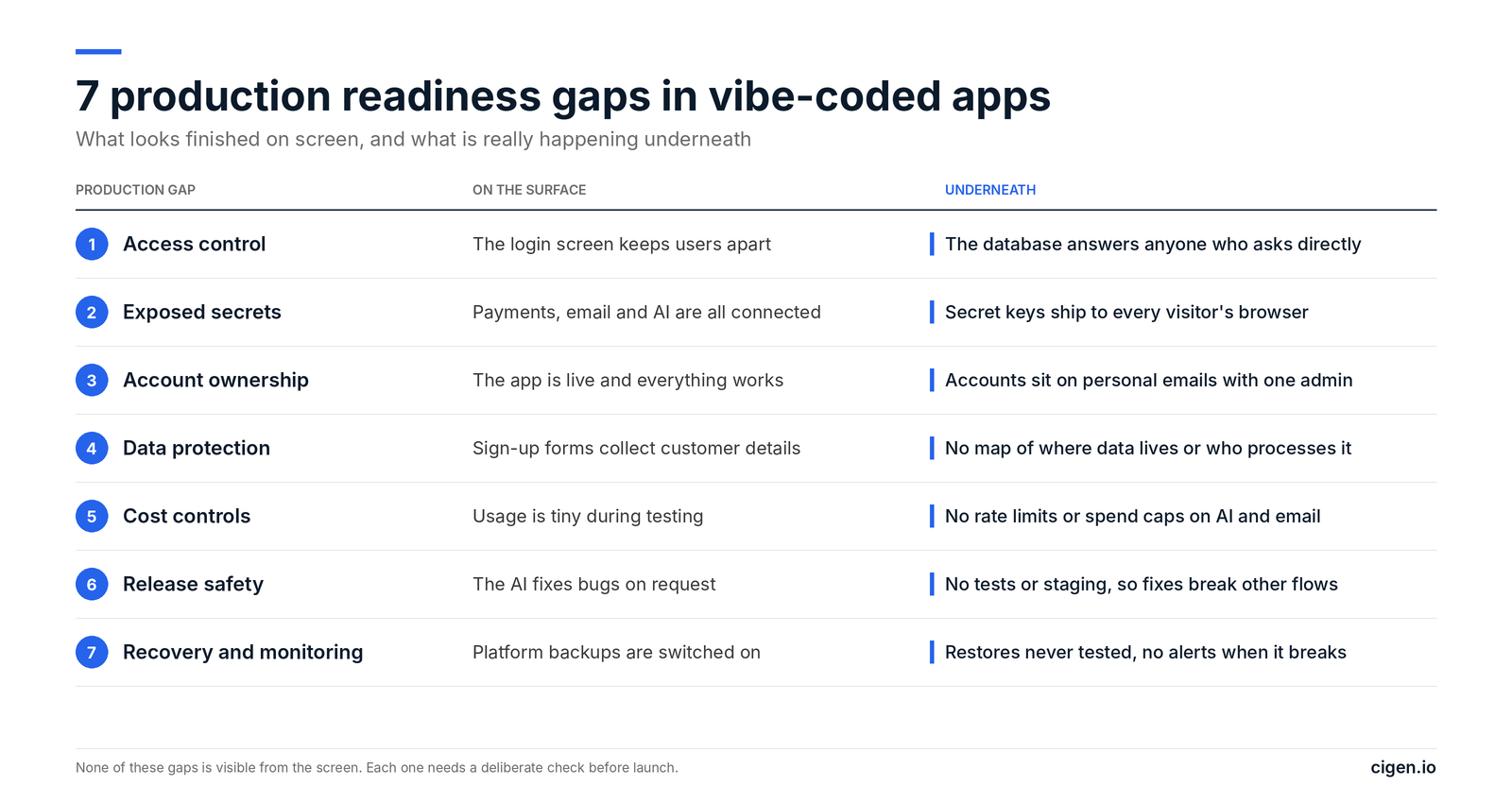
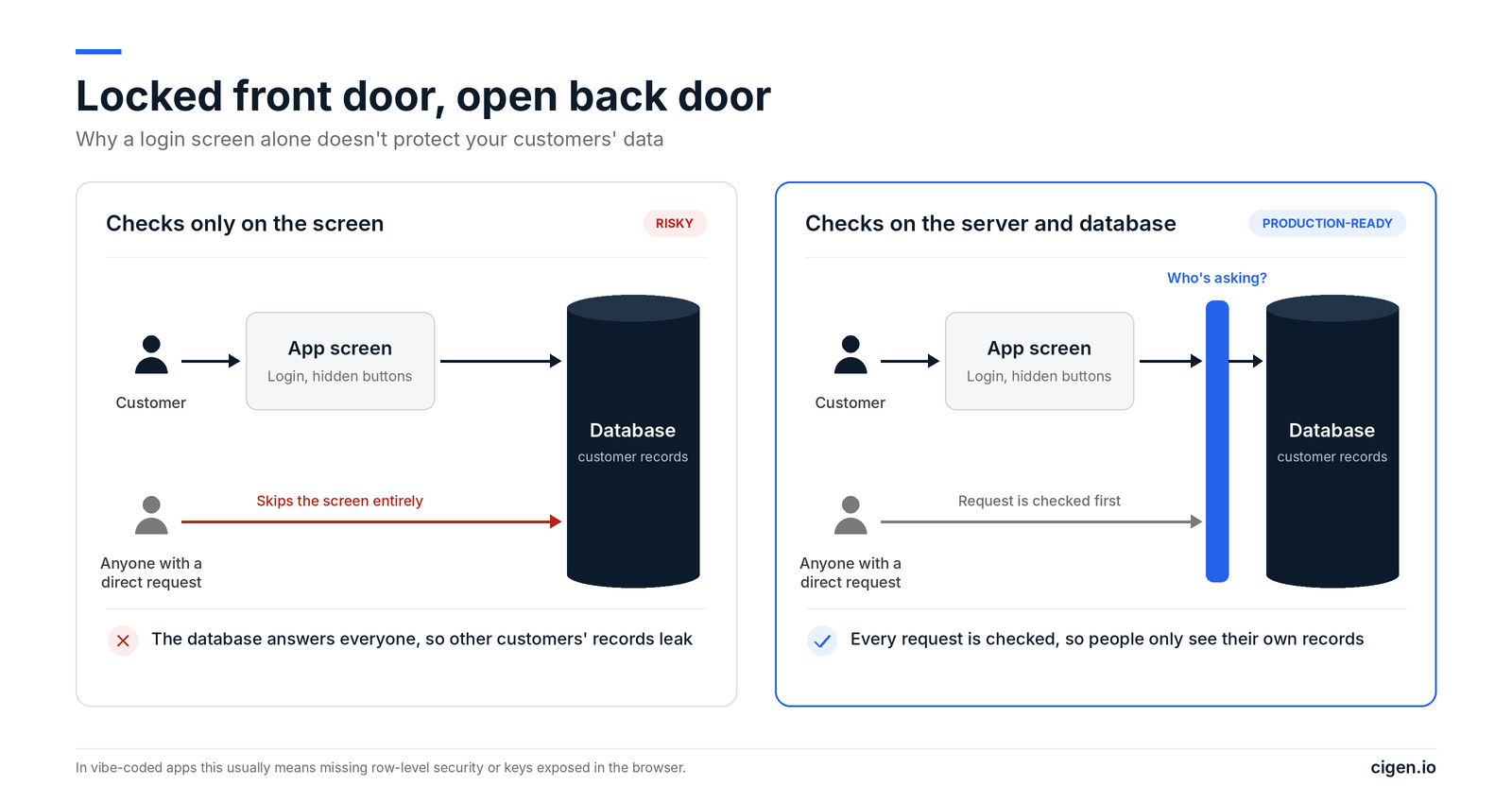
1. The front door is locked, but the back door isn't
Your app shows a login screen and hides admin buttons from regular users, so it looks secure. But the screen is only the front of the app. Behind it sits a database and a set of functions that answer requests directly, and if those don't check who is asking, anyone who knows how to send a request can skip the screen entirely. Security professionals call this broken access control, and it ranks first in the OWASP Top 10:2025. In OWASP's data, every single application tested had some form of it.
In vibe-coded apps, the most common version is a database without row-level security, the rules that decide which rows of data each user is allowed to see. Supabase, the database behind many vibe coding tools, states in its documentation that a table in an exposed schema without these rules is open to reading and writing by any role that has been granted access. A simple way to picture the risk: if you can log in as one customer, change a number in the web address and see another customer's order, so can anyone else on the internet.
2. Secret keys anyone can read
Most apps connect to other services through secret keys: the key to your database, your payment provider, your email service and your AI model. When AI tools wire these connections up quickly, keys often end up inside the code that is sent to every visitor's browser, where anyone can read them with the browser's built-in developer tools. Keys also get hardcoded into source code: when the 2026 Lovable flaw exposed project source code, it exposed the Supabase database credentials written inside it too.
The damage depends on which key leaks. Supabase warns that its secret key ignores all of your row-level security rules and should never be placed in a browser, a shipped application or source control. A leaked AI provider key lets someone else run up usage on your account, and a leaked payment or email key can be worse. If your app was built by prompting, the right question for whoever can check is simple: which keys exist, where do they live, and could a visitor see any of them?
3. You don't fully own what you built
This problem rarely appears in security articles, yet founders run into it all the time. A vibe-coded app is usually assembled across several accounts: the building platform, a database, hosting, a domain registrar, a payment provider, an email service and an AI provider. Often these sit under a personal email address, a freelancer's login or one person's credit card, with no second administrator anywhere.
That arrangement works until someone leaves, an account gets locked, or an investor asks who owns the product. If the person who set up the database can't be reached, neither can your data. Before customers depend on the app, every account it relies on should belong to the company, have at least two people with admin access, and be listed somewhere the team can find it. It is the least technical gap on this list and one of the most expensive to ignore.
4. Customer data you can't account for
The moment real people sign up, you are holding personal data. If your company is based in the EU or serves people there, the General Data Protection Regulation governs how you collect, store and protect that data, regardless of how the app was built. Many founders can't yet answer basic questions about their own product: what personal data it collects, where that data is physically stored, who can access it, and how to delete it when a customer asks.
AI features add another layer. If your app sends customer messages, documents or records to an AI model, that data leaves your system and goes to the AI provider. You need to know whether the provider stores it, uses it for training and where it processes it, and GDPR requires a written contract with any outside service that processes personal data on your behalf. The regulation also requires you to report a personal data breach to the regulator within 72 hours of becoming aware of it, where feasible, unless the breach is unlikely to put people at risk. That is hard to do if you'd only learn about a breach from a customer. Data questions are where a prototype and a business-ready product differ most, because nothing on the screen shows you the answers.
5. Costs that can run away overnight
In a demo, nobody presses a button 10,000 times. In production, bots will, and so will the occasional determined user. Without limits on how often someone can sign up, send messages or trigger an AI feature, a single script can generate thousands of requests, and if each one calls a paid AI model or sends an email, the bill arrives on your card. Spending caps with your AI and cloud providers act as the backstop that turns a surprise invoice into an early warning.
Payments deserve the same attention. If a customer double-clicks "Pay" on a slow connection, or your payment provider resends a confirmation, a quickly built app may process the order twice. Customers rarely forgive being charged twice, and refunds, disputes and support time add up quickly for a small team. Cost controls aren't glamorous, but they are often the difference between a bad day and a cash-flow problem.
6. Every fix breaks something else
Many founders know this one from experience. You ask the AI to fix a bug on the checkout page, and the profile page stops working. AI tools often rewrite more code than a change requires, and without automated tests nothing catches what broke along the way.
Two safeguards make the difference in production. The first is a small set of automated tests for the flows that matter most, such as sign-up, login and payment, that run before every change goes live. The second is a separate staging copy of the app, where changes are tried out before they reach real customers. The PocketOS incident adds a third rule: an AI agent should not hold credentials that let it change or delete your live database without a human approving it. Without these safeguards, every update is effectively tested by your customers.
7. No way back, and no one notices when it breaks
Most vibe-coded apps have some form of backup, often switched on by default by the platform. Far fewer have ever restored one. A backup you have never tested is a hope rather than a plan, and the worst time to discover it doesn't work is the day you need it. Where backups live matters as well: PocketOS lost its recent backups because they sat on the same storage volume as the database that was deleted. The same applies to undoing a bad release: if a change breaks the app at 11 p.m., how quickly can you get back to the version that worked?
The other half of the problem is knowing that something is wrong. Without uptime monitoring and error alerts, the first sign of trouble is usually an email from an annoyed customer, or silence from the ones who simply left. Production apps also accumulate background jobs that nobody remembers creating, such as scheduled emails, data syncs and clean-ups, which can fail quietly for weeks. Agreeing who gets alerted, who responds and how customers can reach you is basic operations, and for a small team it can fit on a single page.
Taken together, these seven gaps explain why so many vibe-coded apps feel finished but aren't. None of them is visible from the screen, and none of them is solved by asking the AI to "make it secure." Each one needs someone to check it deliberately before customers arrive.
From a working prototype to a product customers can trust
Vibe coding is a legitimate way to reach a validated product faster and more cheaply than ever before. The prototype has done its job if it proved that people want what you built. What comes next is a different kind of work, closer to the discipline that separates an AI proof of concept from a system a business can rely on. In most cases that work is about checking and hardening what exists rather than starting over.
The most useful step is also the simplest: have someone who didn't build the app look at it with the gaps above in mind, and close the serious ones before you invite paying customers in. If your app handles payments, health or financial data, or customers whose own security teams will ask hard questions, an independent software systems audit gives you an outside view of the risks before your users find them for you.