The once contemporary tech ecosystem is doomed to become legacy sooner rather than later, if left untouched, even quicker so in the era of AI. A slower release cycle here, an unpatched dependency there,- until the cost of standing still quietly outpaces the cost of change. Continuous app modernization is a new norm for bigger corporations, where A/B tests are running 24/7 to push every measurable KPI to its highest. For the smaller players, app modernization is a precondition for survival, not merely driving the market share up. That's the moment an Application Modernization Roadmap stops being a "someday" initiative and becomes the most important document on a CTO's desk.
The numbers back this up. Roughly 70% of Fortune 500 software was built more than 20 years ago, according to McKinsey, a staggering amount of accumulated technical debt sitting underneath some of the world's largest organizations. And the cost of carrying that debt is real: companies spend an average of several million dollars a year just keeping outdated systems alive, according to CIO Dive, with nearly two-thirds spending over $2 million annually on upkeep alone.
This guide lays out a complete roadmap for getting your software systems up-to-date: what an effective software modernization roadmap actually contains, how the classic phases have evolved for an AI-driven 2026, and how to avoid the pitfalls that derail most modernization programs before they deliver value.
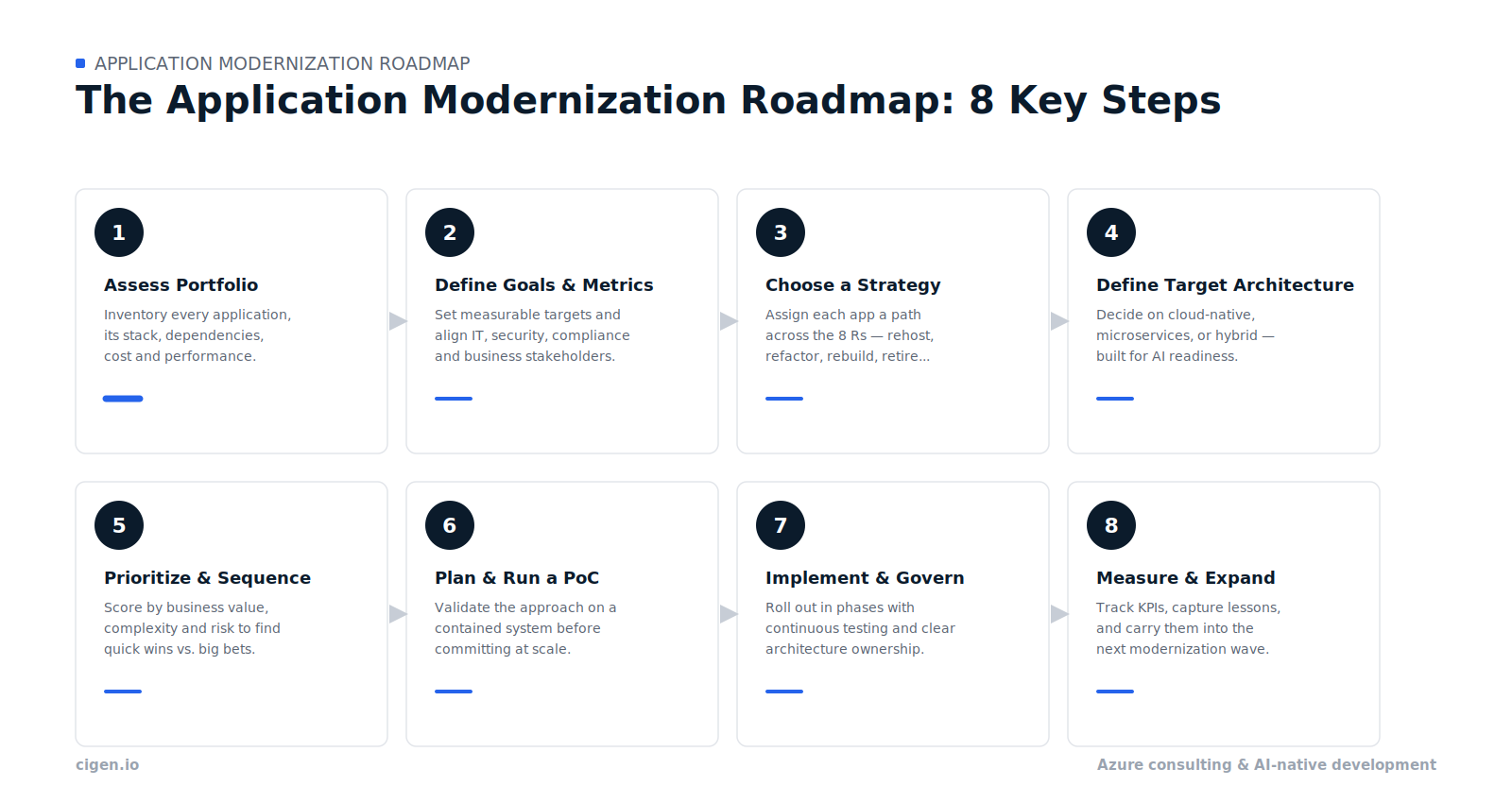
The Application Modernization Roadmap: 8 key steps
Every credible modernization roadmap, whether it comes from Microsoft's own guidance or an enterprise architecture team, breaks down into a similar sequence. What separates a roadmap that actually gets used from one that sits in a slide deck is whether each step produces a concrete deliverable. Here's the structure we recommend, with the artifact each phase should leave behind.
1. Assess your current application portfolio
Deliverable: an application inventory with technology stack, dependencies, performance data, and cost per application.
Before anything else, catalog what you have. This means listing every application in scope, its purpose, its technology stack, who depends on it, and what it costs to run and maintain. This step also surfaces the technical debt, security gaps, and integration fragility that often go unnoticed until something breaks.
2. Define business goals and success metrics
Deliverable: a written statement of what modernization is meant to achieve, with measurable targets attached.
"Improve performance" isn't a goal, but "cut checkout load time from five seconds to two" is. Tie every modernization initiative to a number leadership can track: cost reduction, time-to-market, uptime, or customer satisfaction. This is also the point to engage stakeholders across IT, security, compliance, and the business so the roadmap reflects shared priorities, not just an engineering wish list.
3. Choose a modernization strategy for each application
Deliverable: a strategy assignment (not a blanket decision) for every application in scope.
This is where most teams reach for the classic "Rs" frameworks: rehost, replatform, refactor, rearchitect, rebuild, retire, retain, and replace. The key insight, often missed, is that this isn't a ladder you climb from simplest to most advanced. It's a portfolio decision: different applications in the same organization can and should follow different paths depending on business value, risk, and technical condition.
We've written a full breakdown of how to choose between these strategies in Application Modernization Strategies: The 8 Rs Explained, including when each one is appropriate and how to weigh cost against business impact.
4. Define the target architecture
Deliverable: a description of the future-state architecture: cloud-native, microservices, serverless, or hybrid, and how it supports scalability, security, and AI readiness.
Decide what "modern" actually looks like for your organization before you start moving code. This step should explicitly account for how the target architecture will support future AI and data initiatives, since retrofitting AI-readiness into a freshly modernized system is far more expensive than designing for it up front.
5. Prioritize and sequence
Deliverable: a prioritization matrix scoring each application by business value, technical complexity, and risk.
Few organizations can modernize everything at once, and few should try. Identify the quick wins: low-effort, high-visibility systems that build momentum and stakeholder confidence,- alongside the handful of strategic, high-complexity systems that justify a deeper investment. Sequencing this way avoids both the trap of spreading effort too thin and the trap of attempting a "big bang" rewrite that rarely lands on time or budget.
6. Plan execution and run a proof of concept
Deliverable: a phased implementation plan with timelines, resource allocation, and a validated pilot.
Before committing to full-scale execution, run a proof of concept on a contained, lower-risk application. This surfaces hidden dependencies, undocumented business logic, and integration quirks while the cost of being wrong is still small.
7. Implement, monitor, and govern
Deliverable: a governance model with dashboards tracking deployment frequency, defect rates, and cost against the original business case.
Execution should be phased, not monolithic, with continuous testing (functional, performance, and security), built into every release. Governance here means more than project tracking; it means having a clear owner for architecture standards, security baselines, and change management across every workstream running in parallel.
8. Measure, expand, and continuously improve
Deliverable: a documented set of lessons learned, feeding directly into the next wave of modernization.
Modernization is an operating model, not just a single project with a finish line. Once the first wave proves out, expand to the next tier of applications, carrying forward the patterns, tooling, and institutional knowledge gained from the first cycle.
Where AI changes the roadmap in 2026
The eight steps above haven't fundamentally changed, but how fast and how confidently organizations move through them has. AI is now woven into nearly every phase of a serious AI application modernization roadmap, and treating it as an afterthought is itself becoming a competitive risk.
The financial case for this shift is becoming hard to ignore. Organizations that embed AI into their modernization programs report project acceleration of up to 40%, alongside cost reductions of 20–30%, according to McKinsey. Separately, IDC projects that nearly 60% of enterprise applications will depend on AI-driven features for efficiency and decision support as adoption matures, meaning a modernization roadmap that doesn't plan for AI integration is already planning for obsolescence.
That said, AI-driven modernization introduces its own risks that a roadmap needs to account for explicitly: unchecked AI-generated code can introduce subtle errors, and over-reliance on automation without architectural review or compliance checks can create new technical debt even faster than the old kind. The organizations getting this right tend to pair AI acceleration with human-in-the-loop validation at every stage rather than letting automation run unsupervised.
A maturity model for AI-driven modernization
Anthropic's Code Modernization Playbook frames this well: modernization capability isn't a single yes/no decision an organization makes, but a maturity curve it progresses along, with AI playing a different role at each stage. Adapting that lens for a roadmap context, four broad levels tend to show up in practice:
- Ad hoc. Legacy systems get attention only when something forces the issue: an outage, a vendor end-of-life notice, an audit finding. Documentation and test coverage are thin to nonexistent, and the knowledge needed to safely change the system lives in a handful of people's heads rather than in any artifact.
- Planned. Modernization makes it onto the budget and the calendar, but each initiative is still run as a one-off, rebuilding process and tooling from scratch every time. An inventory of applications usually exists at this stage, but it's rarely scored or prioritized with any rigor.
- Systematic. A dedicated team owns modernization as an ongoing function, working from repeatable processes and tracked metrics. AI tooling starts doing real work here, continuously scanning legacy code, surfacing undocumented business rules, and keeping a current, scored inventory of what's ready to modernize next.
- Optimized. AI agents take on much of the discovery and routine transformation work themselves, flagging modernization candidates with ROI estimates already attached, and executing lower-risk transformations with light human oversight. Technical leadership's time shifts almost entirely to architecture decisions and strategic sequencing rather than day-to-day execution.
Most enterprises today sit somewhere between "ad hoc" and "planned." Reaching "systematic" is a realistic 12–18 month target for most application modernization strategy programs, and worth treating as a milestone on the roadmap in its own right, not just a byproduct of getting through the eight steps once.
Realistic timelines and resourcing
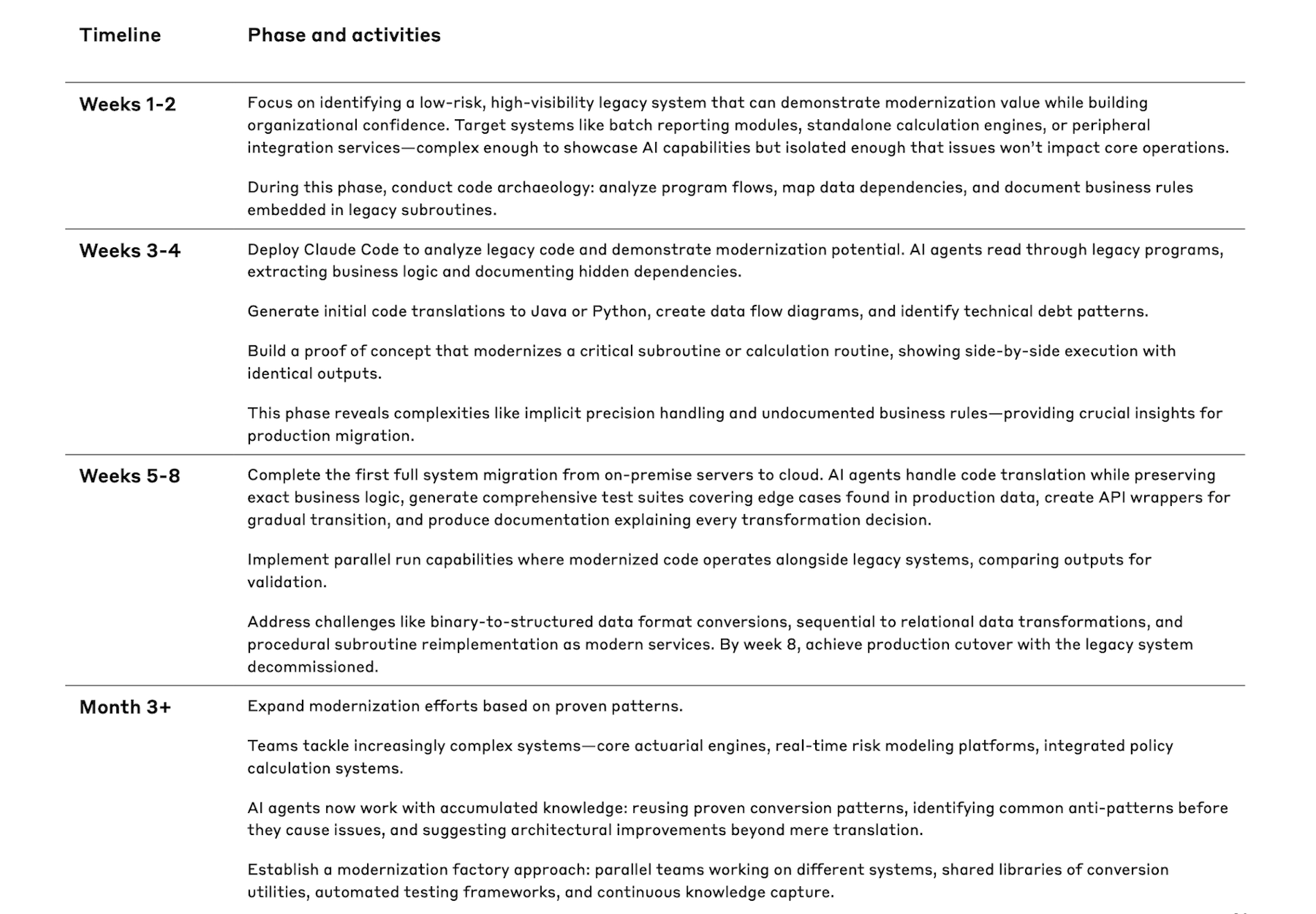
One of the most common reasons modernization roadmaps stall is a mismatch between expectations and reality on timeline and budget. Based on benchmarks compiled across recent industry data, here's roughly what each phase tends to require for a mid-sized application:
For a medium-scale modernization effort, a full cycle from assessment through stabilized production typically spans 12–18 months. AI-assisted execution is compressing the middle of that timeline meaningfully, but assessment, governance, and change management still take the time they take, regardless of how much automation is applied to the code itself.
Common pitfalls that derail a modernization roadmap
A few mistakes show up again and again across failed or stalled programs:
- Attempting a "big bang" rewrite
Large-scale rewrites without incremental milestones tend to run over budget and under-deliver, with no working software to show for months at a time.
- Skipping documentation
Undocumented business logic buried in legacy code is the single biggest source of surprises during execution.
- Ignoring governance and compliance early
Bolting on regulatory and security requirements after architecture decisions are locked in is far more expensive than designing for them from step one.
- Letting AI run unsupervised
AI accelerates modernization dramatically, but unchecked AI-generated code can introduce hallucinated logic or compliance gaps that slip into production without human review.
- Underestimating organizational resistance
Technology change without a change-management plan for the people using the system tends to stall in adoption, even when the technical migration succeeds.
Knowing what derails a modernization program is only half the battle, avoiding those pitfalls reactively still leaves you managing by exception. The practices below are what separate technical leaders who run modernization as a disciplined, instrumented program from those who run it as a string of disconnected projects that happen to share a budget line.
Best practices for keeping your roadmap on track
Whilst no two software modernization processes are the same, sticking to the below battle-proven best practices will help ensure a seamless journey.
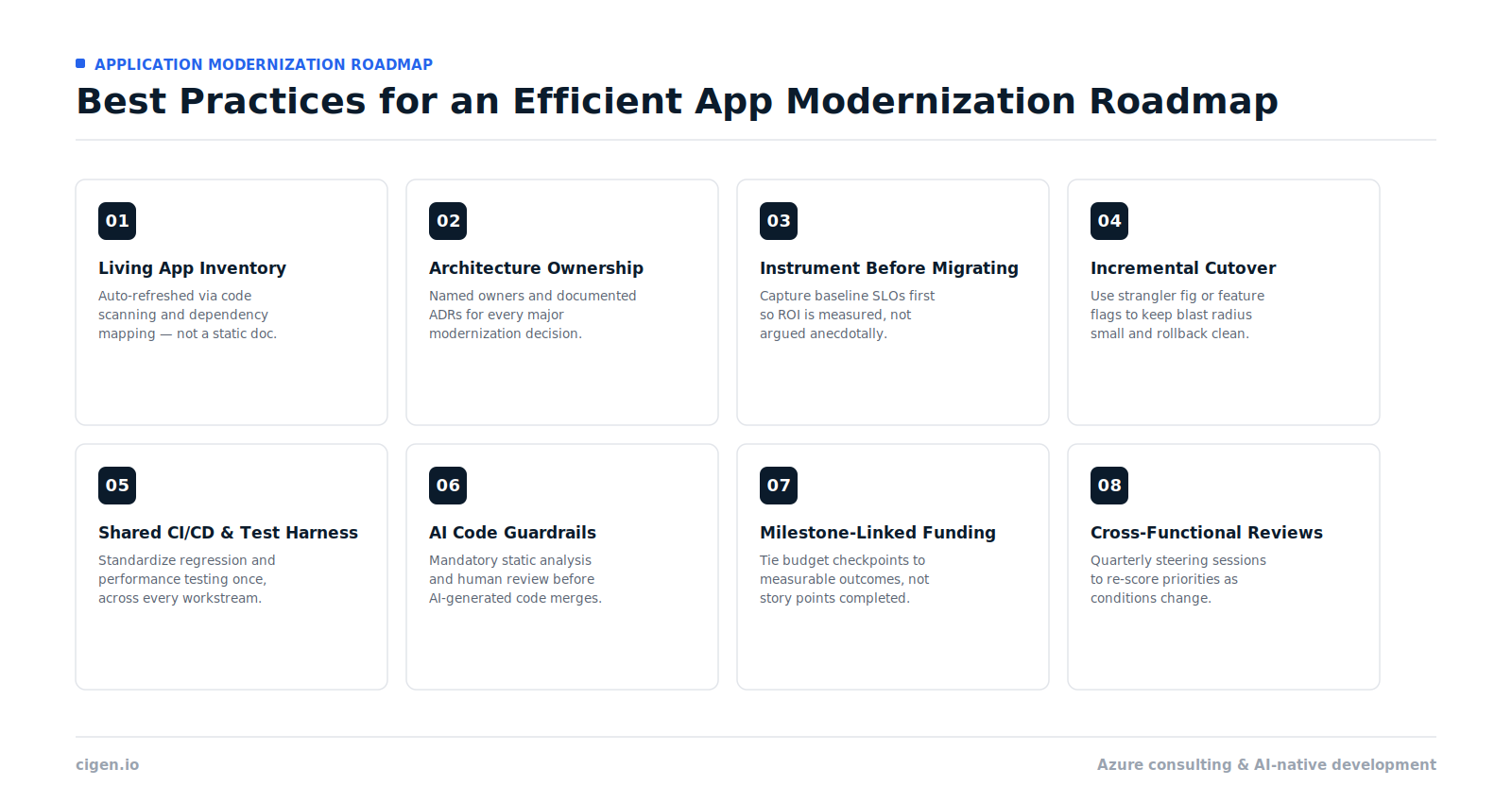
Build a living application inventory, not a static spreadsheet
Tie your portfolio assessment to an architecture registry or CMDB that's refreshed automatically through code scanning and dependency-mapping tools, rather than a document that goes stale the week after the audit. A roadmap built on a six-month-old inventory is making decisions on data that no longer reflects the system it's describing.
Establish architecture ownership and decision records before execution starts
Every major modernization call (which of the 8 Rs applies to a given application, which target architecture pattern to adopt, where to draw service boundaries), should have a named architecture owner and a documented Architecture Decision Record (ADR). This gives you a defensible audit trail when priorities shift six months in.
Instrument before you migrate, not after
Capture baseline SLOs: latency, error rate, deployment frequency, infrastructure cost per transaction,- for every system before modernization begins. Without a real pre-migration baseline, you're arguing for ROI anecdotally instead of pointing to a measured before-and-after.
Cut over incrementally using patterns like the strangler fig or feature flags, rather than a hard switchover
Routing traffic gradually from the legacy system to the modernized one keeps the blast radius of any single failure small and gives you a clean rollback path.
Build the CI/CD pipeline and test harness once, early, and share it across every workstream
Standardizing automated regression, contract, and performance testing before teams ramp up prevents velocity from degrading as more parallel workstreams launch, each with its own ad hoc tooling.
Put hard guardrails around AI-assisted code generation and transformation
Mandate static analysis, security scanning, and a structured human review checklist before any AI-generated or AI-transformed code merges to a main branch — particularly for logic touching compliance, authentication, or financial calculations.
Tie funding to milestone-linked business metrics, not just velocity
Agree a quarterly checkpoint structure with finance and business leadership up front, where continued funding is explicitly linked to measurable outcomes — cost per transaction, deployment frequency, defect escape rate.
Run a recurring architecture and priority review with a cross-functional steering group
A quarterly session with security, compliance, business stakeholders, and architecture leads to re-score the backlog as conditions change keeps the roadmap responsive instead of locked to assumptions made a year earlier.
None of these practices are exotic, most are standard engineering discipline applied deliberately to a modernization program. The organizations that get the most out of their roadmap are rarely the ones with the most sophisticated framework; they're the ones that actually instrument, govern, and revisit the plan as conditions change.
Turning your roadmap into results with CIGen
A roadmap is only as good as the team executing it. As a Microsoft Solutions Partner and ISO/IEC 27001-certified Azure consultancy, CIGen helps engineering and technology leaders move from a modernization plan on paper to a modernized, AI-ready application portfolio in production, combining Azure-native architecture expertise with AI-assisted development workflows to compress timelines without compromising governance or security.
If you're not sure where to start, our free Modernization Self-Assessment Tool evaluates your application's architecture, scalability, and technical debt and provides a quick report on modernization opportunities,- a useful first step before a deeper audit with our team.
Alternatively, you can kickstart your tech systems update processes by booking this FREE 4-hour application modernization assessment on Microsoft Marketaplce.
The bottom line
An effective application modernization roadmap is an ongoing discipline that connects legacy systems to business strategy, sequences risk deliberately, and increasingly leans on AI to move faster without losing control. Organizations that treat this tool as a living, AI-augmented program rather than a static plan will be the ones still competitive when the next wave of technical debt comes due.