
Every production defect has an origin point, and it's rarely the line of code where it finally surfaces. More often, the real cause sits weeks earlier - in a requirement that was ambiguous, incomplete, or never validated against what stakeholders actually needed.
The cost of that gap is well documented. A NASA Johnson Space Center study on error cost escalation found that a requirements defect caught during the requirements phase costs roughly one unit of effort to fix - but the same defect costs 3–8 units if it's caught at design, 7–16 units at build, 21–78 units at integration and test, and anywhere from 29 to over 1,500 units if it escapes to operations (NASA, Error Cost Escalation Through the Project Life Cycle). Software researcher Capers Jones, whose defect-origin studies at IBM in the 1970s helped establish the field, has found that reworking defective requirements, design, and code typically consumes 40–50% or more of total software project cost - making it, in his assessment, the single largest cost driver in software development (cited in Steve McConnell, An Ounce of Prevention).
Requirements testing exists to catch that class of defect before it becomes expensive. It isn't a single phase or a pre-development checkbox - it's a discipline that runs from initial requirements gathering through backlog refinement, verifying that requirements are complete, correct, consistent, and testable before a single line of code depends on them.
What is requirements testing?
Requirements testing is the process of reviewing, validating, and - where possible - deriving test cases directly from a requirement before development begins. It answers a narrower but more foundational question than functional testing: not "does the software do what the requirement says," but "is the requirement itself good enough to build from."
This distinction matters because requirements-based testing (verifying the software against requirements) and requirements testing (verifying the requirements themselves) are often conflated. Both matter, but they happen at different points in the lifecycle. Requirements testing happens first, and it's what prevents requirements-based testing later from validating software against a flawed baseline.
In practice, requirements testing means a QA engineer, business analyst, or product owner reviews each requirement - and the set of requirements as a whole - against a defined quality bar, flags gaps or ambiguity, and confirms that a concrete pass/fail test case can be written from it. If it can't, the requirement isn't ready for development.
Functional vs. non-functional requirements
Requirements testing has to cover two distinct layers, and teams that only validate one tend to ship software that works in the demo and fails in production.
Functional requirements describe what the system does: features, user flows, business logic, and observable behavior. These are usually the easiest to write and the easiest to test, because they map directly to user actions.
Non-functional requirements describe how the system performs, and they're where requirements testing tends to be weakest in practice:
- Performance - response times, throughput under load, degradation behavior at scale
- Security - authentication, authorization, data protection, and audit logging requirements
- Usability and accessibility - WCAG compliance, UX consistency across platforms
- Scalability and reliability - uptime SLAs, failover behavior, disaster recovery targets
- Regulatory and compliance - GDPR, HIPAA, SOC 2, ISO/IEC 27001, or sector-specific mandates
The failure pattern is consistent: a requirement like "the API should be fast" or "the system should be secure" passes review because nobody pushes back on it, and it's untestable by construction. There's no threshold to verify against. Non-functional requirements only pass requirements testing when they're stated as measurable constraints - "p95 latency under 500ms at 500 req/sec," not "fast."
Requirements quality attributes: what "good" actually means
Rather than relying on informal checklists, the international standard for requirements engineering, ISO/IEC/IEEE 29148:2018, defines nine characteristics that a well-formed individual requirement should meet (ISO/IEC/IEEE 29148:2018, summarized in recent requirements-engineering research):
The standard also defines quality characteristics that apply to the set of requirements rather than any single one - chiefly completeness and consistency across the backlog, since a requirement can pass every individual test and still contradict or duplicate another one elsewhere in the set.
A requirement that fails any of these isn't "mostly done" - it goes back for rework before it's estimated or scheduled.
The requirements testing process
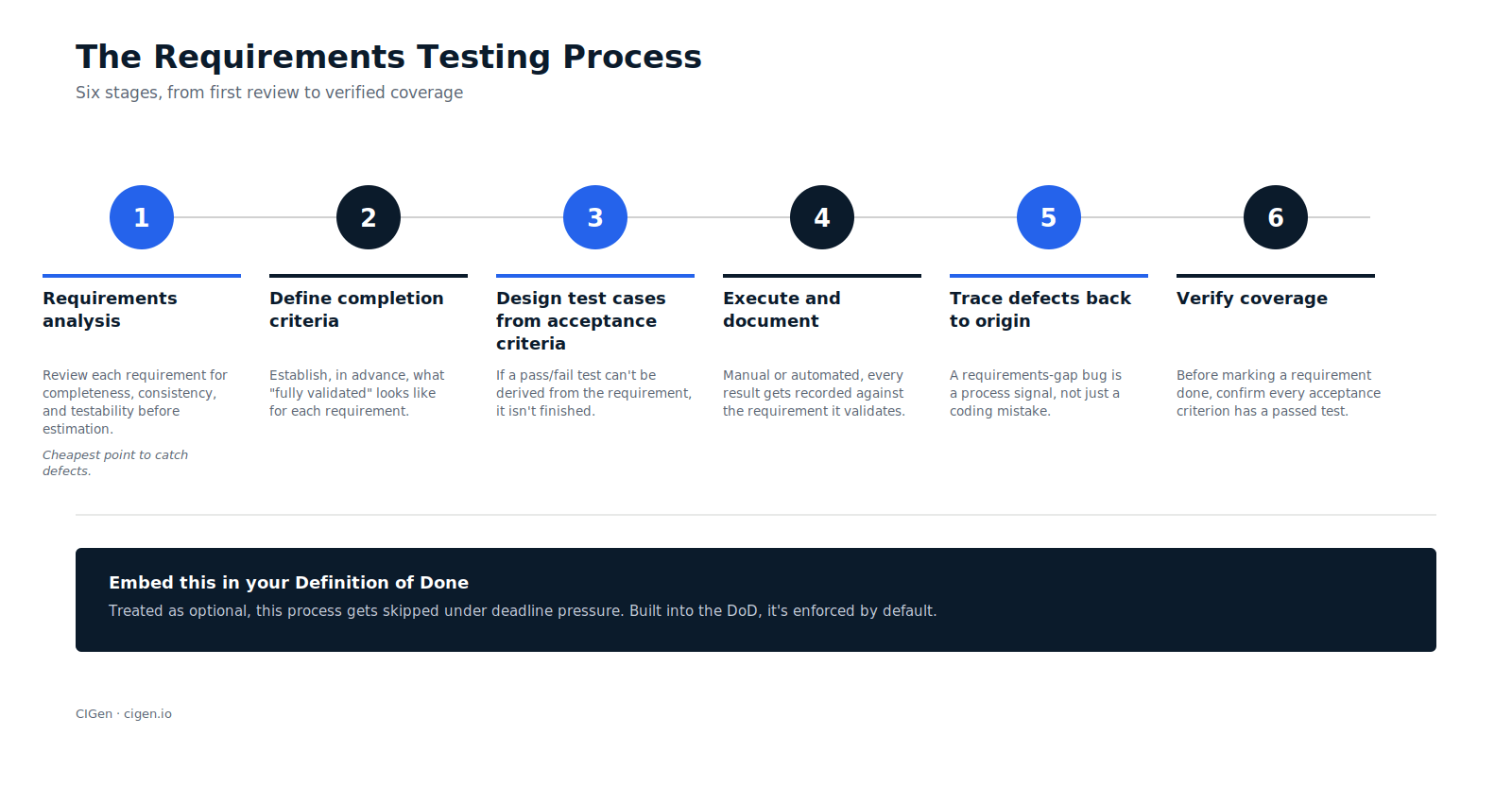
A structured requirements testing process generally runs through six stages:
- Requirements analysis - review each requirement for completeness, consistency, and testability before estimation starts. This is where most defects should be caught, since it's the cheapest point in the lifecycle to fix them.
- Define completion criteria - establish, in advance, what "fully validated" looks like for each requirement. Vague acceptance criteria produce vague test cases downstream.
- Design test cases from acceptance criteria - if a concrete pass/fail test can't be derived from the requirement as written, the requirement isn't finished, regardless of how much prose surrounds it.
- Execute and document - manual or automated, every result gets recorded against the requirement it validates. Exploratory testing can supplement this but shouldn't replace structured cases.
- Trace defects back to origin - when QA finds a bug that traces to a requirements gap rather than an implementation error, that's a signal about the requirements process, not just a coding mistake.
- Verify coverage - before a requirement is marked done, confirm that every acceptance criterion has a corresponding test that passed.
This process works best when it's embedded in the team's Definition of Done rather than treated as an optional pre-sprint activity - anything optional tends to get skipped under deadline pressure.
Requirements traceability matrix
A requirements traceability matrix (RTM) links each requirement to its origin (a business goal, stakeholder need, or regulation), its corresponding test case(s), and its current verification status. It's the artifact that turns "we tested the requirements" into something an auditor, compliance reviewer, or delivery manager can actually verify.
A simple RTM row looks like this:
For teams operating under a certified quality framework - ISO/IEC 27001 being a common example in enterprise and regulated environments - traceability isn't optional documentation; it's evidence that requirements were actually validated, not just written down. Without it, requirements testing produces good intentions but no audit trail.
Requirements testing in Azure DevOps
For teams working in Azure Boards and Azure Test Plans, requirements traceability is a built-in capability rather than a manually maintained spreadsheet:
- Requirement-based test suites in Azure Test Plans populate automatically from a linked work item (user story, feature, or PBI), so every test case in the suite maps directly back to a requirement (Microsoft Learn: Azure Test Plans overview).
- The "Tests / Tested By" link type - not "Related" or "Parent/Child" - is what actually populates a requirement-based suite and drives the traceability reporting; using the wrong link type is the most common reason teams see empty coverage data.
- End-to-end traceability connects the chain from requirement → test case → build → release, so a work item shows not just whether it was tested, but whether the tested code has actually shipped (Microsoft Learn: End-to-end traceability).
- Automated tests can be associated with test cases and run inside a pipeline, so CI/CD becomes a traceability gate: a test with no linked requirement, or a requirement with no passing linked test, is visible in the Requirements widget rather than buried in a spreadsheet nobody opens (Microsoft Learn: Requirements traceability in Azure Pipelines).
For teams already standardized on Azure DevOps for delivery, this makes requirements testing enforceable by tooling rather than dependent on process discipline alone - a query for requirements with no "Tested By" link surfaces gaps automatically, before a release, rather than after one.
AI-assisted requirements analysis
A newer layer of requirements testing uses AI models to perform a first-pass review of a backlog before human reviewers see it - not to replace the Three Amigos session or stakeholder validation, but to catch the mechanical failures that are tedious for humans to find at scale:
- Ambiguity detection - flagging vague terms ("fast," "user-friendly," "should handle") that fail the ISO 29148 unambiguous and verifiable criteria
- Consistency checks across the backlog - surfacing requirements that use different terms for the same object or contradict an earlier story
- Missing-scenario prompts - generating the "what happens when this fails" and "who owns this edge case" questions that first-draft requirements routinely omit
- Traceability gap flags - identifying requirements with no linked acceptance criteria or no linked test case before a sprint is planned
This doesn't remove the need for a human requirements review - correctness and stakeholder intent still require domain judgment an AI model doesn't have. What it does is compress the mechanical part of requirements testing (checking hundreds of stories against a fixed rubric) from hours into minutes, so the human review session can focus on ambiguity and edge cases the model actually surfaces rather than starting from a blank read-through.
.png)
Common pitfalls when requirements testing is skipped
Teams that skip requirements testing tend to see the same failure pattern regardless of methodology: stories pass into development with untestable acceptance criteria, QA discovers the gap during test design rather than before estimation, and the fix becomes a mid-sprint scope conversation instead of a five-minute edit to a backlog item. Non-functional requirements are hit hardest, since "the system should be secure" or "the API should scale" reads as complete to a business stakeholder and is unusable to a QA engineer trying to write a test case against it.
The bottom line
Requirements testing doesn't produce a demo-able feature, and it doesn't close a ticket by itself. What it does is remove the most expensive category of defect from the pipeline before it's possible to write it into code. Teams that treat every ambiguous requirement as the costly problem it will become - rather than a formality to clear before "real" work starts - consistently spend less time on rework and more time building.