
AI in insurance: the mission-critical success factor
Insurers that lead on AI are not just modestly ahead of the pack, they are pulling away from it. Over the past five years, AI leaders in the insurance sector have generated 6.1 times the total shareholder return of AI laggards, a gap far wider than the two-to-three-times advantage AI leaders see in most other industries, according to McKinsey. That is not a productivity statistic. It is a signal that AI adoption in insurance has become a competitive fault line, not a back-office upgrade.
The adoption curve backs this up. In a mid-2024 survey of 200 US insurance executives, 76 percent said their organization had already implemented generative AI in at least one business function, according to Deloitte's Center for Financial Services. Life and annuity insurers were slightly ahead of property and casualty carriers, but the direction is the same across the industry: AI has moved past the pilot stage and into production, even if most insurers are still early in scaling it.
For buyers evaluating where AI fits into their own organization, the harder question is no longer whether to adopt AI. It is which use cases, in which order, will move the needle on loss ratios, claims cycle times, and fraud losses without adding risk the organization cannot manage. This guide walks through the AI use cases that matter most across the insurance value chain, underwriting, claims processing, fraud detection, and customer service and distribution, along with what each one requires to work and where the real payoff tends to show up.
Why AI in insurance, now
Insurance has three characteristics that make it unusually well suited to AI, and unusually exposed if it gets AI wrong. First, the industry runs on data, structured actuarial tables, unstructured claims documents, medical records, images, sensor feeds, more than almost any other sector outside of pure technology. Second, its core economics are directly improvable by better prediction: pricing risk more accurately, settling claims faster, and catching fraud earlier all flow straight to the loss ratio. Third, its workflows are still heavily manual and fragmented across legacy systems, which is exactly the kind of friction AI is good at removing.
That combination is why insurers are under real pressure to move now. Rising claims costs, thinning underwriting margins, and customer expectations shaped by AI-native experiences elsewhere are pushing carriers to automate faster than their legacy infrastructure was built to support.
At the same time, insurance is one of the more heavily scrutinized industries for AI use. In the United States, the NAIC's Model Bulletin on the use of AI systems by insurers directs carriers to test for bias, evaluate consumer risk, and ensure decisions are explainable, and a growing number of states have adopted it. The EU AI Act classifies AI used in life and health insurance risk assessment and pricing as high-risk (P&C underwriting sits in a greyer zone), triggering additional compliance obligations. None of this is a reason to slow down, but it is a reason to choose use cases and vendors carefully, a theme this guide returns to after walking through where AI is actually being applied.
Core AI use cases in insurance, by mission
AI in insurance is not one technology applied uniformly across the business. It shows up differently depending on which part of the value chain it touches, and each mission area has its own data requirements, maturity thresholds, and payoff pattern. The sections below walk through the use cases that matter most in underwriting, claims processing, fraud detection, and customer service and distribution.
AI in underwriting
Underwriting is where AI adoption in insurance is furthest along, largely because the function has always been a prediction problem, and prediction is what machine learning does well.
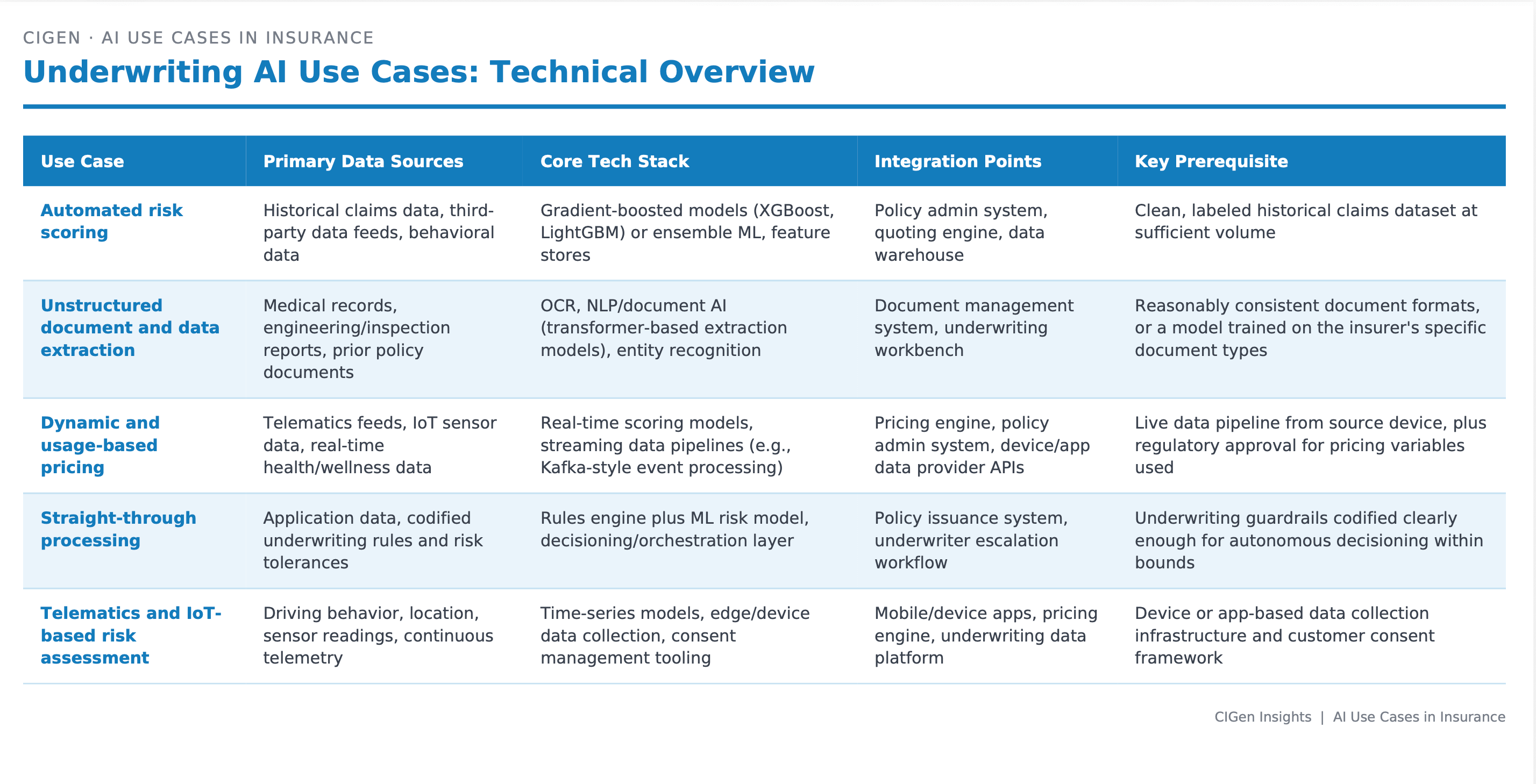
Automated risk scoring
Traditional underwriting relies on a limited set of structured variables run through actuarial tables and underwriter judgment. AI-based risk scoring models expand that input set considerably, pulling in behavioral data, third-party data feeds, and historical claims patterns to produce a more granular risk score. The prerequisite is a clean, well-labeled historical claims dataset large enough to train and validate a model without overfitting to a small population. The outcome signal insurers typically track is a reduction in loss ratio for the segments where the model is deployed, along with fewer manual referrals for straightforward risk profiles.
Unstructured document and data extraction
A large share of underwriting work involves reading things: medical records, engineering reports, prior policy documents, inspection notes. Natural language processing and document AI can extract the relevant fields from these unstructured sources and route them into the underwriting workflow automatically, instead of requiring a human to read and transcribe them. This use case needs a reasonably consistent document format or a model trained on the specific document types the insurer handles most often. The payoff shows up as faster time-to-quote and fewer data entry errors feeding into the risk assessment.
Dynamic and usage-based pricing
AI models can update pricing in near real time based on new information, telematics data from a vehicle, IoT sensor data from a commercial property, or updated health and wellness data for life insurance. This moves pricing away from static annual reviews toward something closer to continuous risk assessment. It requires a live data pipeline from the source device or feed into the pricing engine, not just historical data, and a regulatory framework that permits the pricing variables being used. Insurers pursuing this typically see improved risk selection and higher retention among lower-risk policyholders who benefit from more favorable, personalized pricing.
Straight-through processing for low-complexity policies
For simple, well-understood risk profiles, AI systems can now underwrite and issue a policy with no human involvement at all. This depends on having underwriting rules and risk tolerances codified clearly enough that the model can operate within defined guardrails, plus a fallback path to escalate anything outside those bounds to a human underwriter. The main outcome insurers look for here is underwriting capacity, the ability to process a much larger volume of straightforward applications without proportionally growing headcount.
Telematics and IoT-based risk assessment
In auto and commercial property lines particularly, AI models increasingly combine traditional underwriting data with continuous telemetry, driving behavior, location, sensor readings, to refine risk assessment beyond what a point-in-time application can capture. This requires device or app-based data collection infrastructure and customer consent frameworks, which makes it more of an organizational and legal lift than a purely technical one. Done well, it improves both pricing accuracy and loss prevention, since insurers can sometimes intervene before a risk materializes into a claim.
AI use cases in claims processing
Claims is the function insurance customers actually experience, which makes it a high-visibility place to apply AI, and also the place where getting it wrong does the most reputational damage.
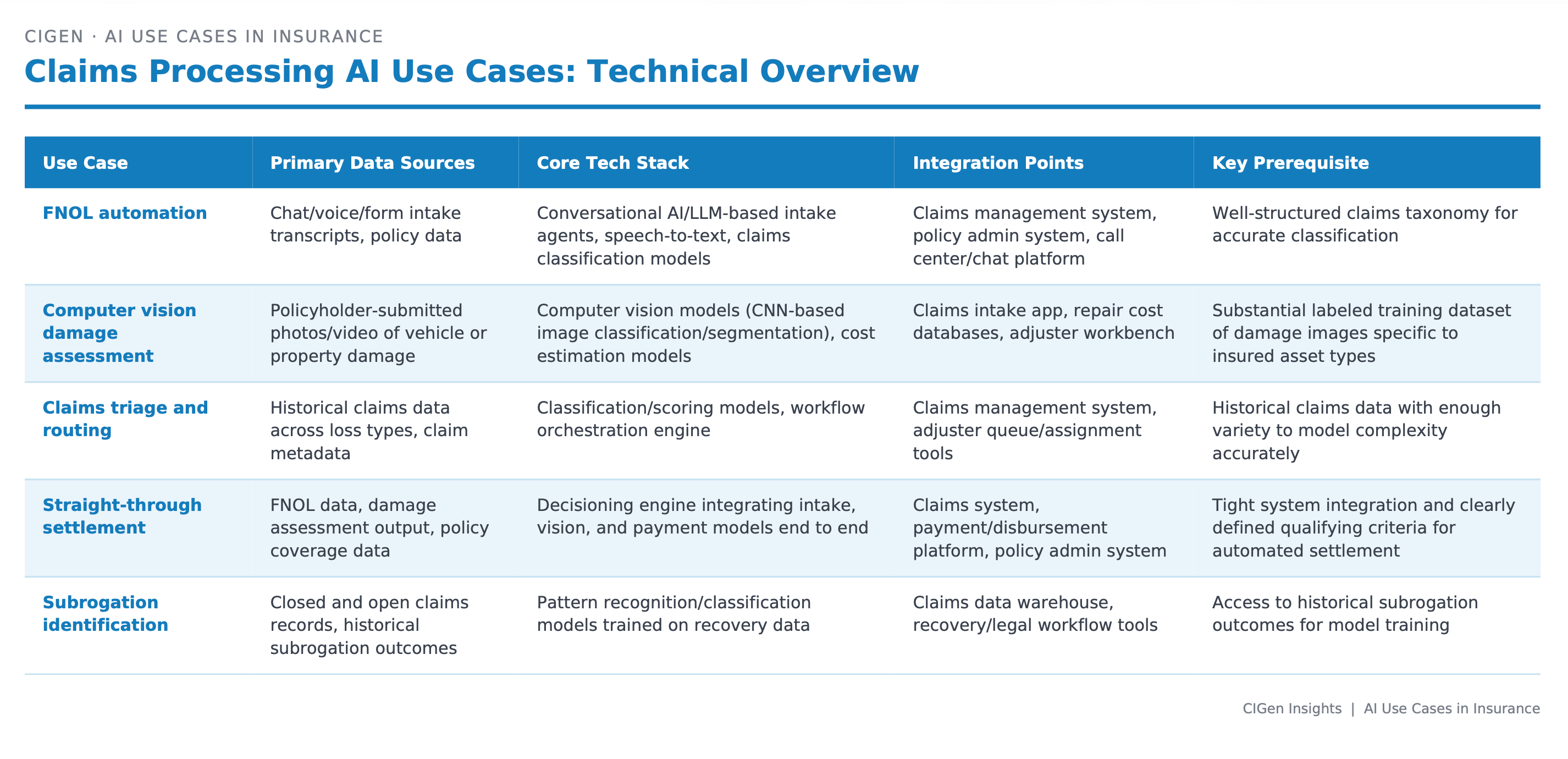
First notice of loss (FNOL) automation
The moment a policyholder reports a loss is the entry point to the entire claims process, and AI-powered intake, chat-based, voice-based, or form-based, can capture the relevant details, classify the claim type, and route it to the right workflow without a human agent doing the initial triage. This needs a well-structured claims taxonomy so the system knows how to classify what it is hearing. The typical outcome is a shorter cycle time from first report to first action, which matters both for customer satisfaction and for controlling claims leakage.
Computer vision damage assessment
For auto and property claims, AI models can now assess damage from photos or video submitted by the policyholder and produce a preliminary repair cost estimate, in some cases fast enough to support instant claim decisions for minor damage. This requires a substantial training dataset of labeled damage images specific to the vehicle types or property types being insured, and it works best paired with a human review step for anything above a certain claim value. Insurers see this reduce the need for in-person inspections and shorten claims cycle time meaningfully for straightforward damage.
Claims triage and routing
Not every claim needs the same level of scrutiny. AI models can score incoming claims for complexity and likely cost, then route simple, low-risk claims toward automated or fast-track handling and flag complex or high-value claims for senior adjusters. This depends on historical claims data with enough variety to teach the model what complexity actually looks like across different loss types. The payoff is better allocation of adjuster time toward the claims that genuinely need it, rather than spreading expertise evenly across a queue.
Straight-through settlement
For a defined set of low-complexity, low-value claims, some insurers now settle claims with no human adjuster involved at all, from FNOL through payment. This is the most operationally demanding use case in claims because it requires tight integration between intake, damage assessment, and payment systems, plus clear guardrails on which claims qualify. Where it works, it delivers the largest cycle-time reduction of any claims use case, sometimes compressing a multi-day process into hours.
Subrogation identification
AI models can scan closed and open claims data to identify cases where the insurer may have a right to recover costs from a third party, a pattern that is easy for a model to catch at scale but easy for a human reviewer to miss in a large claims volume. This needs access to historical subrogation outcomes to train the model on what a recoverable claim looks like. The outcome insurers track is straightforward: recovered dollars that would otherwise have gone unclaimed.
AI in fraud detection: top use cases
Fraud detection is one of the oldest AI use cases in insurance, predating generative AI by years, because the underlying problem, finding unusual patterns in large datasets, is exactly what earlier generations of machine learning were built for. With a hefty annual cost insurers lose due to fraudulent activities of estimated $308 billion each year (CAIF)- the use of AI is indeed justified.
Anomaly and outlier detection
These models learn what normal claims activity looks like for a given line of business and flag claims that deviate from that pattern in ways that correlate with fraud, unusual timing, inconsistent details across a claim file, statistically atypical amounts. This requires a large enough historical dataset of both legitimate and confirmed fraudulent claims to train the model to tell the two apart, which is often the hardest part of standing this use case up. The outcome signal is typically measured as fraud caught per dollar of investigation spend, since the goal is not just catching more fraud but catching it more efficiently.
Network and link analysis
Individual fraudulent claims are one problem; organized fraud rings are a bigger one, and they are structurally harder to spot because no single claim looks obviously wrong. Network analysis models map relationships between claimants, providers, repair shops, and other parties across many claims to surface clusters that share suspicious connections. This use case depends on having claims data structured in a way that preserves these relationships, not just claim-level records in isolation. It is particularly effective against staged accidents and provider fraud schemes that individual claim review would never catch.
Claims fraud scoring
Rather than a binary flag, many insurers now assign every claim a fraud risk score at intake, which lets the organization set a threshold for automatic investigation versus standard processing versus straight-through settlement. This requires the same labeled historical data as anomaly detection, plus a workflow that actually acts on the score rather than treating it as an isolated data point. The payoff is a more consistent, less subjective fraud referral process than one built purely on adjuster instinct.
Identity verification
At both the application and claims stage, AI-based identity verification can confirm that the person applying for coverage or filing a claim is who they say they are, reducing a category of fraud that starts before a policy is even issued. This typically integrates document verification and biometric matching, and it requires the insurer to have a clear policy on what data it is permitted to collect and retain for this purpose. Worth flagging as a consideration rather than a pure use case: any AI application touching identity or biometric data carries meaningfully more privacy and regulatory exposure than the other fraud use cases here, and should be scoped with that in mind.

AI applications in customer service and distribution
Customer-facing AI in insurance tends to get the most public attention, but it is arguably the hardest area to get right, because it is the one place where a bad AI experience directly damages the customer relationship.
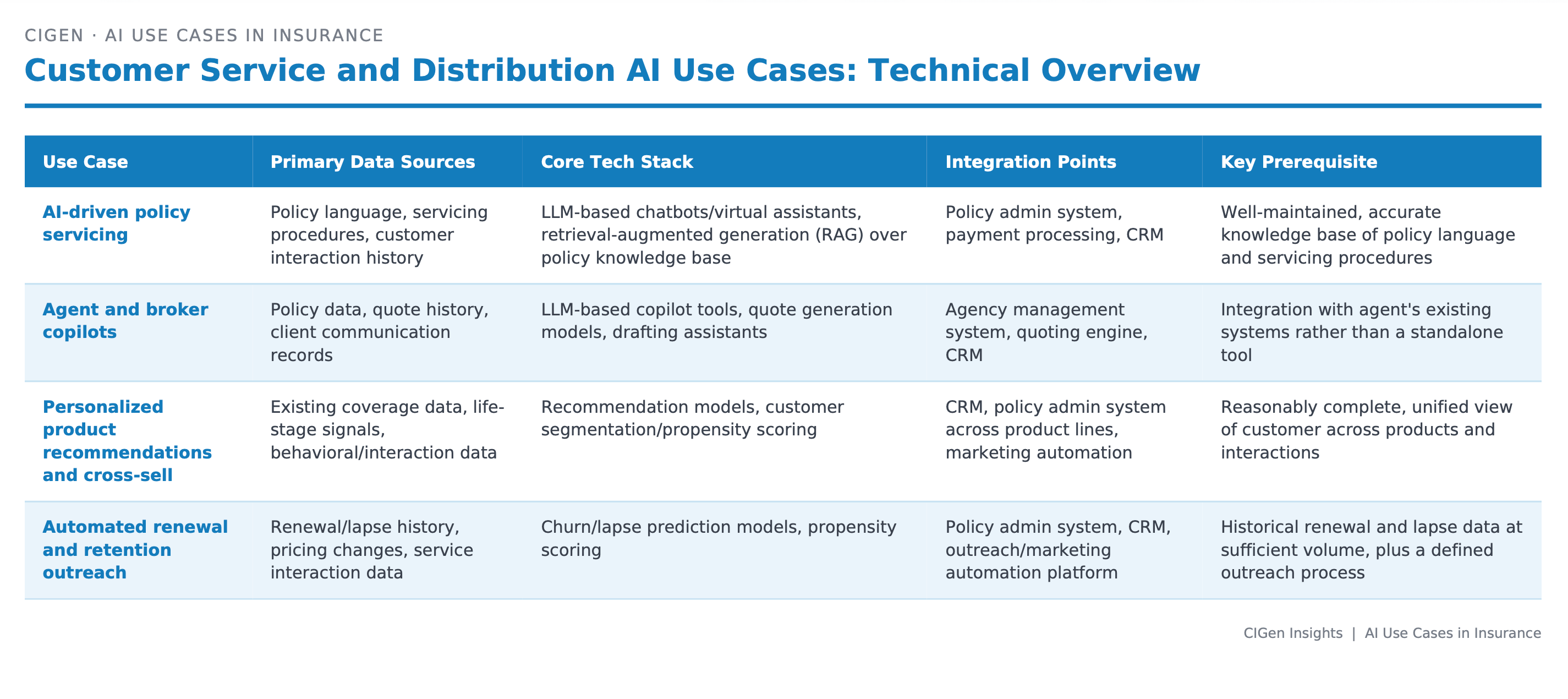
AI-driven policy servicing
Chatbots and virtual assistants can now handle a meaningful share of routine servicing requests, coverage questions, policy document retrieval, payment processing, address changes, without routing to a human agent. This needs a well-maintained knowledge base of policy language and servicing procedures for the AI to draw on accurately, since an AI agent confidently giving wrong coverage information is a worse outcome than a slow human response. The outcome insurers track is typically containment rate, the share of inquiries fully resolved without human escalation, alongside customer satisfaction scores for those resolved interactions.
Agent and broker copilots
Rather than replacing the human agent or broker relationship, which remains central to how much commercial and complex personal lines insurance is sold, AI copilots support agents with faster policy lookups, quote generation, and even drafting client communications. This requires integration with the agent's existing systems rather than a standalone tool, since the value is in reducing friction in an existing workflow, not adding a new one. Agencies that adopt this well typically report agents handling a higher volume of quotes and renewals without a proportional increase in administrative time.
Personalized product recommendations and cross-sell
AI models can analyze a policyholder's existing coverage, life stage signals, and behavior patterns to identify relevant coverage gaps or cross-sell opportunities, surfaced either to the agent or directly to the customer. This depends on having a reasonably complete view of the customer's existing policies and interactions across products, which is often harder for insurers with siloed systems by product line than the modeling itself. Done well, it improves both cross-sell conversion and retention, since well-timed, relevant recommendations read as helpful rather than as a sales pitch.
Automated renewal and retention outreach
AI models can identify which policyholders are at elevated risk of not renewing, based on pricing changes, service interactions, and claims history, and trigger targeted retention outreach before the renewal date rather than after a cancellation notice. This needs historical renewal and lapse data with enough volume to identify meaningful predictive signals, plus a defined outreach process ready to act on the model's output. The outcome insurers care about here is retention rate improvement among the flagged at-risk segment, measured against a comparable segment that did not receive the intervention.
What determines success of AI adoption in insurance use cases: Data readiness and technical maturity
None of the use cases above succeed on model quality alone. They succeed or fail based on two things underneath the model: whether the data feeding it is clean, complete, and accessible, and whether the surrounding technical infrastructure can actually operationalize the model's output.
Insurance carries a specific version of this problem. Core policy administration and claims systems are frequently decades old, built for transaction processing rather than data access, and often fragmented by product line or by legacy acquisitions that were never fully integrated. A risk-scoring model is only as good as the historical claims data it can actually reach, and a straight-through-processing workflow only works if the underwriting or claims system on the other end can accept an automated decision rather than requiring a human to key it in manually.
This is the same data-readiness and technical-maturity question that applies to AI agent deployments generally, and it is worth evaluating with the same rigor before selecting a first use case to scale. A useful starting point is a data and systems audit that maps which of the use cases above are realistic within twelve months given current infrastructure, versus which require a data or systems investment before an AI initiative can even begin.
Testing, validation, and governance
Underwriting and fraud detection sit closer to regulatory scrutiny than most other AI use cases, since both involve decisions that materially affect a consumer's coverage, price, or claims outcome. That makes testing and governance a design requirement, not a compliance afterthought bolted on at the end.
In practice, this means validating models for disparate impact across protected classes before deployment, not just after a complaint arises, and maintaining documentation that can explain a specific underwriting or claims decision if a regulator or policyholder asks for one. KPMG's research on insurance AI adoption found that only 25 percent of surveyed executives fully trust AI within their own organization, and 46 percent have reservations about whether it can be trusted at all, a gap that testing and governance discipline is largely what closes.
The insurers scaling AI successfully tend to build this validation step into the deployment pipeline itself, rather than treating it as a one-time review before launch, since model behavior can drift as the underlying population or claims environment changes.
Vendor and partner selection for implementing of your top AI use cases in insurance
Most insurers face a build, buy, or consult-and-implement decision for each use case rather than a single company-wide AI strategy, since the maturity and urgency of underwriting AI versus customer service AI, for example, are rarely the same.
The criteria that matter most are domain experience specific to insurance rather than general AI capability, since a vendor that understands claims taxonomy or underwriting rules will implement faster and with fewer costly missteps than one learning the industry from scratch. Integration capability with existing policy administration and claims systems matters just as much as the model itself, since a highly accurate model that cannot connect to the production workflow delivers no operational value. And explainability tooling is increasingly a selection criterion in its own right, not a nice-to-have, given the regulatory environment described above.
Cost and ROI framing
The outcome signals described throughout "AI use cases in insurance" section: loss ratio improvement in underwriting, cycle-time reduction in claims, fraud caught per investigation dollar, retention lift in customer service, are the metrics that ultimately justify AI investment in insurance. McKinsey's research found that domain-level AI transformation in insurance has produced a 10 to 20 percent improvement in new-agent success and sales conversion rates, a 10 to 15 percent increase in premium growth, a 20 to 40 percent reduction in costs to onboard new customers, and a 3 to 5 percent accuracy improvement in claims, a useful benchmark range for insurers building their own business case.
The sequencing question matters as much as the ROI math. Insurers that try to tackle five use cases across four mission areas simultaneously tend to struggle more than those that prove out one well-scoped use case, build internal confidence and infrastructure, and expand from there.
Where to start with AI in insurance
Choosing the right first use case, and building the data and governance foundation to support it, is exactly the kind of decision that benefits from outside perspective before an insurer commits budget and internal resources.
CIGen's free AI Adoption Strategy workshop, available on the Microsoft Azure Marketplace, is built for this stage: a structured assessment of use case fit, data readiness, and technical maturity, resulting in a prioritized roadmap rather than a generic AI strategy deck. It is a practical starting point for insurers deciding where AI in underwriting, claims, or fraud detection fits into their next planning cycle.