
Microsoft's development frameworks are in constant motion: new versions ship every year, naming conventions shift, and what counted as "current" five years ago is now legacy. .NET and .NET Framework sit at the center of that evolution, and despite sharing almost the same name, they represent two very different stages of that journey. This article breaks down exactly what separates them, so you can be confident about which one belongs in your next project.
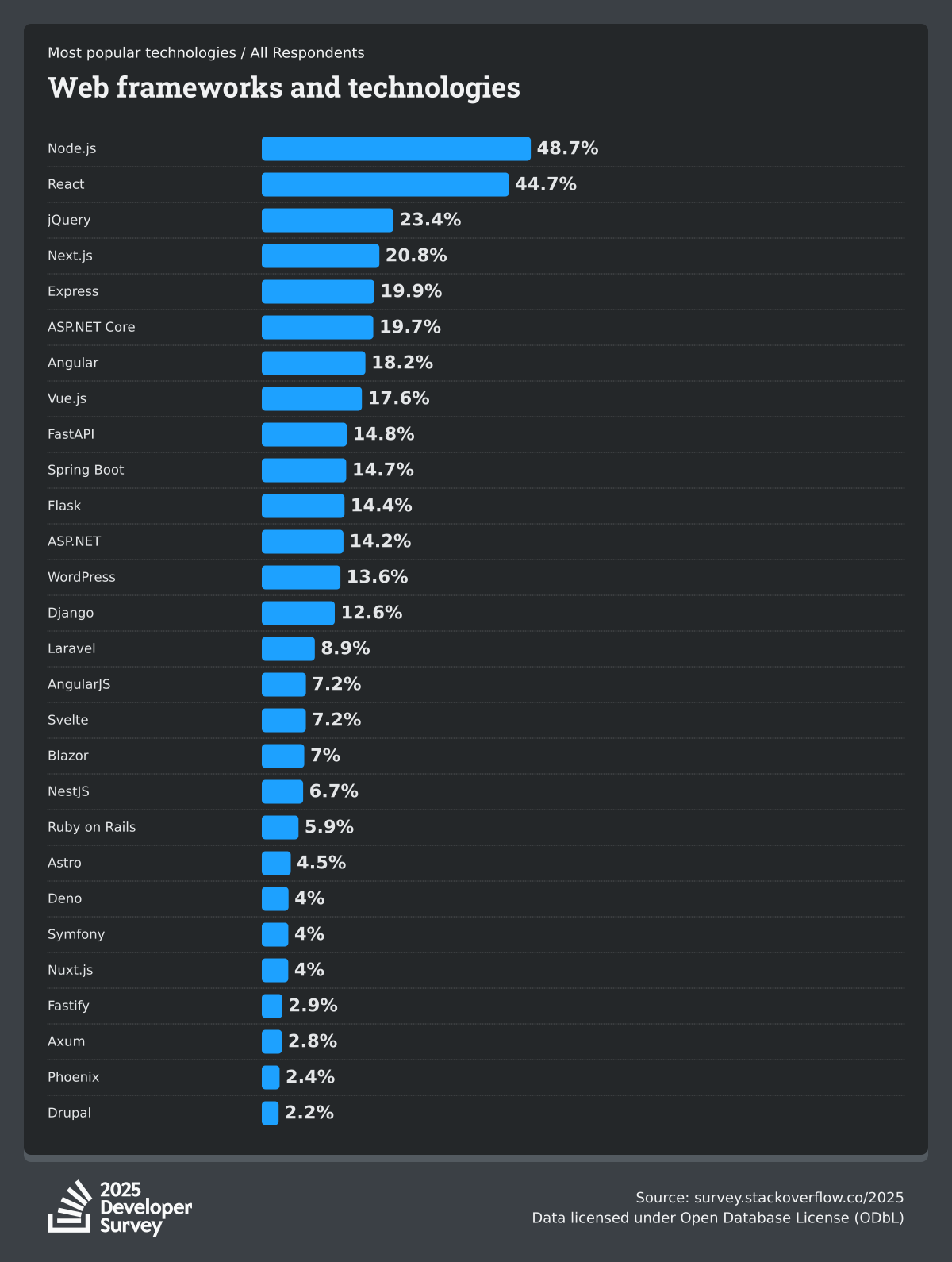
The numbers reflect that this isn't a niche debate. In the 2025 Stack Overflow Developer Survey, ASP.NET Core (the web framework built on modern .NET), ranked among the top 10 most-used web frameworks and technologies overall, with 19.7% of all respondents reporting extensive work with it over the past year. ASP.NET, its .NET Framework-era predecessor, still held a respectable 14.2%, while Blazor, a newer addition to the .NET ecosystem, came in at 7%. Three different generations of the same framework family, all still very much in active use, which is exactly why knowing the difference matters.
What is .NET Framework?
.NET Framework is Microsoft's original application framework, first released in 2002 and built exclusively for Windows. It gave developers a consistent way to build desktop, web, and service-based applications in C#, Visual Basic, and other .NET languages, all running on a shared runtime and class library.
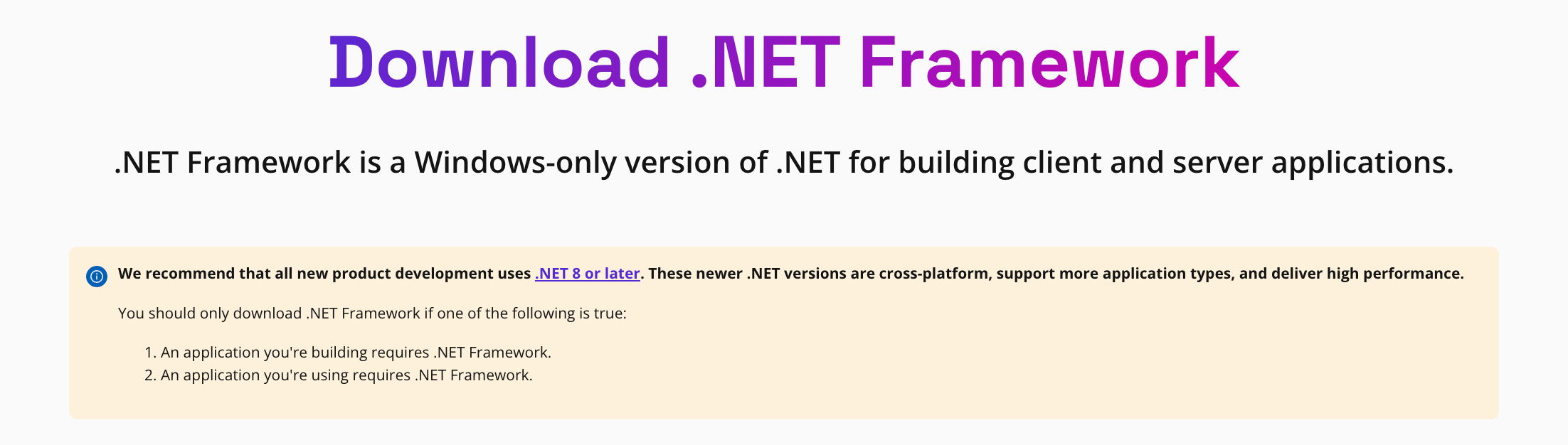
For more than a decade, it was the default choice for Windows-centric business software, and a huge amount of enterprise software still runs on it today. But its architecture is tightly coupled to Windows, and Microsoft has confirmed it has no plans to add new features going forward. According to Microsoft's own guidance, .NET Framework currently covers versions 1.0 through 4.8, and there's no version 5 or beyond on the roadmap.
What is .NET (formerly .NET Core)?
.NET, (originally launched as .NET Core in 2016 and renamed simply ".NET" starting with .NET 5), - is Microsoft's modern, open-source, cross-platform implementation. It runs on Windows, Linux, and macOS, and it's where all of Microsoft's current investment and new feature development is going.
Microsoft is direct about this in its own documentation: the latest .NET version is described as the preferred version of .NET to use for server development, with reasons to keep using .NET Framework now considered specific and limited. That's about as clear a signal as a vendor gives.
.NET vs .NET Framework: The core differences
Here are the core few differences that matter more than the rest.
Platform support
This is the single biggest divide. .NET Framework only runs on Windows. .NET runs cross-platform, so your web or service app can run on Windows, Linux, and macOS, and you can develop using Visual Studio on Windows or Visual Studio Code on macOS, Linux, or Windows. If your team works across operating systems, or you want the option to deploy to Linux infrastructure, .NET Framework simply isn't on the table.
Performance
.NET is built to be leaner and faster. Microsoft notes that ASP.NET Core, running on .NET, is one of the top-performing web frameworks on industry benchmarks, and that performance advantage compounds in microservices environments where fewer servers or virtual machines are needed to handle the same load, which translates directly into lower infrastructure costs.
Deployment and containers
.NET Framework is tied to IIS (Internet Information Services) as its hosting model, which restricts where and how you can deploy.
.NET, by contrast, was designed with portability in mind: while .NET Framework can run in Windows containers, .NET's smaller, more modular runtime produces noticeably smaller container images, and its cross-platform nature means you can deploy straight to Linux Docker containers as well.
Side-by-side versioning
This one trips up a lot of teams running multiple apps on the same server.
.NET supports installing multiple versions side by side on one machine, so different services can run on different
.NET versions independently. .NET Framework 4 doesn't support that, only one version can exist on a machine at a time, and each new release replaces the previous one (the older 3.5 branch is the one exception).
Microservices and modern architecture
If your roadmap includes microservices, .NET is purpose-built for it, with native support for containerization and orchestration tools like Kubernetes.
.NET Framework can technically participate in a mixed-technology microservices setup, but it wasn't designed for that pattern and typically needs more supporting tooling to get there.
Modern application models
Blazor is a good example of how far .NET has moved beyond what .NET Framework ever offered: it lets you build interactive web UIs in C# instead of JavaScript, running either directly in the browser or on the server. There's no equivalent in .NET Framework, it's a capability that simply didn't exist in that generation of the platform, and one reason Blazor has already found its way into a meaningful share of new .NET projects (7% of all respondents in the above-mentioned Stack Overflow survey).
Update cadence
.NET ships a new major version every year, with ongoing performance and feature improvements baked into each release.
.NET Framework, by comparison, now receives security patches only, and its last major functional release shipped back in 2016.
In the next chapter, let's summarize when .NET framework is the right path to choose between the two.
When .NET Framework still makes sense
.NET Framework is quickly becoming obsolete, but not every legacy app needs an urgent rewrite. Microsoft lists specific, legitimate reasons to stay on .NET Framework:
- Your app already runs on it. Microsoft's own recommendation is not to migrate existing .NET Framework apps just for the sake of it - instead, extend them by writing new pieces in .NET where it makes sense, rather than forcing a full rewrite.
- You depend on a technology .NET doesn't support. ASP.NET Web Forms, ASP.NET Web Pages, Windows Workflow Foundation, and WCF Data Services are all examples of .NET Framework technologies with no equivalent in .NET.
- A required third-party library or NuGet package isn't available for .NET, and there's no .NET Standard–compatible alternative.
- A platform or Azure service you rely on doesn't yet support .NET, leaving REST APIs as the only workaround.
If none of those apply to your situation, there's no strong case for choosing .NET Framework over .NET for a new project today.
.NET vs .NET Framework: Quick-reference comparison
In conclusion
For any new project, .NET is the clear default, - it's where Microsoft is investing, it performs better, it's not locked to a single OS, and it fits modern deployment patterns like containers and microservices far more naturally.
.NET Framework still has a place, but it's a narrowing one: legacy applications, specific unported technologies, or constraints you can't currently work around.
As Microsoft's frameworks continue to evolve, the gap reflected in 2025 Stack Overflow survey data (ASP.NET Core's lead over legacy ASP.NET, and Blazor's steady foothold alongside both), - will likely keep widening. If you're maintaining an existing .NET Framework codebase, that's not automatically a problem, but it's worth periodically reassessing whether the original reasons for staying on it still hold, especially as more libraries, tools, and third-party integrations shift their primary support to .NET.
Working through a .NET Framework migration, have an app modernization project, or scoping a new build on the current .NET platform? Talk to our team about what a realistic upgrade path or architecture would look like for your application.