Introduction: modernization is not always the answer
In continuation of the series of insights on legacy application modernization services, we address a critical but often underexplored topic: how to determine when an application should be retired altogether rather than modernized.
Application modernization is often framed as a necessary step toward scalability, innovation, and cloud adoption. Most strategies, frameworks, and vendor narratives emphasize how to migrate, refactor, or rebuild legacy systems. However, this perspective overlooks a critical reality: not every system should be modernized.
The scale of the challenge makes this distinction increasingly important. According to industry data, organizations spend up to 80% of their IT budgets maintaining existing systems, leaving limited capacity for innovation or transformation initiatives. In parallel, modernization investments continue to grow rapidly, with the global application modernization market projected to exceed $100 billion in the coming decade. Together, these trends highlight a structural issue: organizations are investing heavily in transformation while still carrying a large volume of legacy systems that may no longer deliver proportional value.
In this context, defaulting to migration can lead to inefficient outcomes. Moving an application to the cloud does not inherently improve its usefulness, eliminate redundancy, or justify its ongoing cost. In some cases, migration simply transfers inefficiencies into a new environment, where they continue to generate operational overhead.
Decommissioning, or “retiring” an application, addresses a different question altogether. Instead of asking how to modernize a system, it asks whether the system should exist at all. This shift in perspective is central to effective portfolio management.
This article explores when retiring an application is the more rational decision compared to migration. It outlines the key signals, including duplication, declining usage, maintenance risk, and replacement readiness, that indicate when modernization efforts are better redirected toward simplification rather than transformation.
What does “retire” mean in legacy application modernization?
Within the context of application modernization, retire refers to the deliberate removal of an application from active use. The system is decommissioned, its infrastructure is shut down, and its functionality is either no longer required or has been absorbed elsewhere.
Although the term is straightforward, it is often misunderstood or used interchangeably with related concepts. Clarifying these distinctions is important before evaluating when retirement is the right decision.
To establish a clear baseline, the following definitions highlight how retirement differs from adjacent strategies.
- Retire: the application is permanently removed from the portfolio and no longer used
- Replace: functionality is transitioned to another system, often a SaaS or commercial product
- Archive: the application is shut down, but its data is preserved for compliance or historical access
- Decommission: the technical process of shutting down infrastructure, removing access, and disabling integrations
These terms often appear together in modernization programs, but they represent different stages or outcomes rather than interchangeable actions.
Retirement itself is not purely a technical activity. It sits at the intersection of business value, operational risk, and governance. While decommissioning describes how a system is shut down, retiring explains why that decision is made.
In practice, retiring an application typically involves both business and technical alignment. The organization must confirm that the system no longer delivers meaningful value, while also ensuring that its removal will not disrupt dependent processes, users, or data flows.
This is why retirement is closely linked to application portfolio rationalization, the process of evaluating all systems within an organization to determine their relevance, cost, and strategic fit. In frameworks such as the Cloud Adoption guidance by Microsoft, retirement is positioned as one of the valid outcomes alongside migration and modernization strategies.
It is also important to recognize that retiring an application does not always mean eliminating its data or business logic entirely. In many cases, historical records must be preserved due to regulatory requirements, audit needs, or operational reference. This introduces additional considerations around data archiving, access controls, and retention policies.
Ultimately, retirement should be understood as a strategic portfolio decision supported by a controlled technical process. It reduces complexity, lowers cost, and creates clarity, but only when applied with proper analysis and validation.
Why organizations over-invest in migration instead of retiring legacy systems
Despite the clear benefits of reducing portfolio complexity, many organizations default to migration rather than retirement when evaluating legacy systems. This tendency is not always driven by technical necessity, but by a combination of organizational habits, risk perception, and limited visibility into actual system usage.
Modernization programs are often framed around transformation goals such as cloud adoption, scalability, and innovation. Within this context, migration becomes the default action, even for systems that may no longer justify continued investment.
To better understand this pattern, it is useful to examine the most common drivers behind over-migration.
- Perceived safety of preserving functionality: teams prefer to keep systems running “just in case,” even when usage is minimal
- Lack of clear ownership: legacy applications often exist without a defined business owner responsible for their lifecycle
- Incomplete dependency mapping: uncertainty about integrations or downstream impact discourages decommissioning
- Overestimation of usage: anecdotal importance is often mistaken for actual operational reliance
- Migration-first strategy mandates: organizational initiatives may prioritize cloud migration targets over portfolio optimization
These factors collectively create a bias toward preservation rather than simplification.
Another important contributor is limited visibility into application behavior. Many organizations lack reliable data on system usage, user activity, or transaction volume. Without this insight, decision-makers tend to assume that systems remain critical, even when their actual impact has declined significantly.
There is also a psychological dimension to consider. Retiring an application can feel riskier than migrating it, even when the opposite is true. Migration preserves the status quo, while retirement requires a definitive decision to remove functionality. In environments where accountability is distributed, this can slow down or prevent decommissioning efforts.
In addition, modernization budgets are often allocated with a focus on transformation outcomes. As a result, migration and refactoring initiatives receive funding and attention, while retirement, which is perceived as cost-saving rather than value-creating, is deprioritized.
However, this approach can lead to inefficient outcomes. Migrating redundant or low-value systems increases cloud costs, operational overhead, and architectural complexity without delivering proportional business benefit.
A more effective approach begins with evaluation rather than action. Before deciding how to modernize an application, organizations should first determine whether modernization is justified at all.
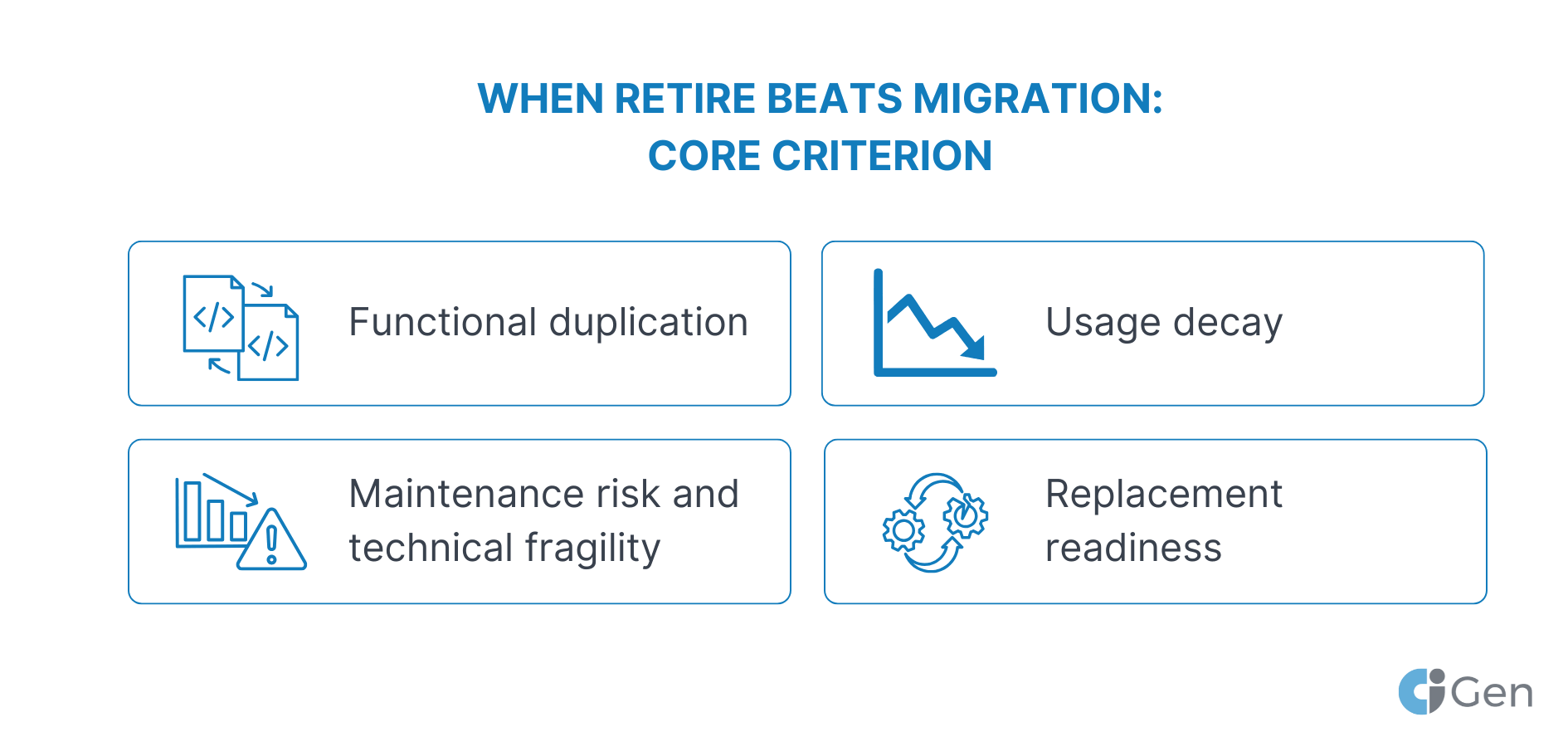
Core criteria: when retire beats migration
Deciding whether to retire or migrate an application requires a structured evaluation of its actual business value, usage, and operational characteristics. While migration preserves functionality, retirement eliminates unnecessary complexity. The key is identifying when preservation no longer delivers proportional benefit.
To make this decision objective rather than intuitive, organizations should assess a set of consistent signals that indicate whether an application still justifies investment.
Functional duplication
One of the most common indicators that an application should be retired is functional overlap with other systems. Over time, organizations accumulate multiple tools that serve similar purposes due to organic growth, acquisitions, or departmental autonomy.
This duplication often remains hidden until a portfolio-level assessment is conducted.
Typical examples of duplication include the following scenarios.
- Two CRM systems used across different regions or teams
- Legacy reporting tools replaced by centralized BI platforms
- Internal tools that replicate functionality already available in newer systems
- Parallel workflow systems developed independently by different departments
In such cases, maintaining multiple systems increases cost and operational complexity without adding business value. Migration simply perpetuates this redundancy in a new environment.
Eliminating duplicate systems not only reduces infrastructure and maintenance overhead, but also simplifies data flows and governance.
Usage decay
Applications rarely become obsolete overnight. Instead, their usage declines gradually as business processes evolve, users shift to newer tools, or functionality becomes less relevant.
Without active monitoring, this decline can go unnoticed for extended periods.
Common indicators of usage decay include the following signals.
- Low or declining login frequency
- Small number of active users
- Reduced transaction volume over time
- Limited reliance in core business processes
- Usage concentrated in edge cases or legacy workflows
These patterns suggest that the application no longer plays a central role in operations.
Migrating such systems often results in continued cost without meaningful return. In contrast, retiring them allows organizations to eliminate low-value assets and reallocate resources more effectively.
Maintenance risk and technical fragility
Some applications remain in use despite becoming increasingly difficult to maintain. These systems often rely on outdated technologies, undocumented logic, or a shrinking pool of knowledgeable engineers.
Over time, this creates operational and security risk.
Key warning signs of maintenance risk typically include the following conditions.
- Lack of documentation or architectural clarity
- Dependence on obsolete or unsupported technologies
- Limited internal expertise to support the system
- Increasing frequency of incidents or failures
- Known security vulnerabilities that are difficult to address
In these situations, migration does not resolve the underlying issues. It may even increase exposure by extending the lifecycle of fragile systems.
When the cost and risk of maintaining an application outweigh its business value, retirement becomes a more rational option.
Replacement readiness
In many cases, an application continues to exist even after its functionality has been effectively replaced by another system. This can occur during phased rollouts, incomplete migrations, or gradual adoption of new platforms.
As a result, legacy systems remain operational long after they are no longer required.
Signals that indicate replacement readiness include the following observations.
- A new system has already been deployed and adopted
- Core workflows have been migrated to another platform
- Data has been partially or fully transferred
- Users no longer depend on the legacy interface
- The legacy system is used only for reference or backup
When these conditions are met, migrating the legacy system adds little value. The focus should instead shift to completing the transition and decommissioning the outdated application.
Retiring systems at the right moment prevents unnecessary duplication and accelerates simplification of the IT landscape.
Summing up criteria for retiring an application
Each of these criteria - duplication, usage decay, maintenance risk, and replacement readiness - highlights a different dimension of declining application value. When multiple signals are present, the case for retirement becomes significantly stronger.
Rather than treating modernization as a default path, organizations should use these criteria to determine whether an application deserves continued investment at all.
Retire vs migrate: decision comparison
After identifying the signals that indicate an application may no longer justify investment, the next step is to compare retirement and migration directly. Both are valid strategies, but they serve fundamentally different objectives.
Migration preserves and relocates functionality. Retirement removes it. The decision between the two should therefore be based on value, not habit.
To clarify the trade-offs, the following comparison highlights how each approach performs across key dimensions.
This comparison illustrates that the two strategies are not interchangeable. They address different problems within the application portfolio.
Migration is appropriate when the application continues to deliver business value but requires a more scalable or maintainable environment. Retirement, on the other hand, is appropriate when the application no longer justifies its existence.
In practice, the distinction often comes down to one key question: does the application still serve a meaningful purpose in current operations?
If the answer is yes, migration may be the right path. If the answer is uncertain or negative, migration can introduce unnecessary cost and complexity by preserving a system that no longer contributes to business outcomes.
Another important consideration is cost trajectory. Migration typically shifts or restructures cost rather than eliminating it. Even when infrastructure becomes more efficient, the application still requires monitoring, maintenance, and support. Retirement removes these obligations entirely.
At the same time, retirement requires greater upfront certainty. Organizations must validate that no critical dependencies, workflows, or compliance requirements are tied to the system. This makes discovery and stakeholder alignment essential before proceeding.
Ultimately, the decision should not be framed as “retire versus migrate” in isolation. It should be part of a broader portfolio evaluation, where each application is assessed based on value, usage, risk, and strategic relevance.
The application decommissioning process (step-by-step)
Decommissioning an application is a controlled process that ensures business continuity, data integrity, and compliance are maintained while the system is removed. Although retirement reduces long-term complexity, it requires careful execution to avoid unintended disruption.
A structured approach helps reduce uncertainty and ensures that all dependencies and stakeholders are accounted for.
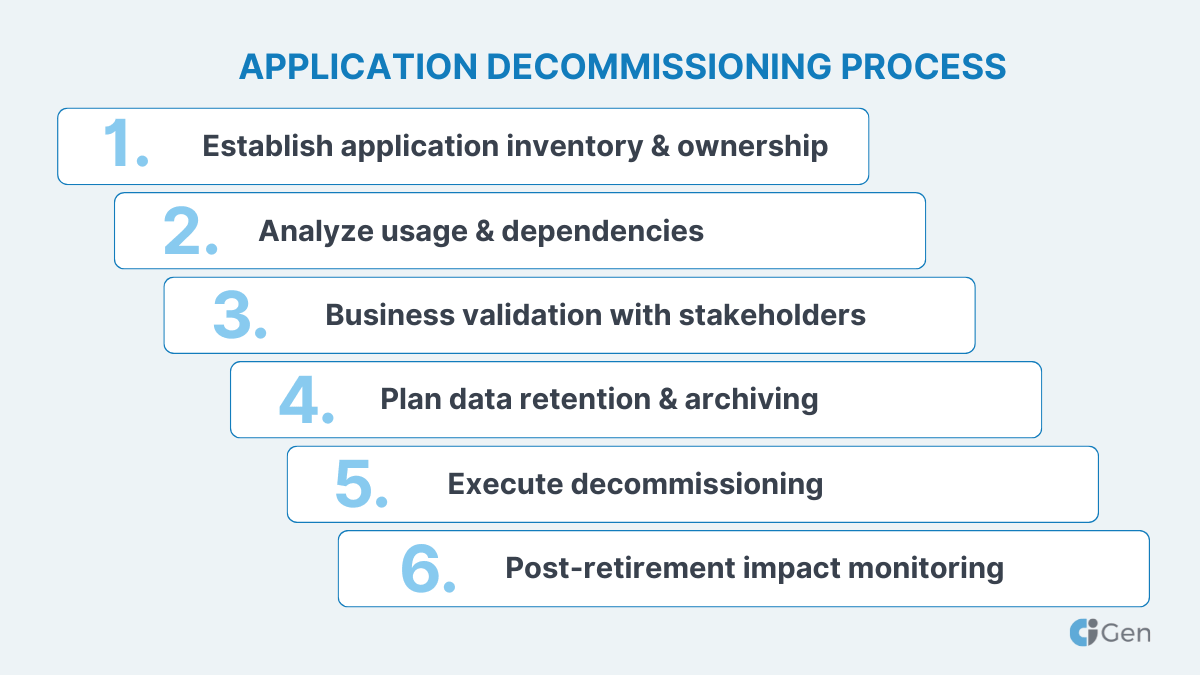
1. Establish application inventory and ownership
Before any retirement decision can be executed, the organization must clearly identify what is being decommissioned and who is responsible for it. Many legacy systems lack clear ownership, which creates risk during decision-making.
The initial step typically involves the following actions.
- Identifying the application within the portfolio
- Assigning a business owner and technical owner
- Documenting purpose, users, and key workflows
- Mapping high-level integrations
This step creates accountability and ensures that decisions are validated by relevant stakeholders.
2. Analyze usage and dependencies
Understanding how the application is used (and what depends on it) is critical before decommissioning. Incomplete visibility is one of the most common causes of retirement-related issues.
This analysis usually includes the following activities.
- Reviewing user activity and access patterns
- Identifying upstream and downstream integrations
- Mapping data flows and external dependencies
- Detecting batch jobs, APIs, or hidden system interactions
The goal is to ensure that no critical process is unintentionally disrupted.
3. Validate with stakeholders
Technical analysis alone is not sufficient. Business validation is required to confirm that the application can be safely retired.
This validation process typically includes the following steps.
- Confirming with business units that functionality is no longer required
- Verifying that replacement systems are fully adopted
- Identifying any edge-case usage scenarios
- Communicating planned timelines and impact
This step reduces the risk of overlooking informal or undocumented usage.
4. Plan data retention and archiving
Even when an application is no longer needed, its data may still be subject to regulatory, legal, or operational requirements. Proper handling of data is therefore a critical component of decommissioning.
Data planning typically involves the following considerations.
- Determining retention requirements based on compliance policies
- Archiving historical data in accessible formats
- Defining access controls for archived data
- Ensuring data integrity and auditability
This ensures that retirement does not result in loss of required information.
5. Execute decommissioning
Once validation and planning are complete, the application can be safely shut down. Execution should follow a controlled sequence to minimize risk.
Typical execution steps include the following actions.
- Disabling user access
- Turning off integrations and scheduled jobs
- Shutting down infrastructure and services
- Removing application from monitoring and support systems
Execution should be documented and, where possible, reversible within a short window in case issues arise.
6. Monitor post-retirement impact
After decommissioning, it is important to monitor for any unexpected effects. Even with thorough preparation, hidden dependencies may surface.
Post-retirement monitoring usually includes the following checks.
- Monitoring error logs and system alerts
- Tracking support requests related to the retired system
- Verifying that replacement workflows function correctly
- Confirming no residual dependencies remain
This final step ensures that the retirement has been completed successfully.
Decommissioning is a sequence of coordinated steps involving technical, business, and compliance considerations. Each phase reduces the risk of disruption and ensures that retirement delivers its intended benefits.
When executed properly, application retirement becomes a predictable and repeatable process rather than a high-risk one-off initiative.
Application modernization challenges: common risks when retiring applications
While retiring an application can reduce cost and complexity, it also introduces risks that must be carefully managed. Unlike migration, which preserves system behavior, retirement requires confidence that removing the system will not disrupt operations, data access, or compliance obligations.
Understanding these risks in advance allows organizations to plan mitigation strategies and avoid unintended consequences.
The most common risks associated with application retirement include the following areas.
- Hidden dependencies: undocumented integrations, batch jobs, or data flows that rely on the system
- Data loss or compliance violations: improper handling of historical data subject to regulatory requirements
- User resistance: teams continuing to rely on legacy workflows or tools outside formal processes
- Incomplete process migration: business processes not fully transitioned to replacement systems
- Knowledge gaps: lack of documentation or institutional knowledge about how the system is used
Each of these risks can impact business continuity if not addressed during the decommissioning process.
Hidden dependencies are particularly challenging because they are often not visible in system documentation. Legacy applications may support reporting pipelines, manual exports, or indirect integrations that only surface after the system is removed. This is why dependency mapping and monitoring are critical before and after decommissioning.
Data-related risks are equally important. Many industries require long-term retention of operational or transactional data. Simply shutting down a system without a clear archiving strategy can lead to compliance violations or loss of critical historical information. Proper data extraction, storage, and access controls must be defined in advance.
User behavior also plays a role. Even when a system is technically ready for retirement, users may continue to rely on familiar tools or undocumented processes. Without proper communication and transition planning, this can result in workarounds that introduce new risks.
Another common issue is incomplete migration of business processes. A replacement system may exist, but not all workflows have been fully adopted or validated. Retiring the legacy system prematurely can expose gaps that disrupt operations.
To reduce these risks, organizations should treat retirement as a governed process rather than a technical cleanup task. Validation, communication, and phased execution are essential components of a safe decommissioning strategy.
When managed properly, the risks associated with retirement are predictable and controllable. In many cases, they are lower than the long-term risks of maintaining outdated or redundant systems.
How retire fits into broader application modernization strategy
Application retirement is often perceived as a secondary outcome of modernization programs. In practice, it plays a foundational role in shaping effective transformation initiatives. By reducing portfolio complexity upfront, retirement enables more focused and efficient modernization efforts across remaining systems.
Rather than being an isolated action, retirement should be integrated into the early stages of modernization planning.
To understand its role more clearly, consider how retirement contributes to broader portfolio strategy.
- Reduces modernization scope: fewer applications require migration, refactoring, or redesign
- Improves budget allocation: resources can be directed toward systems that deliver measurable business value
- Simplifies architecture: fewer systems mean fewer integrations, dependencies, and failure points
- Enhances governance: a clearer portfolio improves visibility, ownership, and decision-making
- Accelerates transformation timelines: eliminating low-value systems reduces overall program complexity
These effects compound across large environments, where even a modest reduction in application count can significantly impact cost and operational overhead.
Retirement is particularly valuable at the portfolio rationalization stage, which typically precedes any large-scale cloud migration or modernization initiative. At this stage, organizations evaluate their full application landscape to determine which systems should be retained, modernized, replaced, or removed.
By addressing redundancy and low-value systems early, organizations avoid investing in migration or refactoring efforts that do not contribute to strategic outcomes.
It is also important to recognize that retirement improves not only efficiency but also clarity. A simplified application landscape makes it easier to define target architectures, establish governance models, and implement consistent operational practices.
In contrast, attempting to modernize an unfiltered portfolio often leads to fragmented architectures and increased long-term complexity.
From a strategic perspective, retirement aligns modernization efforts with business priorities. It ensures that transformation initiatives focus on systems that support growth, differentiation, or operational efficiency, rather than preserving legacy structures by default.
This alignment is essential for achieving measurable outcomes from modernization investments.
When to consider expert support: application retirement consulting
In smaller environments, identifying applications for retirement may be relatively straightforward. However, as system landscapes grow in size and complexity, the process becomes significantly more challenging. Multiple stakeholders, undocumented dependencies, and fragmented ownership can make it difficult to reach confident decisions.
In such cases, structured assessment and external perspective from application decommissioning services experts can help reduce uncertainty and accelerate decision-making.
There are several scenarios where organizations typically benefit from expert support.
- Large application portfolios: when dozens or hundreds of systems need to be evaluated consistently
- Limited system visibility: when usage data, ownership, or documentation is incomplete
- Complex integrations: when applications are tightly coupled through APIs, batch jobs, or shared data layers
- Ongoing cloud migration programs: when retirement decisions must be aligned with broader transformation initiatives
- Regulatory or compliance constraints: when data retention and audit requirements introduce additional complexity
Each of these conditions increases the risk of overlooking critical factors during the retirement decision process.
External support often focuses on creating a structured evaluation model. This typically includes application inventory analysis, usage tracking, dependency mapping, and business value assessment. By applying consistent criteria across the portfolio, organizations can prioritize which systems to retire, retain, or modernize.
Another important benefit is stakeholder alignment. Retirement decisions frequently involve multiple business units, each with different perspectives on system importance. An objective, data-driven assessment helps facilitate these discussions and reduce bias.
In addition, experienced teams can help define and execute decommissioning processes, including data archiving strategies, validation workflows, and post-retirement monitoring. This reduces operational risk and ensures that retirement is implemented in a controlled and auditable manner.
It is important to note that expert support does not replace internal knowledge. Instead, it complements it by providing structure, methodology, and external benchmarking.
When applied effectively, this combination enables organizations to move from uncertainty to actionable decisions more quickly.
Structured assessment and guided execution can significantly reduce both cost and transformation risk, particularly in environments where application landscapes have evolved over many years without centralized governance.
If you are looking for application modernization Azure, our certified experts will be delighted to provide a no-obligation phone consultation followed by a detailed quote based on your specific case requirements.
Conclusion
Application modernization strategy is often approached as a question of how to evolve systems: migrate, refactor, or rebuild. However, an equally important question is whether a system should continue to exist at all.
As this article has outlined, retirement is not a fallback option but a strategic decision grounded in business value, usage, and risk. Criteria such as functional duplication, usage decay, maintenance fragility, and replacement readiness provide a practical framework for identifying systems that no longer justify continued investment.
Choosing to retire an application can deliver immediate benefits. It reduces operational overhead, simplifies architecture, and frees up resources that can be redirected toward systems that support growth and innovation.
At the same time, retirement requires discipline. Proper dependency analysis, stakeholder validation, and data handling are essential to ensure that decommissioning does not introduce unintended disruption.
When integrated into broader modernization strategy, retirement serves as a filtering mechanism. It helps organizations avoid migrating inefficiencies into new environments and ensures that transformation efforts focus on systems that deliver measurable value.
Ultimately, effective modernization is about making deliberate decisions across the application portfolio. In some cases, the most efficient and impactful outcome is not transformation, but removal.