
Where replatforming fits in modernization
Across industries, many organizations still rely on applications built 10–20 years ago, often stable, business-critical, and deeply integrated into daily operations. However, these systems increasingly struggle to meet modern expectations around scalability, performance, security, and integration with cloud-native services. This is where application modernization becomes a strategic priority rather than a purely technical initiative.
Replatforming sits at the center of this modernization spectrum. It offers a pragmatic path between minimal change (rehosting or “lift-and-shift”) and more complex, resource-intensive approaches such as refactoring or full rearchitecting. Instead of rewriting applications from scratch, replatforming focuses on moving them to a modern cloud environment (such as Microsoft Azure), while making targeted optimizations to improve efficiency, maintainability, and operational performance.
In practical terms, replatforming enables organizations to:
- Transition from on-premises infrastructure to managed cloud services
- Replace outdated runtimes, databases, or hosting environments
- Introduce containerization or platform-as-a-service (PaaS) models
- Align legacy systems with DevOps and CI/CD practices
This approach is often described as “lift, tinker, and shift”, highlighting that while the core application architecture remains largely intact, selected components are optimized to better leverage cloud capabilities.
Replatforming becomes a practical entry point for organizations that:
- Need faster time-to-cloud without disrupting business operations
- Want to reduce technical debt incrementally rather than through large-scale rewrites
- Aim to unlock immediate benefits such as cost optimization and scalability
- Are preparing their systems for further modernization, including AI and data initiatives
From a strategic standpoint, to replatform is rarely the final destination. Instead, it acts as a transitional step, creating a more flexible, cloud-aligned foundation that can later support deeper transformations such as microservices adoption, event-driven architectures, or AI integration.
For CIOs and CTOs, the key consideration is how to sequence that modernization effectively. Replatforming provides a controlled, lower-risk way to start that journey, balancing speed, cost, and long-term architectural flexibility.
In the following sections, we will break down what this modernization technique involves in practice, how it compares to other modernization strategies, and how organizations can approach replatforming to Azure in a structured, ROI-driven way.
What is replatforming? Definition and core concept
Replatforming is a cloud migration and modernization approach that involves moving an existing application to a new platform,- typically a cloud environment,- while making selective optimizations to improve performance, scalability, and operational efficiency. It is commonly referred to as “lift, tinker, and shift,” reflecting its balance between minimal disruption and targeted improvement.
Unlike full-scale refactoring or rearchitecting, replatforming does not fundamentally change the application’s core architecture or business logic. Instead, it focuses on updating the underlying infrastructure and runtime components so the application can better leverage cloud capabilities, particularly within platforms like Microsoft Azure.
At its core, replatforming answers a practical question: How can an application benefit from the cloud without the time, cost, and risk of a complete rewrite?
Core characteristics of replatforming
This software modernization strategy typically involves a combination of the following changes:
- Runtime modernization
Migrating from legacy runtimes (e.g., older .NET Framework versions) to modern equivalents such as .NET (Core/5+) that are optimized for cloud environments - Infrastructure transition
Moving from on-premises servers or unmanaged virtual machines to managed cloud services (PaaS or container platforms) - Database migration or optimization
Transitioning from self-managed databases to managed services (e.g., Azure SQL, managed PostgreSQL) with minimal schema changes - Containerization (in many cases)
Packaging applications into containers (e.g., Docker) to improve portability and deployment consistency - Basic configuration and performance tuning
Adjusting application settings, scaling rules, and resource allocation to align with cloud environments
What remains largely unchanged is equally important:
- Core application architecture (e.g., monolith vs microservices)
- Business logic and workflows
- User-facing functionality
This distinction is what differentiates replatforming from deeper modernization strategies.
Replatforming vs Rehosting: a critical distinction
It is often confused with rehosting, but the two approaches differ in both intent and outcome.
- Rehosting (“lift-and-shift”) involves moving applications to the cloud with minimal or no changes. For example, migrating a virtual machine from an on-premises data center directly into a cloud VM environment.
- Replatforming, by contrast, introduces incremental improvements during the migration process, (such as moving from VMs to managed services or updating runtimes), without altering the core architecture.
In practical terms:
- Rehosting prioritizes speed and minimal effort
- Replatforming balances speed with optimization and long-term value
What “platform” means in replatforming
The “platform” here refers to the environment where the application runs and is managed. This includes:
- Operating system and runtime environment
- Middleware and application servers
- Database systems
- Hosting model (VMs, containers, PaaS)
- DevOps and deployment infrastructure
Replatforming shifts these layers to more modern, cloud-aligned alternatives while keeping the application logic intact.
For example, a typical transition might look like:
- Windows Server + IIS → Azure App Service
- On-prem SQL Server → Azure SQL Database
- Monolithic deployment → containerized deployment on Azure Kubernetes Service (AKS)
The “middle ground” approach
This modernization method is often described as the “middle ground” because it avoids two extremes:
- On one side: minimal change, which limits long-term benefits
- On the other: full transformation, which requires significant time, cost, and organizational effort
This positioning makes it particularly relevant for organizations that:
- Need measurable improvements within constrained timelines
- Cannot afford downtime or major architectural risk
- Want to validate cloud adoption before committing to deeper transformation
Strategic role in app modernization
Replatforming is an enabler. It creates the conditions under which more advanced modernization efforts can be executed with lower risk and greater predictability.
From a CIO/CTO perspective, replatforming enables organizations to:
- Establish a cloud foundation
- Introduce modern engineering practices (CI/CD, automation, monitoring)
- Reduce operational overhead
- Prepare systems for future enhancements such as microservices or AI integration
In the next chapter, we will position replatforming against other modernization strategies, such as rehosting, refactoring, and rearchitecting, to clarify when it is the most appropriate choice.
Replatforming vs other software modernization strategies
Choosing the right modernization approach is less about technical preference and more about aligning business goals with risk tolerance, timelines, and available resources. Replatforming is often selected because it provides a balanced path, but it only becomes effective when evaluated against the available alternatives.
At a high level, application modernization strategies typically fall along a spectrum - from minimal intervention to full transformation. Frameworks such as the widely referenced “7 Rs” (or expanded “8 Rs”) help categorize these approaches, but in practice, most enterprise decisions revolve around five core strategies:
- Rehost (lift-and-shift)
- Replatform (lift, tinker, and shift)
- Refactor
- Rearchitect
- Rebuild or replace
Understanding how replatforming compares across these options is critical for making informed, ROI-driven decisions.
Why replatforming is often the “middle ground”
Replatforming occupies a practical middle position because it:
- Delivers tangible improvements without long delivery cycles
- Reduces operational inefficiencies introduced by pure lift-and-shift
- Avoids the organizational strain of large-scale rewrites
For many organizations, especially those with large application portfolios, modernization is a portfolio-level strategy. In this context, replatforming is frequently applied to:
- Systems that are stable but outdated
- Applications with moderate business criticality
- Workloads that need cloud benefits quickly
Meanwhile, more complex or strategic systems may be earmarked for refactoring or rearchitecting over time.
A portfolio-based approach to modernization
CIOs and CTOs increasingly avoid applying a single strategy across all systems. Instead, they segment applications based on:
- Business value
- Technical complexity
- Risk tolerance
- Time-to-market requirements
Within such a model:
- Some applications are rehosted for speed
- Some are replatformed for quick optimization
- Others are refactored or rearchitected for long-term innovation
Replatforming plays a central role in this approach because it enables incremental progress without requiring full commitment to complex transformations.
Key drivers for replatforming
Organizations typically do not replatform for purely technical reasons. The decision is driven by a combination of cost pressures, operational inefficiencies, and the need to align legacy systems with modern cloud capabilities such as those offered by Microsoft Azure. For experts in technical leadership roles, replatforming becomes relevant when incremental improvements can unlock measurable business value without the disruption of a full-scale transformation.
Cost optimization
Reducing infrastructure and maintenance overhead by transitioning from self-managed environments to managed cloud services.
Scalability and performance
Enabling applications to handle variable workloads more efficiently through elastic cloud resources.
Faster time to market
Accelerating deployment cycles by leveraging modern platforms, automation, and CI/CD pipelines.
Technology obsolescence
Mitigating risks associated with outdated runtimes, unsupported systems, and legacy dependencies.
Security and compliance
Improving baseline security posture using built-in cloud controls, updates, and compliance frameworks.
Cloud readiness and future innovation
Preparing systems for advanced capabilities such as AI, analytics, and integration with modern services.
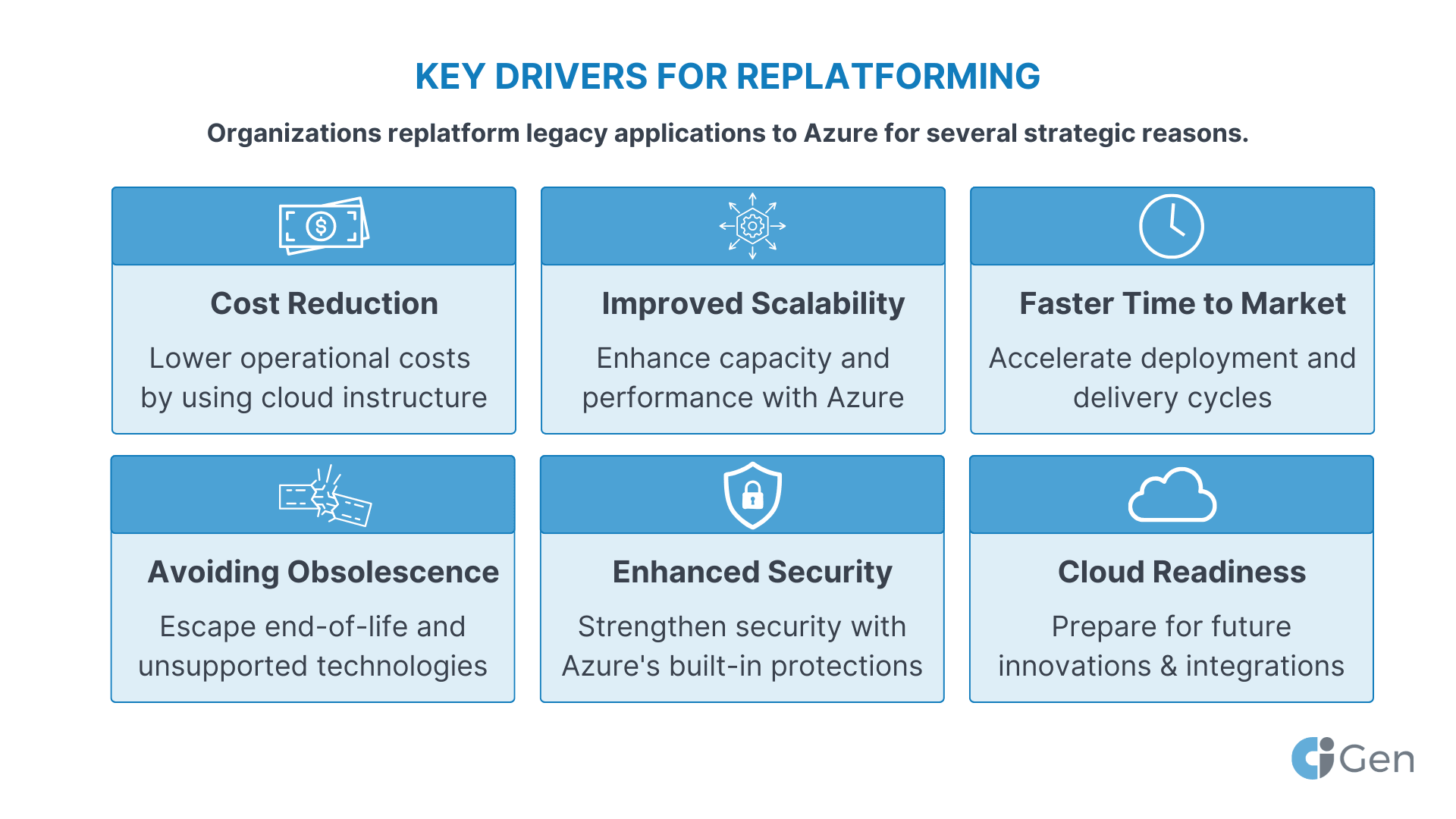
While each of these drivers can independently justify replatforming, the strongest business cases typically emerge when multiple factors converge, for example, when rising infrastructure costs coincide with scalability limitations and growing security requirements. In such scenarios, replatforming provides a controlled path to modernization, delivering immediate improvements while laying the groundwork for deeper transformation initiatives.
What can be replatformed: typical application components
Replatforming is rarely applied uniformly across an entire system. Instead, it targets specific layers of an application stack where modernization can deliver immediate operational or cost benefits without requiring fundamental redesign. In most enterprise systems, several core components can be replatformed independently or in combination, depending on business priorities, technical constraints, and desired outcomes.
1. Application runtime and frameworks
One of the most common replatforming actions involves upgrading the application runtime environment.
Typical examples include:
- Migrating from legacy .NET Framework versions to modern .NET (Core/5+)
- Moving from older Java runtimes to supported, cloud-optimized versions
- Standardizing runtime environments across applications
These changes improve:
- Performance and resource efficiency
- Compatibility with cloud services
- Long-term support and maintainability
Importantly, the application logic itself remains largely unchanged, minimizing development effort while extending system lifespan.
2. Hosting and compute layer
The hosting model is often the primary focus of replatforming.
Common transitions include:
- On-premises servers → cloud-based virtual machines
- Virtual machines → platform-as-a-service (PaaS) environments
- Monolithic deployments → containerized workloads
Within Microsoft Azure, this typically translates to:
- Moving from self-managed infrastructure to services like Azure App Service
- Deploying workloads into container platforms such as Azure Kubernetes Service (AKS)
This shift enables:
- Reduced infrastructure management overhead
- Built-in scaling and availability
- Faster deployment and rollback capabilities
3. Databases and data layer
The data layer is another high-impact area for replatforming, often delivering immediate gains in reliability and operational efficiency.
Typical changes include:
- Migrating from on-premises databases to managed cloud databases
- Moving from self-managed SQL Server to Azure SQL Database or Managed Instance
- Adopting managed PostgreSQL or MySQL services
These transitions provide:
- Automated backups and patching
- High availability by default
- Simplified scaling and performance tuning
In most cases, schema and query logic remain unchanged, keeping the scope aligned with replatforming rather than refactoring.
4. Storage systems
Legacy file storage systems can also be modernized as part of replatforming.
Examples include:
- File servers → object storage (e.g., Azure Blob Storage)
- Local storage → distributed, cloud-based storage systems
Benefits include:
- Lower storage costs
- Improved durability and redundancy
- Easier integration with analytics and data processing tools
5. Integration and API layers
Many legacy systems rely on tightly coupled integrations, which can limit scalability and flexibility.
Replatforming can introduce improvements such as:
- Exposing functionality through modern APIs
- Introducing API gateways (e.g., Azure API Management)
- Standardizing communication protocols
These changes:
- Improve interoperability between systems
- Enable gradual modernization of dependent services
- Support future transition toward microservices architectures
6. Deployment and DevOps infrastructure
Replatforming often includes modernization of how applications are built, deployed, and maintained.
Typical upgrades include:
- Introducing CI/CD pipelines (e.g., Azure DevOps or GitHub Actions)
- Implementing infrastructure as code (IaC) using tools like Bicep or Terraform
- Automating testing and deployment processes
This layer is critical because it:
- Reduces manual effort and operational risk
- Improves release frequency and reliability
- Aligns development practices with modern engineering standards
7. Containerization as a cross-cutting layer
While not always mandatory, containerization is increasingly a core part of replatforming strategies.
Typical approach:
- Package existing applications into containers (e.g., Docker)
- Deploy to orchestration platforms such as AKS
Containerization enables:
- Environment consistency across development and production
- Simplified scaling and deployment
- Greater portability across cloud environments
However, it is important to note that containerization alone does not make an application cloud-native, it is a step toward modernization, not the end state.
8. Selective vs full-stack replatforming
Not all components need to be replatformed at once. Organizations typically choose between:
- Selective replatforming
Targeting specific bottlenecks (e.g., database or hosting layer) for quick wins - Full-stack replatforming
Updating multiple layers simultaneously to maximize efficiency and alignment
The choice depends on:
- Business urgency
- Risk tolerance
- Application complexity
- Available resources
Key takeaways
Replatforming software modernization technique is most effective when approached as a layered transformation, rather than a single migration event.
By focusing on components such as runtime, hosting, data, and DevOps infrastructure, organizations can:
- Achieve measurable improvements quickly
- Reduce operational complexity
- Prepare systems for deeper modernization in the future
In the next chapter, we will explore common patterns and approaches, how these component-level changes are typically implemented in real-world scenarios.
Replatforming patterns and approaches
While the components of an application define what can be replatformed, patterns and approaches define how replatforming is executed in practice. Selecting the right pattern is critical to balancing speed, cost, and long-term flexibility, particularly when working within cloud ecosystems such as Microsoft Azure.
VM to Platform-as-a-Service (PaaS) migration
One of the most common replatforming patterns is transitioning from Infrastructure-as-a-Service (IaaS) to Platform-as-a-Service (PaaS).
Typical scenario:
- Application currently runs on virtual machines (VMs)
- Dependencies include web servers, runtime environments, and OS-level configurations
Replatforming approach:
- Move application to managed services such as Azure App Service
- Remove the need to manage OS patches, scaling, and infrastructure
Outcome:
- Reduced operational overhead
- Built-in scalability and availability
- Faster deployment cycles
This pattern is particularly effective for web applications and APIs that do not require deep infrastructure customization.
Containerization and orchestration
Containerization is increasingly used as a replatforming approach for applications that require more flexibility than PaaS can provide.
Typical scenario:
- Monolithic or multi-tier applications with complex dependencies
- Need for portability across environments
Replatforming approach:
- Package application into containers (e.g., Docker)
- Deploy to orchestration platforms such as Azure Kubernetes Service (AKS)
Outcome:
- Consistent environments across development, testing, and production
- Improved scalability and deployment control
- Foundation for gradual transition toward microservices
This approach is often chosen when organizations want more control than PaaS but are not yet ready for full rearchitecture.
Database modernization
Replatforming frequently includes moving from self-managed databases to managed cloud database services.
Typical scenario:
- On-premises SQL Server or open-source database
- High operational overhead for maintenance, backups, and scaling
Replatforming approach:
- Migrate to managed services such as Azure SQL Database or Managed Instance
- Optimize configurations for cloud performance
Outcome:
- Automated maintenance and patching
- High availability by default
- Improved performance tuning capabilities
This pattern delivers quick wins in terms of reliability and cost efficiency with relatively low risk.
Hybrid replatforming (partial modernization)
Not all applications are suitable for full replatforming in a single phase. Hybrid approaches allow organizations to modernize selectively.
Typical scenario:
- Large, complex systems with tightly coupled components
- High business criticality and low tolerance for disruption
Replatforming approach:
- Modernize specific layers (e.g., database or frontend)
- Retain other components in their existing environment temporarily
Outcome:
- Reduced risk compared to full migration
- Incremental value delivery
- Flexibility to prioritize high-impact areas first
This approach aligns well with portfolio-based modernization strategies.
Incremental vs big-bang execution
Beyond technical patterns, execution strategy plays a critical role in replatforming success.
Incremental approach
- Applications or components are migrated in phases
- Allows for testing, validation, and adjustment at each step
- Lower risk, but potentially longer timelines
Big-bang approach
- Entire application is migrated in a single coordinated effort
- Faster completion, but higher risk and complexity
In practice, most organizations favor incremental replatforming, and big-bang approaches are typically reserved for smaller or less critical systems.
Strangler pattern (adjacent to replatforming)
While more commonly associated with rearchitecting, the strangler pattern can complement replatforming efforts.
- New functionality is built on modern platforms
- Legacy components are gradually replaced over time
In replatforming scenarios, this approach can:
- Reduce reliance on legacy systems
- Enable gradual transition to cloud-native architectures
Automation-first replatforming
Modern replatforming initiatives increasingly rely on automation to reduce risk and improve consistency.
Common practices include:
- Infrastructure as code (IaC) for environment provisioning
- Automated CI/CD pipelines for deployment
- Monitoring and observability tools for validation
This approach ensures:
- Repeatability across environments
- Faster rollout and rollback capabilities
- Reduced human error
Choosing the right pattern
There is no single “best” replatforming pattern. The optimal approach depends on:
- Application architecture and dependencies
- Business criticality and downtime tolerance
- Team capabilities and cloud maturity
- Long-term modernization goals
In many cases, organizations combine multiple patterns, for example:
- Containerizing the application
- Migrating the database to a managed service
- Deploying via CI/CD pipelines
In summary, replatforming is a set of patterns and execution strategies that can be tailored to each application.
The most successful initiatives combine technical patterns with incremental execution, focus on quick wins while enabling future transformation and use automation to ensure consistency and scalability.
Replatforming in Azure: tools and services
Replatforming to Microsoft Azure is less about a single migration step and more about selecting the right managed services to replace legacy infrastructure components. Azure’s strength in replatforming lies in its breadth of platform-as-a-service (PaaS) and container-native offerings, which allow organizations to modernize incrementally while reducing operational overhead.
Below are the core Azure services most commonly used in replatforming initiatives and how they map to typical legacy components.
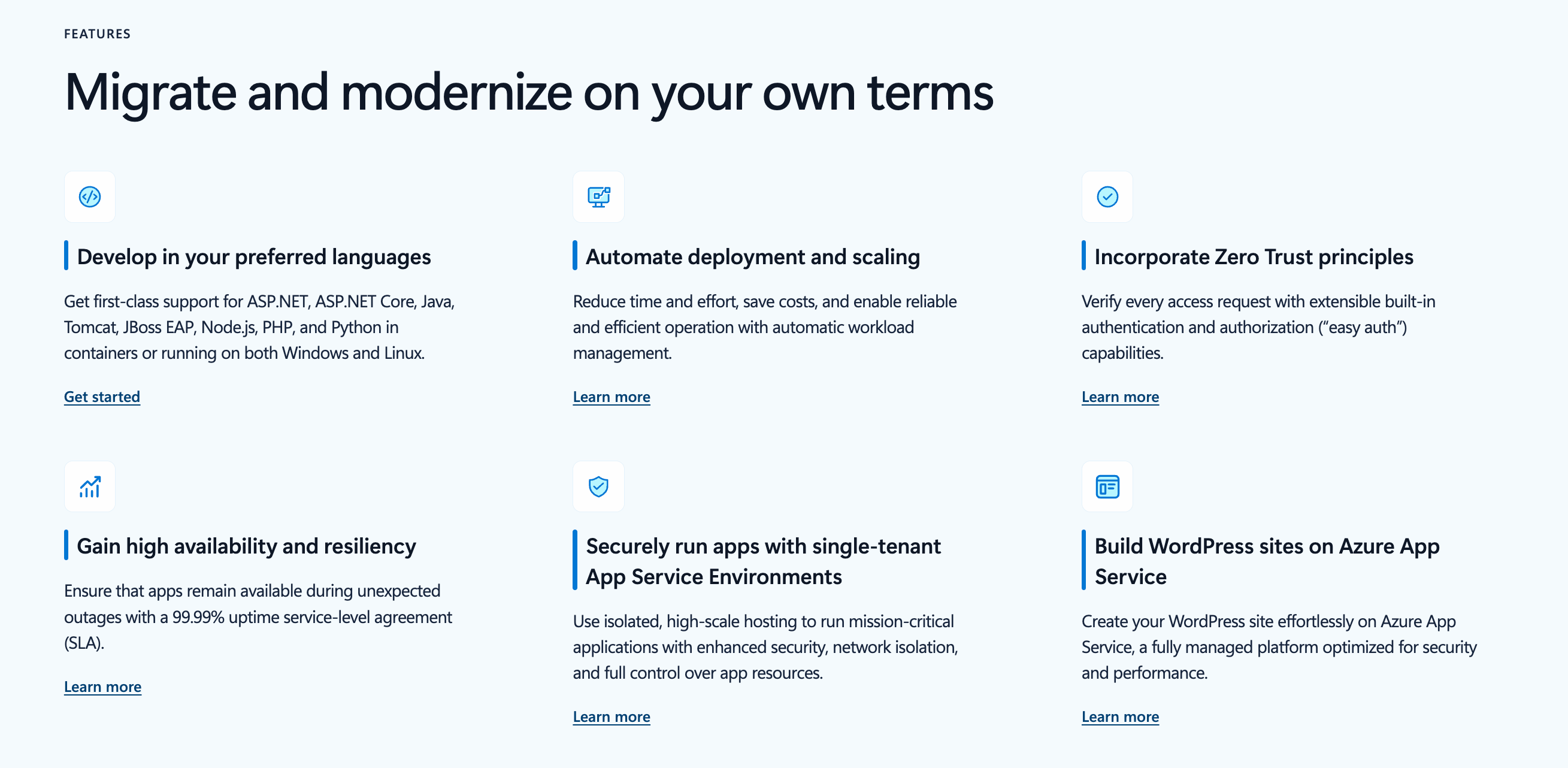
Azure App Service
Azure App Service is often the first step beyond virtual machines in replatforming.
What it replaces:
- IIS-hosted applications on Windows Server
- Self-managed web servers on VMs
Role in replatforming:
- Provides a fully managed environment for hosting web applications and APIs
- Eliminates the need to manage OS patches, scaling, and infrastructure
Key benefits:
- Built-in autoscaling and load balancing
- Native integration with CI/CD pipelines
- Support for multiple runtimes (.NET, Node.js, Java, Python)
Typical use case:
- Migrating monolithic web applications to a managed PaaS environment without code changes
Azure Kubernetes Service (AKS)
Azure Kubernetes Service enables container-based replatforming for more complex workloads.
What it replaces:
- Monolithic deployments on VMs
- Custom container orchestration setups
Role in replatforming:
- Hosts containerized applications with orchestration, scaling, and service management
- Provides flexibility beyond PaaS while still reducing infrastructure management
Key benefits:
- Fine-grained control over deployments and scaling
- Supports microservices transition over time
- Strong ecosystem for observability and networking
Typical use case:
- Replatforming applications that require custom dependencies or gradual decomposition into microservices
Azure SQL Database and Managed Instance
Azure SQL Database and Azure SQL Managed Instance are central to data-layer replatforming.
What they replace:
- On-premises SQL Server
- Self-managed database instances on VMs
Role in replatforming:
- Provide managed database environments with minimal changes to schema and queries
- Reduce operational burden related to backups, patching, and availability
Key benefits:
- High availability and disaster recovery built-in
- Automatic tuning and performance optimization
- Flexible scaling models
Typical use case:
- Migrating existing SQL workloads to the cloud with minimal refactoring
Azure Blob Storage
Azure Blob Storage is commonly used to modernize legacy file storage systems.
What it replaces:
- File servers and network-attached storage (NAS)
- Local disk-based storage systems
Role in replatforming:
- Provides scalable, durable object storage for unstructured data
- Enables integration with analytics and data processing pipelines
Key benefits:
- Cost-effective storage tiers (hot, cool, archive)
- High durability and redundancy
- Easy integration with other Azure services
Typical use case:
- Moving application assets, logs, and documents to cloud-based storage
Azure API Management
Azure API Management modernizes integration layers during replatforming.
What it replaces:
- Custom API gateways or tightly coupled integrations
- Direct service-to-service connections
Role in replatforming:
- Acts as a centralized API gateway for exposing and managing services
- Enables controlled access, versioning, and monitoring
Key benefits:
- Improved security through authentication and throttling
- Standardized API governance
- Easier integration with external systems
Typical use case:
- Exposing legacy functionality as APIs while preparing for service-based architectures
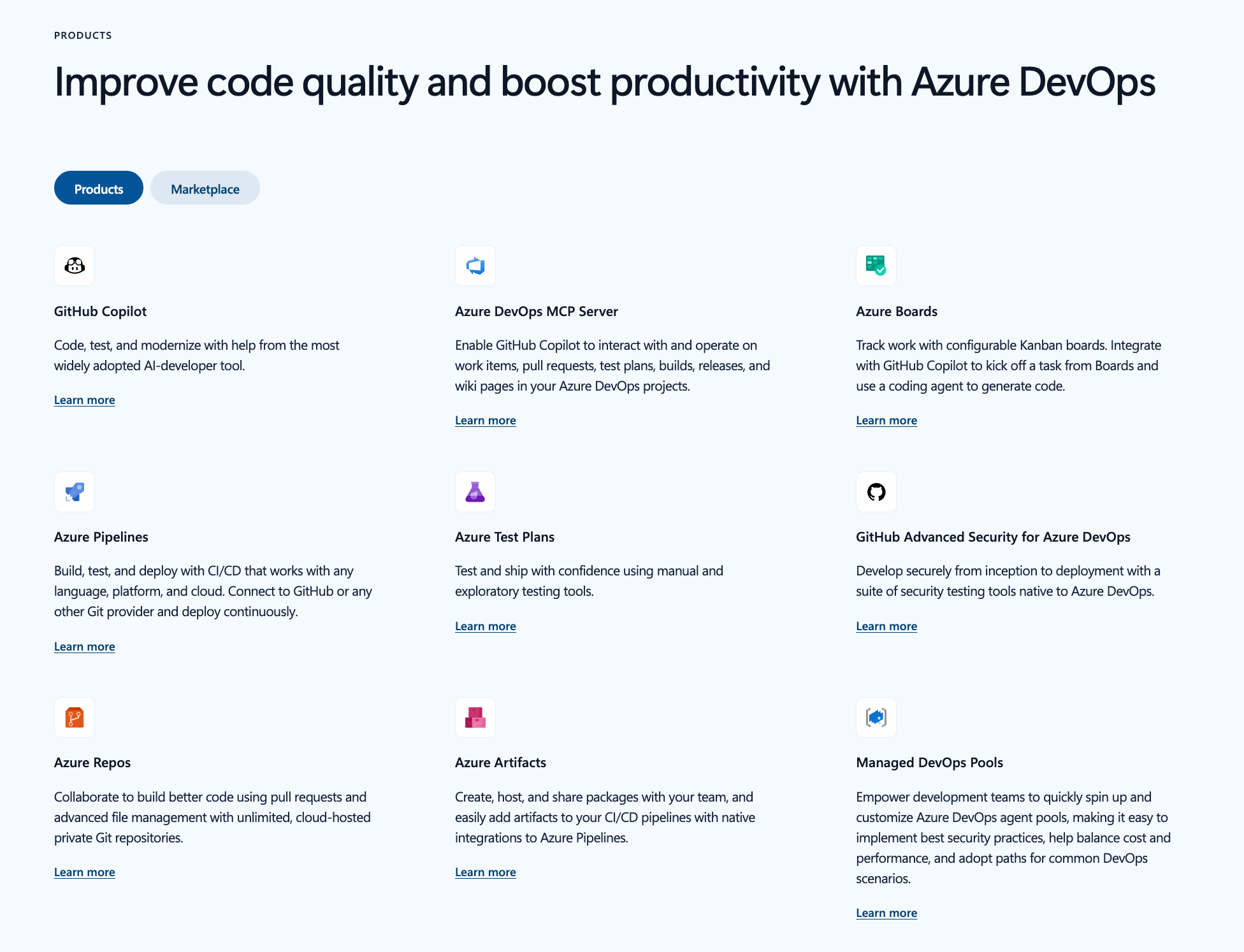
Azure DevOps and GitHub Actions
Azure DevOps and GitHub Actions play a critical role in modernizing delivery processes.
What they replace:
- Manual deployments
- Fragmented build and release processes
Role in replatforming:
- Introduce automated CI/CD pipelines
- Enable infrastructure as code and repeatable deployments
Key benefits:
- Faster and more reliable releases
- Reduced human error
- Improved collaboration between development and operations
Typical use case:
- Establishing modern deployment pipelines alongside infrastructure migration
How Azure accelerates replatforming
Azure’s ecosystem is designed to support incremental modernization, which aligns closely with replatforming principles.
Key acceleration factors include:
Managed services by default
Most Azure services abstract infrastructure management, allowing teams to focus on application-level improvements rather than maintenance tasks.
Flexible migration paths
Organizations can move from IaaS to PaaS or containers progressively, rather than committing to a single approach upfront.
Deep integration across services
Native integration between compute, storage, networking, and DevOps tools simplifies architecture and reduces implementation complexity.
Enterprise-grade security and compliance
Built-in security controls and compliance certifications reduce the effort required to meet regulatory requirements.
Alignment with modernization roadmap
Azure services provide a natural progression:
- Rehost → Azure VMs
- Replatform → App Service / Managed DB / Containers
- Rearchitect → AKS, serverless, event-driven architectures
Summing up, Azure provides a comprehensive set of services that map directly to common replatforming needs, from hosting and data to integration and deployment. This alignment allows organizations to modernize selectively, replacing legacy infrastructure components with managed services while preserving core application logic.
As a result, replatforming to Azure is a structured step toward a more scalable, efficient, and future-ready application landscape.
When is a replatforming software modernization method the right choice?
Thgis software modernization method is often positioned as a balanced approach, but in practice, it is only effective when applied under the right conditions.
Rather than asking whether replatforming is “better” than other approaches, the more relevant question is: Does this path deliver sufficient value within the constraints of time, cost, and risk?
Ideal scenarios: when to use replatforming
It is particularly effective in the following situations:
- Stable but aging applications
Systems that continue to deliver business value but rely on outdated infrastructure or unsupported technologies - Applications with predictable workloads
Workloads that can benefit from cloud scalability without requiring architectural redesign - Сost optimization initiatives
Environments where infrastructure and maintenance costs are increasing without corresponding business value - Portfolio-level modernization programs
When organizations need to modernize multiple applications simultaneously, replatforming allows for consistent, repeatable execution - Preparation for future modernization
Systems that are expected to be refactored or rearchitected later can first be replatformed to reduce risk and complexity
When replatforming services may not be the right choice
Despite its advantages, it is not always the optimal path:
Applications with significant technical debt in code
If core issues are embedded in the application logic rather than infrastructure, replatforming will not address root causes.
Systems requiring rapid innovation or differentiation
Applications that need to support new business models, advanced analytics, or AI capabilities may require refactoring or rearchitecting instead.
Highly inefficient architectures
Monolithic systems with poor scalability characteristics may see limited benefit from infrastructure-level improvements alone.
End-of-life systems
Applications that are no longer aligned with business needs may be better candidates for replacement rather than incremental improvement.
Balancing short-term gains and long-term strategy
A common misconception is that choosing replatforming delays “real” modernization. In practice, it often enables it.
By improving infrastructure, standardizing environments, and introducing modern deployment practices, this option:
- Reduces operational friction
- Improves system observability
- Creates a more stable baseline for future changes
This allows organizations to sequence modernization more effectively, prioritizing high-impact transformations while maintaining business continuity.
In summary, replatforming is the right choice when speed and risk mitigation are priorities, infrastructure inefficiencies outweigh architectural limitations, and organizations need to establish a cloud foundation quickly
It is less suitable when core application issues require deep code-level changes and/or strategic differentiation depends on architectural transformation.
In conclusion
Replatforming has emerged as one of the most pragmatic approaches among legacy application modernization methods, positioned between minimal-change migrations and full-scale architectural transformation. It enables organizations to transition to cloud environments such as Microsoft Azure while introducing targeted improvements that deliver immediate operational and financial benefits.
From an executive perspective, the value of replatforming lies in its balance. It allows organizations to:
- Reduce infrastructure and maintenance overhead
- Improve scalability and performance
- Introduce modern engineering practices such as CI/CD and automation
- Minimize disruption to business-critical systems
At the same time, it avoids the complexity, cost, and risk associated with large-scale rewrites.
However, replatforming should not be viewed as an end state. It is most effective when treated as part of a broader modernization roadmap, one that may later include refactoring, rearchitecting, or adopting cloud-native patterns as business needs evolve.
Ultimately, the decision to replatform comes down to alignment:
- Alignment between business goals and technical capabilities
- Alignment between short-term gains and long-term strategy
- Alignment between available resources and desired outcomes
When applied in the right context, replatforming delivers measurable value quickly, while creating a more flexible foundation for future innovation, including data-driven initiatives and AI-enabled capabilities.

.jpg)