
Get your case-specific AI use cases for Logistics:
20 Ideas for all maturity levels
Which AI use cases fit your logistics operation? Find out in under a minute.
Answer two quick questions and get a personalized PDF: the AI use cases best matched to your company size and current AI maturity, each with the technical detail your team needs to evaluate it. Not a generic idea list, a shortlist built for where you actually are.
Get your detailed custom use cases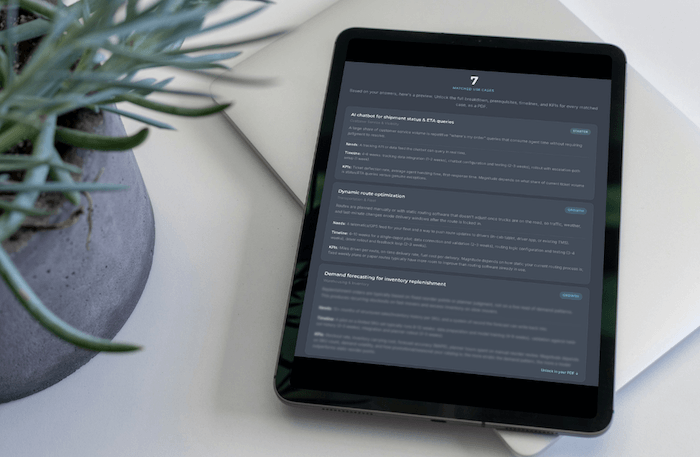
How this AI use case discovery tool supports confident logistics AI decisions
Answer two questions and get the 5–7 use cases with technical details that actually fit your size and maturity.
Get a clean PDF built for pasting into a slide or forwarding to a stakeholder, not a screenshot of a chat.
Each use case is tagged by complexity, so you know which ones are quick wins and which ones need groundwork first.
Every matched case includes what it needs to start, a realistic timeline, and the KPIs it affects, not just a one-line pitch.
A single-site operation just starting with AI and a multi-depot network already scaling AI get genuinely different shortlists, not the same list with a different logo.
Get a bonus link to all 20 logistics AI use cases across the value chain, no extra form required.
Key features of the AI in Logistics use case discovery tool
This interactive tool helps you find the AI use cases with the best fit for your logistics operation right now. It combines a short 2-question matcher with a curated library of 20 real logistics AI use cases, each documented with the technical depth stakeholders actually ask for.
Not sure where to start with AI in logistics?
Get inspired by 20 logistics-specific AI automation ideas that help cut freight costs, improve on-time delivery, reduce stockouts, strengthen driver safety, and free up staff hours on manual work
What you'll get for every use case in your report
Every use case we discover for you goes deeper than a one-line idea. Here's exactly what you'll see for each one you're matched with.
The specific operational pain point this use case addresses, in plain business language, not a vague "AI can help here."
A warehouse team manually recounting inventory that's already drifted from what the WMS shows.
The actual mechanism behind the use case, forecasting model, computer vision, document extraction, telematics-driven scoring, so your team knows what kind of build this really is.
A route optimization use case isn't "AI magic," it's a live-data-fed optimization engine re-solving the route as conditions change.
The realistic data and system prerequisites, stated honestly, including when a use case needs almost nothing to pilot.
A returns-triage use case needs your existing return-intake data, nothing new. A predictive maintenance use case needs sensors you may not have yet.
The KPIs this use case affects. We name the metrics, not a fabricated percentage, since real impact depends on variables specific to your operation.
A carrier-selection use case moves freight cost per shipment, carrier on-time performance, and claims rate together, not just one number.
A realistic build-and-pilot timeframe based on the use case's complexity, so you know what you're signing up for before you start.
A shipment-status chatbot is a 4–6 week build. A compliance classification assistant is 3–5 months, given the accuracy bar it has to clear.
Tool limitations: when expert scoping is required
This AI use case discovery tool gives you a fast, directional shortlist of relevant AI use cases for your logistics operation. It helps you decide where to look first, it isn't a substitute for technical discovery or a full feasibility assessment on any single use case.
Where experts help: Once you've picked a use case from your shortlist, our AI Agent Feasibility & Cost Estimator gives you a real score, cost range, and timeline for that specific idea.
Where experts help: A short scoping call validates what your actual systems support before you commit engineering time.
Where experts help: Use our AI Use Case Prioritization Template to rank candidates side by side once you've shortlisted a few.
Where experts help: Specialists design the compliance and access-control layer around the use case from day one.
Signals of a strong fit
Not every logistics operation is equally ready to act on an AI use case shortlist.
These signals are worth checking before you run the generator.
Manual hours tied up in repetitive processes
Route planning, exception handling, and status queries that consume real staff time each week are where AI use cases show the clearest return.
Existing systems already generating data
A TMS, WMS, or telematics platform already in place gives most of these use cases a data foundation to build on, rather than starting from zero.
A next AI initiative on the roadmap
Whether you're piloting your first AI project or scaling your fifth, having a decision-maker ready to act on a shortlist is what turns a match into a pilot.
Next steps: turning your matched use cases into action
This tool helps you find the right starting point among 20 logistics AI use cases. Once you have your shortlist, here's how to move forward.
Answer two questions about your company size and AI maturity. The entire process with the use case generation takes a minute or two, depending on internet connection.
See your match count and a preview of two full use cases immediately, without providing any data.
Get the complete technical detail, prerequisites, timeline, and KPIs, for every matched use case as a PDF, plus the bonus full 20-case library in your inbox.
Once you've picked a use case (or a few) worth pursuing, use the AI Use Case Prioritization Template to rank them against other initiatives on your roadmap.
For a more detailed feasibility score and quote on a specific use case, book a short call. It's a no-obligation engagement that's value-packed, regardless.


