The construction industry is undergoing a steady shift toward digital operations as companies face persistent challenges such as labour shortages, rising material costs, complex regulatory requirements, and frequent schedule deviations. Artificial intelligence (AI) has become a central part of this transformation, offering data-driven methods to improve planning accuracy, strengthen safety measures, enhance quality control, and reduce operational inefficiencies.
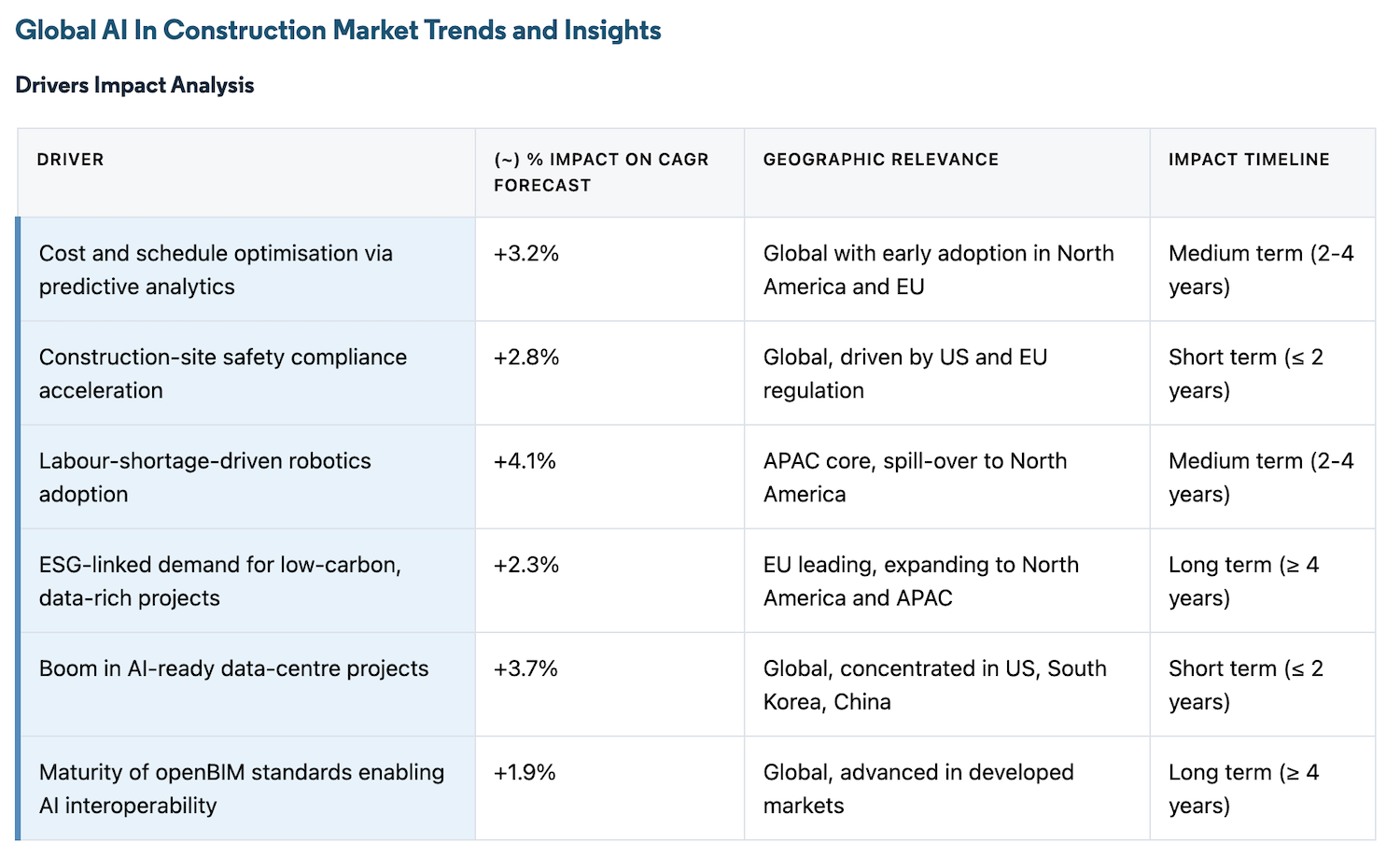
AI agent development and adoption in construction is also supported by significant market momentum. According to Mordor Intelligence, the AI in construction market is expected to reach USD 24.3 billion by 2030 from 11.2 billion in 2025 with a CAGR of 16.9%. This growth is driven by the increasing availability of site data, from BIM models and project schedules to drones, sensors, and telematics, as well as the rapid maturation of machine learning, computer vision, and generative AI technologies. Large general contractors, infrastructure builders, and industrial developers are already applying AI solutions to tasks such as schedule forecasting, defect detection, and equipment maintenance, with measurable improvements in cost and delivery performance.
This article examines the technologies that enable AI in construction, the practical applications shaping modern project delivery, and the implementation strategies organizations use to adopt AI effectively.
Core technologies powering AI in construction
AI adoption strategy in construction relies on a combination of machine learning, computer vision, generative models, IoT hardware, and BIM-driven data structures. These technologies work together to transform raw project information, like schedules, drawings, sensor feeds, drone imagery, procurement logs, into insights that can improve decision-making throughout the project lifecycle. The sections below explain how each technology functions and why it matters for real-world construction environments.
Machine Learning and predictive analytics
Machine learning models identify operational patterns that are difficult to detect manually due to the scale and variability of construction projects. These models are trained on historical data such as duration logs, change orders, submittal timelines, equipment records, weather histories, and procurement events.
Common model families used in construction workflows include:
- Gradient Boosting Machines (GBMs): Effective for predicting schedule delays, cost variance, or productivity drops because they handle noisy, mixed-type data.
- Random Forests: Useful for risk classification and early-warning systems (e.g., flagging activities likely to overrun based on precedent).
- Time-series forecasting models: Applied for demand forecasting, equipment usage prediction, and delivery timing estimations.
- Anomaly detection algorithms: Identify outliers such as unusual sensor readings, abnormal equipment movement, or unexpected material consumption.
Typical predictive analytics pipeline in construction follows these stages:
- Data ingestion (BIM metadata, daily reports, weather feeds, telematics).
- Feature engineering (e.g., converting schedule logic into numerical features such as activity density, dependencies, or resource loading).
- Model training and validation.
- Integration into dashboards for project managers.
- Continuous monitoring and retraining as conditions change.
Machine learning is especially valuable in preconstruction planning, schedule and risk forecasting, equipment maintenance, and logistics optimization.
Computer vision for safety and quality
Construction sites generate significant visual data from CCTV systems, drones, handheld cameras, and 360° site walkthrough tools. Computer vision models process this imagery to detect safety risks, quality defects, and deviations from design intent.
Core models and techniques include:
- Convolutional Neural Networks (CNNs): Learn visual patterns such as cracks, misalignments, missing elements, or surface imperfections.
- Object detection models (YOLO, Faster R-CNN, Mask R-CNN): Identify people, machinery, materials, and unsafe conditions (e.g., missing PPE, workers entering restricted areas).
- Segmentation models: Useful for detailed assessment of structural elements or material boundaries.
Common outputs include:
- Automated detection of unsafe practices.
- Daily quality reports comparing photos to BIM geometry.
- Drone-based scanning for progress verification.
- Detection of early-stage defects in concrete, steel, or MEP installations.
These systems reduce manual inspection workloads and offer a structured way to convert visual site data into measurable insights.
Generative AI for design and planning
Generative AI supports construction planning by producing design alternatives, drafting documentation, and simulating workflows.
Typical applications:
- Generative layout optimization: Produces multiple building configurations that respect design rules, structural constraints, energy performance criteria, and material usage goals.
- Construction sequencing simulation: Generative models can propose optimized activity sequences, crane locations, or equipment routing strategies.
- Documentation automation: Large Language Models (LLMs) help with RFI drafting, summarization of design packages, and interpretation of building codes.
- Scenario exploration: Planners can test how different material choices, weather scenarios, or resource levels influence schedule feasibility.
Generative AI does not replace engineering judgment, but it accelerates the exploration of viable options and reduces time spent on repetitive design or documentation tasks.
IoT sensors, telematics, and edge AI
Many AI applications in construction rely on continuous data streams from sensors and connected equipment.
Key components include:
- Environmental sensors: Track temperature, humidity, vibration, dust levels, and curing conditions.
- Telematics systems on machinery: Record fuel consumption, idle time, hydraulic pressure, operator behaviour, and GPS location.
- Wearable devices: Monitor worker movement patterns to detect fatigue or unsafe interactions with equipment.
- Edge AI modules: Process data locally on devices for low-latency safety detection when network connectivity is limited.
These systems enable predictive maintenance, monitor structural conditions, and feed real-time site intelligence into project management platforms.
BIM and AI integration
Building Information Modeling (BIM) acts as the data backbone for many AI workflows. BIM models structure geometric, material, and schedule information in a machine-readable format, enabling AI tools to interpret construction intent with higher accuracy.
Key integration points:
- AI-enhanced clash detection: Models detect conflicts based not only on geometry but on historical patterns (e.g., MEP installations that typically cause sequencing issues).
- As-built vs as-designed comparison: Computer vision outputs are matched to BIM coordinates to verify that installations meet design specifications.
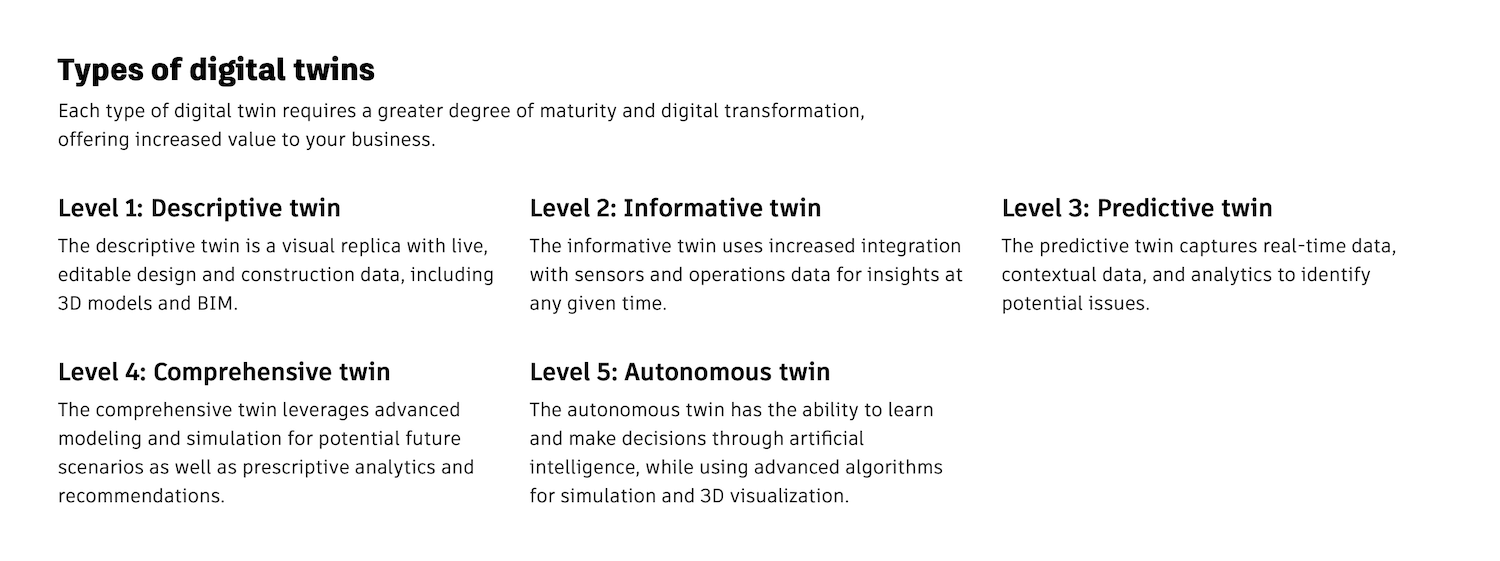
- Digital twins: BIM models linked to live sensor feeds create up-to-date representations of buildings for performance analysis and predictive maintenance.
- 4D/5D simulation improvements: AI models refine schedule and cost data linked to BIM elements to create more reliable 4D (time) and 5D (cost) forecasts.
BIM + AI integration increases transparency, supports earlier issue detection, and simplifies multidisciplinary coordination.

Practical AI applications across the construction lifecycle
AI supports construction activities from early planning through execution and facility operations. The following sections outline how AI technologies are applied across each stage of a project, with real examples demonstrating measurable outcomes and technical implications.
Pre-construction phase
Cost estimation and quantity takeoff automation
Cost estimation relies heavily on historical pricing data, project specifications, drawings, and subcontractor inputs. AI models improve accuracy by learning from past projects and automating extraction of quantities from documents and BIM files.
Technical components include:
- NLP for document parsing: Identifies quantities, materials, and specifications within PDFs or scanned drawings.
- ML-based bid estimation models: Predict likely costs for labour, materials, and equipment based on project type, location, and historical trends.
- BIM-linked estimators: Automatically extract material volumes and quantities directly from model elements.
Real-life case example:
Skanska trialled an AI-enabled cost and carbon estimating tool that automates BIM processes to simulate design options and material quantities, replacing manual measurement methods and supporting faster pre-construction estimation on HS2 project sites.
Scheduling and risk prediction
Construction schedules contain thousands of dependencies, making it difficult to anticipate bottlenecks or delays manually. AI models analyze historical schedule data and external variables to predict where risks may emerge.
Key technical elements:
- Predictive models trained on historical durations, change orders, and risk logs.
- Weather-linked forecasting using time-series models.
- Monte Carlo simulations enhanced with ML-generated probability distributions.
- NLP analysis of RFIs, submittals, and progress reports to detect early signs of delay.
Real-life case example:
Parsons Corporation uses artificial intelligence across its infrastructure and mission solutions to analyze complex data and enable predictive modelling that supports decision-making and risk evaluation in project management workflows.
Generative design and construction sequencing
Generative AI enhances design and planning workflows by creating alternatives aligned with specific constraints, such as energy performance, material limits, structural rules, or cost benchmarks.
Technical approach:
- Constraint-based generative algorithms: Produce thousands of design variations for evaluation.
- Reinforcement learning (RL): Optimizes equipment paths or sequencing strategies.
- Energy and daylight simulations: Evaluated automatically against generated layouts.
- 4D sequence generation: AI proposes optimal order of construction tasks.
Real-life case example:
Autodesk Research collaborated with Dutch construction company Van Wijnen to apply generative design workflows for producing residential and urban layout options using data-driven design exploration tools integrated with BIM software.
Construction phase (on-site operations)
Safety monitoring with computer vision
Construction safety issues often arise from inconsistent PPE use, equipment blind spots, and complex interactions between workers and machinery. Computer vision models automate hazard detection using camera feeds and drone footage.
Technical foundations:
- Object detection models identify helmets, vests, machinery, and unsafe behaviours.
- Spatial analytics determine worker proximity to hazardous zones.
- Edge inference allows real-time detection without sending all video to the cloud.
Real-life case example:
Computer vision-based AI systems are being developed to monitor worker safety on construction sites by detecting whether personnel are wearing required personal protective equipment (PPE) such as helmets, vests, and safety shoes, supporting automated compliance reporting and hazard prevention.
Quality control and defect detection
Quality inspections often rely on heavily manual processes. AI improves consistency by detecting defects in real time.
Technical details:
- CNNs classify and detect defects such as cracks, misaligned installations, or incomplete assemblies.
- Drone scanning provides high-resolution imagery mapped to BIM coordinates.
- Photogrammetry + AI validates work progress and dimensional accuracy.
Real-life case example:
DPR Construction uses reality capture technologies, such as laser scanning and aerial capture, in its Virtual Design and Construction workflow to validate as-built conditions against BIM models and improve quality control by identifying deviations early in the construction process.
Equipment optimization and predictive maintenance
Construction equipment downtime can significantly affect critical path activities. AI-driven telematics models predict maintenance needs and optimize usage.
Key technologies:
- Telematics data (engine temp, hydraulic pressure, idle time).
- Anomaly detection algorithms identifying early signs of equipment stress.
- Predictive maintenance models forecasting component failure windows.
- Route optimization for hauling and earthmoving operations.
Real-life case example:
Caterpillar’s connected equipment and analytics platforms, such as VisionLink® and other Cat® connectivity solutions, collect telematics data from machines and provide equipment health insights that help owners prioritize maintenance, reduce downtime, and improve operational efficiency. These tools use advanced data analysis to transform sensor and usage data into actionable recommendations that support predictive maintenance and fleet utilization decisions.
Productivity and resource allocation analytics
AI helps project managers optimize work assignments and material flows based on project constraints and real-time data.
Technical aspects:
- Workforce allocation models match labour availability with task requirements.
- Material consumption forecasting predicts shortages or surplus.
- Logistics routing models reduce wait times for deliveries or equipment.
Real-life case example:
Bechtel uses AI and predictive analytics to evaluate project data and better understand schedule correlations, supporting risk mitigation and informed decision-making in complex project environments.
Post-construction and operations
Predictive maintenance for building systems
Large buildings rely on continuous monitoring of elevators, HVAC units, pumps, and other systems. AI helps operators predict failures and optimize maintenance activities.
Technical mechanisms:
- Sensor data fusion combining vibration, temperature, acoustic signals, and pressure readings.
- Failure prediction models identifying patterns that precede breakdowns.
- Real-time anomaly detection to catch unexpected deviations.
Real-life case example:
The Burj Khalifa uses intelligent predictive maintenance systems that monitor facility equipment—including elevators and other critical loads—by collecting real-time sensor data and applying condition-based analysis to help facility teams identify potential issues early and improve operational reliability.
Digital twins for lifecycle management
Digital twins integrate BIM data with real-time performance metrics to create a continuously updated model of the building.
Technical components:
- BIM as the core data structure with geometry and metadata.
- IoT integration feeding live environmental and equipment data.
- AI-driven forecasting for energy performance, occupancy trends, and system degradation.
Digital twins help owners make informed decisions about maintenance, retrofitting, and operational efficiency.
These applications illustrate how AI supports construction teams during planning, execution, and long-term facility operations.
Implementation strategies for adopting AI in construction
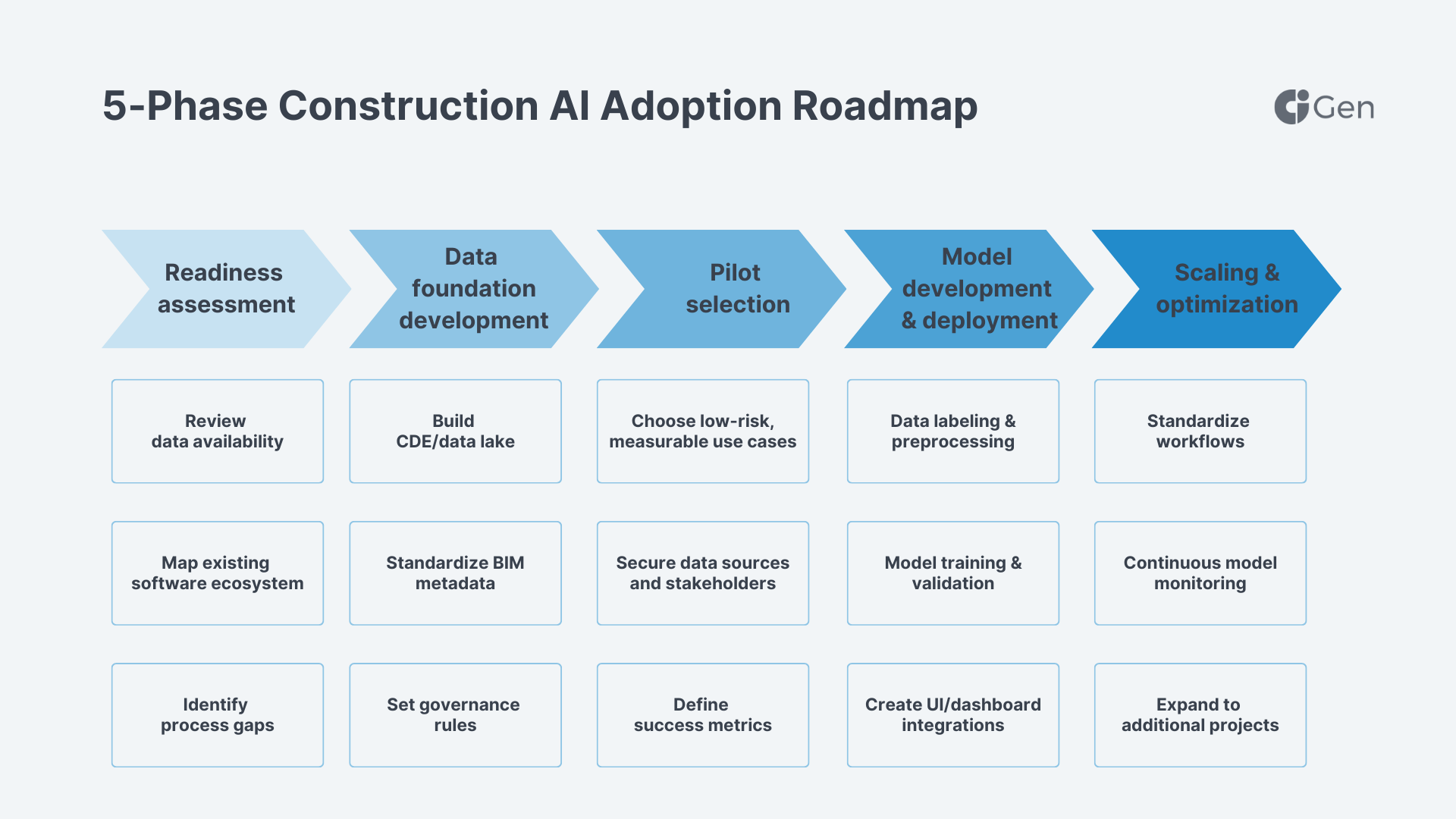
Introducing AI into construction operations requires more than deploying algorithms. Successful adoption depends on structured planning, accessible data, clearly defined objectives, and coordination between engineering, operations, and IT teams. The following implementation strategies outline how organizations typically approach AI adoption, focusing on practical steps rather than theoretical maturity models.
Assessing organizational readiness
Before selecting tools or partners, construction companies evaluate their existing digital capabilities and project delivery processes. Key areas of assessment include:
- Data availability and quality:
BIM maturity, historical project data, schedule logic, telematics records, safety logs, and photography workflows. Fragmented or inconsistent data will limit AI accuracy until standardized. - Existing software ecosystem:
Prevalence of BIM systems, ERPs, project management tools, or CDEs (Common Data Environments) that can act as data sources for AI pipelines. - Technical capacity:
Availability of cloud infrastructure, integration tools (APIs, middleware), and internal IT resources to support implementation. - Process variability:
Repetitive, data-rich processes (e.g., scheduling, inspections, equipment usage) usually provide more immediate value for pilot projects.
A readiness assessment helps identify realistic starting points and prevents premature investment in complex systems.
Building a scalable construction data foundation
AI systems require consistent and interpretable data. Building a scalable data foundation ensures that models can be trained, validated, and maintained reliably.
Typical components include:
- Common Data Environment (CDE):
Centralized storage for drawings, BIM models, RFIs, reports, and logs. - Data lake or warehouse:
Structure for integrating BIM metadata, IoT streams, telematics, cost data, and schedules into a uniform schema. - Data governance framework:
Defined rules for naming, versioning, access permissions, retention, and documentation. - BIM integration:
Establishing consistent object attributes, classification standards (e.g., IFC, COBie), and linking BIM elements to schedule and cost codes.
With these foundations in place, downstream AI models perform more consistently and require less manual data cleaning.
Selecting practical pilot projects
Organizations typically begin with pilot projects that:
- Have clear, measurable outcomes (e.g., reduced inspection time, improved schedule reliability).
- Use data that is already accessible.
- Pose minimal operational risk if outputs are inaccurate during early iterations.
- Can be evaluated within a few months.
Common pilot areas include:
- Computer vision for PPE detection or defect identification
- Predictive scheduling based on historical patterns
- Automated quantity extraction from designs
- Predictive maintenance using telematics and IoT sensors
Pilot results inform decisions about long-term scaling and resource allocation.
Developing and deploying AI models
Once a pilot is selected, teams define the technical workflow for model development and operation.
Typical stages:
- Data labeling and preparation:
Images, BIM elements, logs, and sensor data are annotated and formatted for training. - Model training and validation:
Teams test multiple algorithms: CNNs for vision tasks, gradient boosting for forecasting, anomaly detection for equipment behaviour, selecting the best-performing model. - Deployment environment:
Models may run on cloud infrastructure, edge devices (for real-time camera analysis), or integrated project software platforms. - Monitoring and ongoing improvements:
AI models degrade when project conditions or data distributions change. Continuous monitoring flags model drift and triggers retraining cycles. - User interface and integration:
AI outputs are incorporated into existing tools: dashboards, mobile apps, digital checklists, ensuring site teams can act on insights quickly.
This development loop continues beyond the pilot as the model’s performance stabilizes.
Integrating AI into existing systems
AI adoption is most effective when integrated into established construction workflows rather than functioning as a separate tool.
Key integration points include:
- BIM workflows: Linking model outputs to object attributes or conflict detection processes.
- Project management platforms: Feeding predictions into schedule dashboards or cost tracking systems.
- Field management apps: Providing real-time alerts on mobile devices for safety or quality issues.
- ERP systems: Aligning AI outputs with procurement, equipment allocation, and financial reporting.
Clear integration reduces workflow friction and increases user adoption among project teams.
Scaling AI across projects
Scaling AI beyond initial pilots requires organizational processes rather than purely technical effort.
Typical scaling considerations:
- Standardized data collection: Ensuring all projects follow consistent reporting and metadata practices.
- Training and change management: Introducing field teams and managers to new AI-supported workflows.
- Governance structure: Defining responsibilities for model oversight, data stewardship, and compliance.
- Vendor and partner strategy: Establishing long-term relationships with technology partners and ensuring interoperability with existing systems.
- Budget planning: Allocating resources for ongoing model maintenance, cloud consumption, and infrastructure upgrades.
Organizations that scale AI successfully tend to focus on incremental rollouts, moving from one use case to several, then deploying across multiple projects.
Risks, limitations, and considerations
While AI offers measurable advantages across construction planning, execution, and operations, its adoption also introduces technical, operational, and ethical considerations. Understanding these risks early helps organizations design implementations that are both effective and responsible.
Data privacy and worker monitoring concerns
Many AI applications, particularly those involving computer vision and wearables, capture images or behavioural patterns of workers. This introduces important privacy and compliance considerations.
Key issues include:
- Worker consent and transparency:
Teams must understand what data is being collected, how it is used, and how long it is retained. - Regulatory compliance:
Projects in the EU must consider GDPR requirements, including lawful bases for processing video or geolocation data. Other regions may have local privacy laws requiring similar controls. - Purpose limitation:
Safety monitoring, productivity analytics, and behavioural assessment must be clearly distinguished to avoid misuse or unintended monitoring of individuals. - Security protections:
Raw imagery, sensor data, and access logs require encryption, access controls, and secure storage policies to prevent unauthorized access.
Construction companies adopting AI-based monitoring must balance technology benefits with clear communication and ethical handling of personal data.
Model accuracy, validation, and liability
AI models can produce inaccurate predictions if underlying data is inconsistent or if project conditions shift beyond what the model has seen before.
Common risks include:
- False positives and false negatives:
For safety and quality applications, incorrect alerts may cause operational disruptions or missed hazards. - Model drift:
Seasonal weather changes, new construction methods, or equipment variations can degrade accuracy, requiring periodic retraining. - Explainability limitations:
Complex models, such as deep neural networks, may be difficult to interpret, complicating decision-making and regulatory review. - Liability allocation:
If an AI-influenced decision contributes to an incident or defect, responsibility between contractors, technology vendors, and project owners must be clearly defined.
To mitigate these risks, teams typically use validation frameworks, human-in-the-loop review processes, and clear documentation of model assumptions and limitations.
Integration challenges with existing systems
Construction technology environments often include a mix of legacy tools, paper-based processes, point solutions, and discipline-specific software. AI systems need a cohesive data backbone to operate reliably.
Key integration challenges:
- Fragmented data structures:
BIM models, schedules, IoT sensors, ERP data, and field reports may use incompatible formats or naming conventions. - Limited connectivity on sites:
Bandwidth constraints can hinder real-time video analytics or cloud data synchronization, especially on remote or large-scale sites. - Inconsistent reporting practices:
Variability in how project teams document progress or issues can reduce data quality and hinder model accuracy. - Vendor ecosystem complexity:
Ensuring interoperability between BIM tools, project management systems, and AI platforms requires careful architectural planning.
Overcoming these challenges typically involves establishing standardized data schemas, strengthening digital workflows, and investing in a unified platform architecture.
Organizational resistance and change management
AI adoption often requires changes in long-established field practices, which may lead to hesitation among project teams.
Typical sources of resistance include:
- Preference for familiar manual workflows
- Concerns about job displacement or oversight
- Lack of training or confidence in digital tools
- Unclear ownership of new AI-supported processes
Effective change management strategies, clear communication, practical training, and demonstrating early value—help increase adoption and trust in AI-driven insights.
Cost, scalability, and long-term maintenance
AI is not a one-time deployment. Ongoing work is required to maintain infrastructure, models, and integrations.
Key considerations include:
- Cloud and storage costs:
Computer vision and IoT applications generate large volumes of data requiring scalable storage and compute resources. - Model lifecycle management:
Periodic retraining and performance evaluation ensure that predictions remain relevant and accurate. - Vendor lock-in risk:
Proprietary solutions may limit flexibility or interoperability with other systems. - Scalability across multiple projects:
What works as a pilot may need redesign to function reliably across diverse project types, geographies, and subcontractor structures.
Clear budgeting and long-term planning help organizations sustain AI value while avoiding fragmented or short-lived deployments.
Future trends in AI for construction
AI capabilities in construction are expected to expand steadily over the next five years as data becomes more structured, computing resources become more accessible, and stakeholders adopt more standardized digital workflows. The following trends illustrate how AI is likely to evolve and what construction teams may expect as these technologies mature.
Greater adoption of autonomous and semi-autonomous machinery
Advances in computer vision, sensor fusion, and path-planning algorithms will support broader use of autonomous or operator-assisted equipment, especially for repetitive or hazardous tasks. Earthmoving, grading, compaction, and material transport operations are strong candidates for automation due to their predictable patterns and measurable performance criteria.
Key developments may include:
- Semi-autonomous dozers, excavators, and haul trucks with AI-assisted controls
- Real-time obstacle detection for improved on-site safety
- Continuous performance optimization based on telematics data
- Integration with digital terrain models and 4D schedules
These systems aim to improve consistency, reduce operator fatigue, and enhance safety.
Real-time generative design and simulation
Generative design tools will continue to move from early-stage planning into more integrated project workflows. Improvements in computational efficiency and constraint handling may enable project teams to use generative tools in near real time.
Likely developments:
- Design alternatives generated instantly based on updated requirements
- Automated reconciliation of structural, architectural, and MEP constraints
- Real-time feedback loops between BIM, energy models, and cost databases
- Dynamic construction sequencing adjustments driven by field conditions
These capabilities may reduce iteration cycles and improve coordination between disciplines.
AI-driven procurement and supply chain forecasting
Supply chain reliability has become a priority following recent global disruptions. AI models are expected to play a stronger role in forecasting material availability, lead times, and price fluctuations.
Potential applications:
- Predictive models estimating future material costs
- Automated evaluation of supplier performance and risk indicators
- Optimization of procurement schedules to reduce delays
- Identification of alternative materials or suppliers based on constraints
Better supply chain predictability can support more reliable planning and reduce contingency costs.
Enhanced integration of AI with digital twins
Digital twins are increasingly used to monitor and optimize building operations. Between 2025 and 2030, AI is likely to enable digital twins that not only display real-time conditions but also forecast performance and recommend interventions.
Expected advancements:
- Predictive models linked to system components (HVAC, vertical transport, lighting)
- Automated anomaly detection with minimal human supervision
- Simulation of maintenance scenarios to support budget planning
- Integration of occupancy and energy data for operational optimization
AI-enhanced digital twins may play a central role in long-term asset management and sustainability initiatives.
Standardization of data formats and interoperability
Construction data is currently fragmented across systems and disciplines. Broad adoption of open standards, along with policy initiatives in several regions, may accelerate data harmonization.
Likely changes:
- Greater use of IFC, COBie, and ISO 19650-compliant workflows
- APIs enabling interoperability between BIM, project management, and AI platforms
- Unified data layers that reduce manual data transfers
- Increased adoption of cloud-based common data environments
With more standardized data, AI models can be deployed faster and at larger scale.
Expanded use of AI for sustainability and carbon analysis
Environmental performance is becoming a central design and operational priority. AI tools are expected to support carbon accounting, material selection, and energy optimization.
Possible developments:
- Predictive models estimating embodied carbon across design alternatives
- Automated comparison of material options based on lifecycle impacts
- Optimization algorithms for reducing construction waste
- AI-assisted energy modelling for operational efficiency
Sustainability-related AI applications may become compulsory in some jurisdictions as regulations evolve.
Increased focus on federated learning and secure data collaboration
Since construction projects involve multiple parties, general contractors, subcontractors, design teams, and owners, sharing raw data is often impractical due to confidentiality concerns. Federated learning offers a way to train models across distributed datasets without centralizing sensitive information.
Potential benefits:
- Improved model accuracy without exposing private project data
- Broader industry collaboration while maintaining contractual boundaries
- More representative models for safety, scheduling, and cost prediction
- Reduced barriers to cross-company AI research
This approach may become essential for advancing industry-wide AI capabilities.
Conclusion
AI is becoming a practical component of modern construction management, supporting activities ranging from early-stage design and cost estimation to site safety monitoring, equipment optimization, and lifecycle operations. Its value stems from the ability to process large volumes of project data, identify patterns that are not easily visible to manual inspection, and provide actionable insights that improve schedule reliability, safety performance, and operational efficiency.
Successful adoption, however, depends on more than deploying technical tools. Organizations need reliable data foundations, clear objectives, disciplined pilot selection, and strong integration with existing BIM and project management workflows. Attention to privacy, model accuracy, and change management is equally important to ensure AI systems are used responsibly and sustainably. As technologies mature, especially in areas such as generative design, autonomous equipment, and digital twins, Artificial Intelligence is likely to become increasingly embedded in everyday construction workflows. Companies that prepare now by standardizing data practices and experimenting with targeted use cases will be better positioned to benefit from these improvements in the years ahead.



.jpg)